Hello and welcome back to the course.
In our last lesson, we focused on automating the generation of a specific on-page element: meta tags. We saw how AI can turn this task into a scalable, data-driven process. Today, we're taking that principle of automation and applying it more broadly to the content itself.
Your learning outcome for this lesson is to use AI-powered tools to automatically audit a website for specific on-page content issues like thin content and keyword gaps. As an SEO specialist, you're familiar with the painstaking process of manual content audits. This lesson will show you how to leverage AI to perform these audits faster, more frequently, and at a much larger scale, allowing you to move from tedious data collection to strategic implementation.
1. The Logic of an AI-Powered Content Audit
Before diving into specific tools, it's important to understand the underlying process. A manual content audit often involves exporting GSC data, crawling your site, and cross-referencing everything in massive spreadsheets. AI-powered tools automate this entire workflow.
The core logic usually follows these steps:
- Data Ingestion: The tool connects directly to your Google Search Console (GSC) and Google Analytics 4 (GA4) accounts via API. Some also perform their own crawls of your site and competitor sites.
- Analysis & Scoring: The AI model processes this data to identify patterns. It might compare a page's content against the top-ranking competitors for its target query, or it might analyze a page's performance metrics (impressions, clicks, CTR) from GSC.
- Insight Generation: Based on the analysis, the tool generates a prioritized list of issues and opportunities.
This automated process is exceptionally good at flagging common but hard-to-spot-at-scale on-page issues. To understand this workflow and the types of insights you can expect, let's look at a detailed overview.
Best AI Tools for Content Audits with GA4 & GSC
The article 'Best AI Tools for Content Audits with GA4 & GSC' from The Rank Masters provides an excellent breakdown of how this process works. It explains the typical workflow, the kinds of insights generated, and the potential pitfalls.
Please read the sections titled 'How AI Turns GA & GSC Data into Content Audit Reports' and 'Limitations & risks of AI content audits'. Focus on the typical workflow described and the list of insights you can expect, such as identifying pages with low CTR, traffic drops, and cannibalization.
As you read, the key takeaway is that these tools transform raw data into an actionable to-do list, flagging issues like:
- Thin Content: Pages that lack topical depth compared to top performers.
- Keyword Gaps: Important keywords and subtopics that your competitors cover but you don't.
- Performance Gaps: Pages that get many impressions but few clicks, suggesting a mismatch between your content/metadata and user intent.
- Content Cannibalization: Multiple pages on your site competing for the same keyword and diluting your authority.
2. The Tool Landscape: Auditing for Gaps and Weaknesses
The market for AI SEO tools is growing rapidly. They generally fall into two categories: tools that help you optimize a single piece of content by analyzing the SERP, and tools that audit your entire site using your own performance data.
Analyzing a Single Page Against Competitors
These tools are perfect for when you're creating new content or refreshing a high-priority page. They analyze the current top-ranking pages to identify the "anatomy" of a successful article and show you where your content falls short.
Clearscope is a classic example of this. Its "Content Report" function analyzes the SERP for your target keyword and provides:
- A list of important terms and entities to include (identifying keyword gaps).
- A target word count and readability score (helping to avoid "thin" content).
- Insights from competitor outlines and common questions (People Also Ask).
Similarly, the Ahrefs AI Content Helper, a tool you're likely familiar with, focuses on achieving "comprehensive topical coverage" by reviewing how your competitors address topics you may have missed.
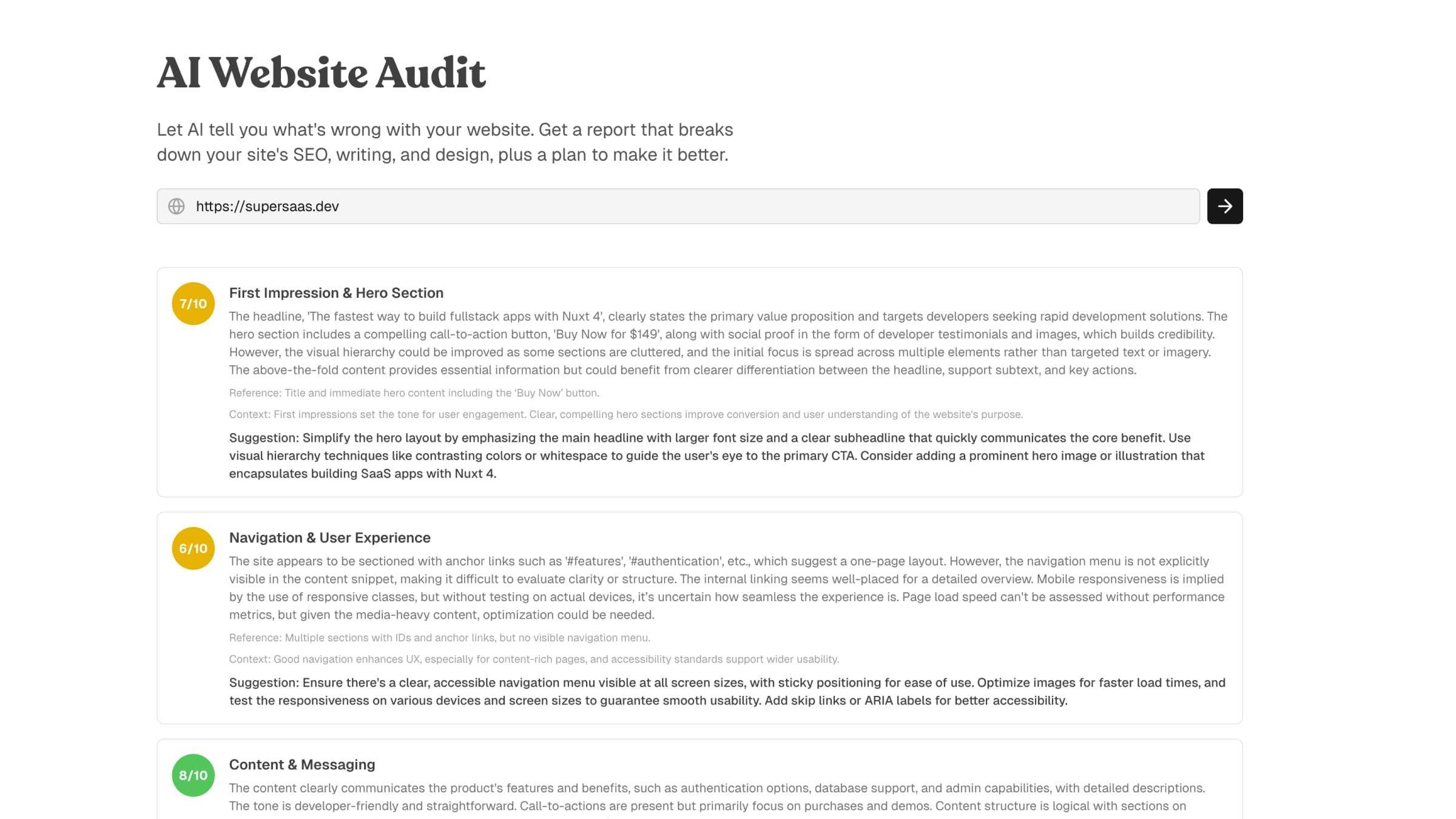
Auditing an Entire Site at Scale
While single-page optimizers are useful, the real power of AI comes from its ability to audit your entire content inventory. These tools typically connect directly to your GSC account.
Best AI Tools for Content Audits with GA4 & GSC
This article, 'Best AI Tools for Content Audits with GA4 & GSC', provides detailed overviews of several leading platforms. We'll focus on two that exemplify different strategic approaches: SurferSEO for page-level optimization at scale, and MarketMuse for strategic topic-level analysis.
Please read the detailed descriptions for SurferSEO and MarketMuse. For each tool, pay attention to 'What it does?' and 'Why teams use it?'. Notice how SurferSEO focuses on providing a prioritized list of pages to fix, while MarketMuse focuses on higher-level 'topical authority' and content strategy.
- SurferSEO's Content Audit gives you a prioritized list of existing pages to improve based on their current performance and missed potential. It's highly tactical.
- MarketMuse operates more strategically. It inventories your entire site to score your "topical authority," identifying gaps not just at the page level but at the cluster level. It helps answer the question, "What topics should we own, and where is our content thin?"
Other tools like Writesonic's Chatsonic are also entering this space, offering conversational AI agents that can connect to your GSC or Semrush data and perform audits on command, flagging missed keyword opportunities and content structure issues.
3. A Practical Workflow for AI-Powered Audits
Regardless of the specific tool you choose, the workflow for using them is quite similar. It's a systematic process for turning AI-generated insights into an actionable roadmap.
Step-by-Step Process:
- Connect Your Data: The first and most crucial step is to grant the tool access to your GSC and/or GA4 properties. The quality of the audit depends entirely on the quality of this input data.
- Run the Audit: Initiate the content audit. Depending on the tool and the size of your site, this might take anywhere from a few minutes to a few hours.
- Segment and Prioritize: The tool will typically segment its findings into categories like "quick wins," "content to update," or "low-hanging fruit." Your first task is to focus on the highest-impact categories, such as pages with high impressions but low CTR.
- Validate and Interpret the Insights: This is where your expertise as an SEO is critical. The AI provides the "what," but you must determine the "why."
- Keyword Gap? The AI says you're missing a keyword. Is it truly relevant to your audience? Does it align with the page's search intent, or does it signal the need for a new piece of content?
- Thin Content? The AI flags a page for low word count. Is the content thin because it's poorly written, or is it a page where users expect a concise answer? Analyze the SERP to understand the required depth.
- Create an Action Plan: Based on your validation, build a content refresh plan. This plan becomes your execution roadmap for the next quarter.
Test your understanding!
An AI audit tool flags one of your key blog posts. It reports:
- Issue: "Thin Content" (word count is 30% below top competitors).
- Opportunity: "Keyword Gap" (provides a list of 15 related terms your page doesn't mention).
As the SEO specialist, what are your next three strategic steps? Simply adding the keywords and increasing the word count is not enough.
Show answer
Here is a strategic approach:
- Validate the Keyword Gaps for Intent: First, analyze the list of 15 "missing" keywords. Group them by theme and search intent. Are they informational queries that can be added to the existing post? Or are they transactional or navigational queries that suggest a user wants a different type of page? Discard any irrelevant terms.
- Perform a Manual SERP Analysis: For the primary keyword, manually review the top 3-5 ranking pages. Don't just look at what they wrote; analyze how they structured their content. What subtopics do they cover? Do they use images, videos, or FAQ schema? This provides crucial context that the AI might miss. This step helps you understand why their content is considered more comprehensive, beyond just word count.
- Develop a Content Brief for the Refresh: Create a detailed brief for the writer or for yourself. This brief should include the validated keywords to be incorporated naturally, the new subtopics to cover (based on your SERP analysis), and instructions on improving the content's structure, formatting, and E-E-A-T signals (e.g., adding author bio, citing sources, updating stats). This ensures the "fix" is strategic and qualitative, not just quantitative.
Conclusion
You've now seen how AI-powered tools can fundamentally change the process of conducting content audits. By automating the data analysis, they free you up to focus on strategy and execution.
Key Takeaways:
- Automation of a Core Task: AI audit tools automate the process of connecting to performance data (GSC/GA4), analyzing competitors, and identifying on-page content issues at scale.
- Key Issues Identified: These tools excel at flagging thin content, keyword/topic gaps, content cannibalization, and pages with performance gaps (e.g., high impressions, low CTR).
- A Spectrum of Tools: The landscape includes single-page optimizers like Clearscope, tactical site-wide auditors like SurferSEO, and strategic topic modelers like MarketMuse.
- The SEO's Role is Strategic: Your job shifts from manual data-digging to validating the AI's recommendations against business goals and user intent, and then building an actionable roadmap. The AI is a powerful junior strategist; you are the final decision-maker.
In this lesson, we've learned how to automatically identify on-page problems. In our next lesson, we'll address the next logical step: designing a semi-automated workflow to generate, review, and apply AI-driven fixes for these issues. We'll explore how to build a system that takes the outputs from these audits and begins the process of remediation efficiently.