Hello! Welcome to the final module of our course, Capstone: Building an Integrated SEO Strategy.
In our last lesson, we concluded our module on future-proofing by creating a comprehensive framework for auditing an existing SEO strategy. We learned how to diagnose weaknesses in content extractability, E-E-A-T signals, and technical accessibility, all through the lens of AI-driven search. That audit process helps us answer the question, "What should we fix?"
Today, we address the next logical question: "How will we know if our fixes are working?" To do that, your learning outcome is to define KPIs for a hybrid strategy that measures success in both traditional and AI-driven search channels. As search splits into two parallel tracks—the classic "10 blue links" and the new AI-generated answer engines—our measurement must also evolve. Relying solely on traditional metrics like rankings and organic traffic will leave you blind to your performance in a rapidly growing part of the search ecosystem.
1. From SEO to GEO: A Fundamental Shift in Measurement
Your expertise lies in traditional SEO, where the primary goal is clear: drive qualified traffic from a search engine result page (SERP) to a website. The KPIs are direct measures of this goal—rankings, click-through rates (CTR), and organic sessions.
However, with the rise of Generative AI search, a new paradigm has emerged, often called Generative Engine Optimization (GEO) or Answer Engine Optimization (AEO). Its primary goal is different.
To understand this shift, let's watch a short segment that contrasts the objectives of SEO and GEO.
What is GEO (Generative Engine Optimization)?
The video 'What is GEO (Generative Engine Optimization)?' from SMA Marketing clearly explains the different goals of traditional SEO versus optimizing for AI engines.
Watch the clip from 05:34 to 07:30. Pay close attention to how the speaker contrasts the goals and metrics for SEO and GEO. This distinction is the foundation for our hybrid KPI framework.
As the video highlights:
- SEO Goal: Drive people from a search engine to your website.
- GEO Goal: Make your brand and content surface within the AI's response.
This doesn't mean traditional SEO is obsolete. In fact, many of the signals that power GEO, like authority and structured data, are rooted in good SEO practices. The key takeaway is that we are now operating on two parallel tracks or "discovery rails." Your strategy must therefore be hybrid, and your KPIs must reflect performance on both.
2. Defining Your KPI Sets for Each Discovery Rail
To build a robust hybrid measurement framework, we need to define two distinct sets of KPIs—one for the traditional SEO rail and one for the new AI discovery rail. Treating them as one amorphous group leads to attribution errors and strategic confusion.
The article "AI SEO vs Traditional SEO" provides an excellent, clear separation of these metrics.
AI SEO vs Traditional SEO - Four Dots
This article from Four Dots offers a direct comparison of the KPIs you should be tracking for each channel. It forms the basis of our hybrid framework.
Please read the two sections under the headings 'Distinct KPIs and Dashboards' and 'KPI Sets by Discovery Rail'. Focus on the specific metrics listed for both 'Traditional SEO' and 'AI discovery'.
Let's break these down into a clear framework.
Traditional SEO KPIs (The Foundation)
You are already intimately familiar with these. They remain the bedrock of performance measurement for the classic search experience. A quick review:
- Keyword Rankings: Your position in traditional SERPs for target queries.
- Organic Traffic: The volume of sessions originating from organic search.
- Click-Through Rate (CTR): The percentage of impressions that result in a click.
- Conversions from Organic: The volume or value of goal completions (e.g., sales, leads) directly attributed to the organic channel.
- Backlink Profile Growth: The quantity and quality of new referring domains.
AI-Driven Search (GEO) KPIs (The New Frontier)
This is where we need to expand our measurement vocabulary. These KPIs are designed to measure influence and visibility inside AI models. As Neil Patel states in his video on the topic, tracking citations is the "new KPI."
Here are the essential GEO KPIs to add to your dashboard:
-
Citation Frequency & Mentions: The raw count of how many times your brand, products, or content URLs are referenced in AI-generated answers for a given set of prompts. This is the most fundamental GEO metric.
-
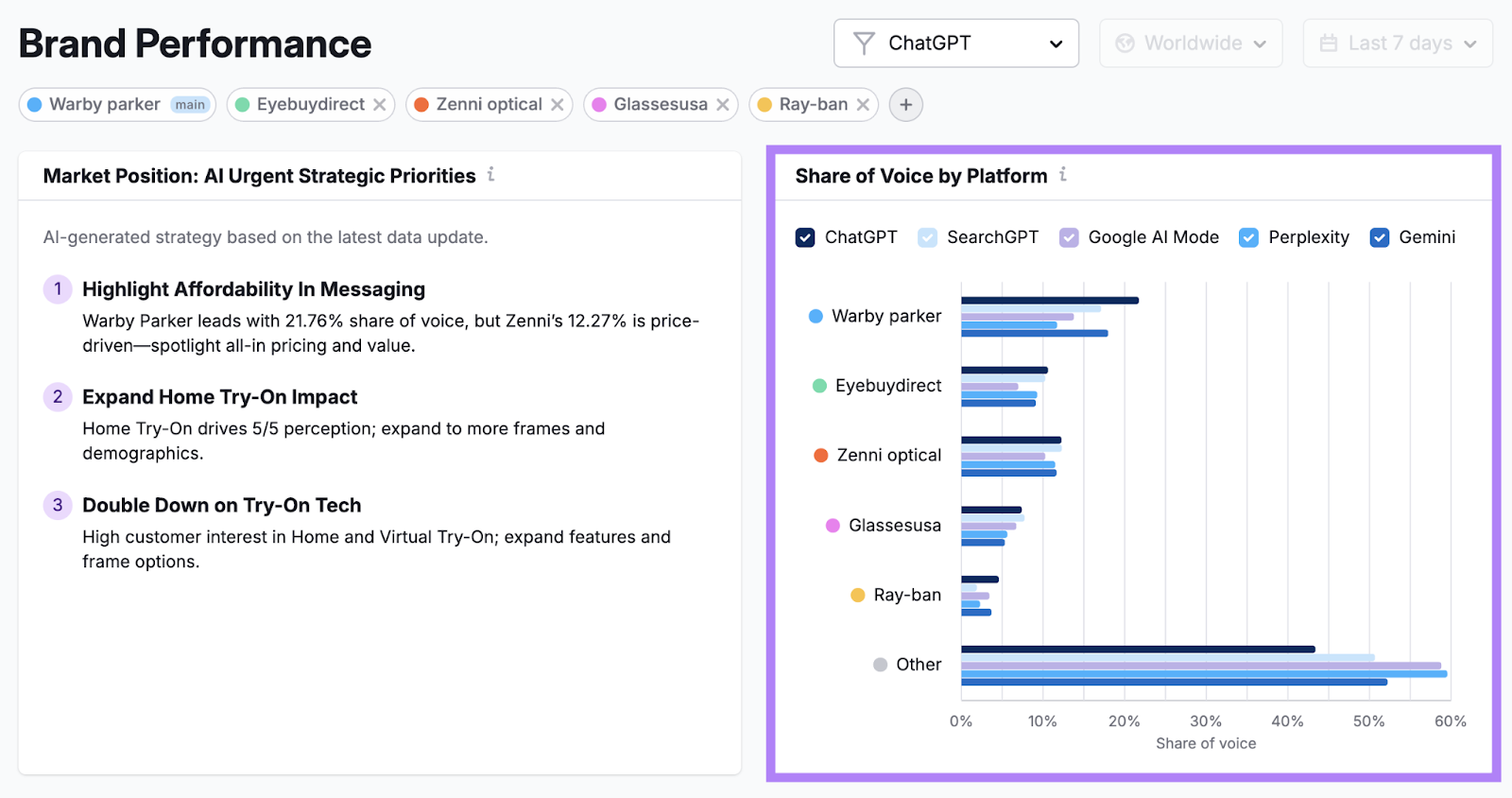
Share of Voice (SoV) / Share of Answer: Your citation frequency as a percentage of all citations for a specific topic or set of prompts, compared to your competitors. This tells you how dominant your brand is in the AI conversation.
-
Prompt Coverage: The percentage of your tracked, high-value prompts for which your brand appears in the AI answer. A low coverage indicates significant content gaps.
-
AI-Referred Traffic: The number of clicks on citation links within AI answers that lead to your website. This is a crucial metric that bridges the gap between GEO visibility and traditional traffic.
-
Sentiment & Accuracy: A qualitative analysis of your mentions. Is the AI portraying your brand positively, neutrally, or negatively? Is the information it's citing from your site correct?
-
Assisted Conversions: This advanced metric tracks users who were exposed to your brand in an AI answer and later converted through a different channel (e.g., direct visit, paid search). This requires more sophisticated attribution modeling but demonstrates the broader influence of GEO.
Test your understanding!
You are building a performance report. For each metric below, would you place it in your "Traditional SEO Dashboard" or your "AI Discovery Dashboard"?
- Citation Frequency in Google AI Overviews
- Click-Through Rate from SERPs
- Share of Voice in ChatGPT
- Organic Sessions (Last-Click Attribution)
Show answer
- AI Discovery Dashboard: This directly measures visibility within an AI-generated result.
- Traditional SEO Dashboard: This is a classic metric for performance on the standard SERP.
- AI Discovery Dashboard: This is a core GEO metric comparing your visibility against competitors within a specific AI model.
- Traditional SEO Dashboard: This is a standard measure of traffic from traditional organic search.
3. Building a Hybrid Measurement and Reporting Framework
Now that we have two distinct sets of KPIs, the final step is to integrate them into a coherent reporting structure. The key is to track them separately but report on them together.
Step 1: Set Up Your Tracking Tools
Measuring GEO KPIs requires a new set of tools, as traditional platforms like Google Search Console were not designed to monitor conversations inside third-party AI models.
How to Track Your Brand's Visibility Across Multiple AI Search ...
The article 'How to Track Your Brand's Visibility Across Multiple AI Search...' provides an excellent summary of the key metrics to look for and the types of tools available to track them.
First, review the definitions under the heading 'What is GEO?' to reinforce the core metrics. Then, study the table under 'Choosing the Right Tool', focusing on the 'Metrics' row which lists what to look for: mentions, citation links, share-of-voice, referral traffic, and sentiment.
As the article suggests, tools like Anvil, Profound, and Otterly.ai are emerging to fill this gap. When evaluating them, you should look for:
- Platform Coverage: Do they track mentions in ChatGPT, Perplexity, Gemini, and Google's AI Overviews?
- Metric Depth: Do they provide Share of Voice, sentiment analysis, and competitor benchmarking?
- Data Quality: Is the data gathered in real-time or updated daily?
Step 2: Design Your Dashboards
Best practice is to maintain two separate operational dashboards:
- Traditional SEO Dashboard (Your comfort zone): Built in Looker Studio, connecting to GSC, GA4, and Ahrefs/Semrush APIs. This tracks your rankings, traffic, and conversions.
- AI Discovery Dashboard: This will likely be inside one of the new GEO tools mentioned above or a custom dashboard you build by exporting their data. It will visualize Share of Voice, Citation Frequency, and Prompt Coverage.
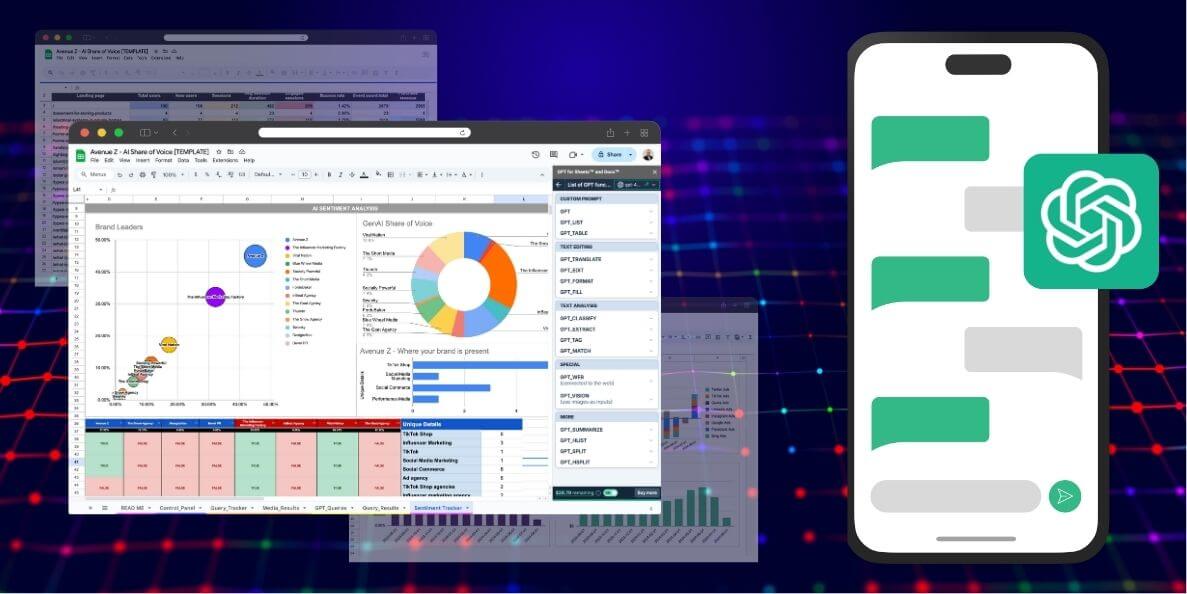
Step 3: Create a Unified Executive Report
While operational dashboards are separate, your strategic reports for stakeholders should synthesize insights from both. A monthly or quarterly performance review should include:
- Executive Summary: A high-level overview of total search performance.
- Traditional SEO Performance: Key trends in organic traffic, keyword visibility, and conversions.
- AI Discovery Performance: Key trends in Share of Voice, new citations gained, and competitive movements.
- Crossover Analysis: Highlight interesting connections. For example, "We launched a new content hub in May. This led to a 15% increase in organic traffic (Traditional KPI) and we are now cited in 30% of answers for 'best project management software' in Perplexity (GEO KPI)."
- Strategic Recommendations: Based on the combined data, what are the priorities for the next quarter?
This hybrid approach ensures you're accountable for the traditional traffic-driving function of SEO while also demonstrating progress in the new, critical area of AI influence.
Conclusion
In this lesson, we have constructed a modern, hybrid framework for measuring SEO success. You now understand that to compete effectively in 2026 and beyond, you must look past traditional metrics and embrace a new set of KPIs designed for the age of generative AI.
Key Takeaways:
- Success requires a hybrid strategy: You must measure performance on both the traditional SERP and within AI answer engines.
- GEO introduces new KPIs: The most important new metrics are Citation Frequency, Share of Voice, Prompt Coverage, and Sentiment.
- Track separately, report together: Use specialized GEO tools to monitor AI visibility but integrate those insights with traditional SEO data into a single, unified strategic report.
- The goal has expanded: Your job is no longer just to win the click, but also to become the source of truth that AI models rely on.
What's Next:
This lesson has given you the measurement tools for your capstone project. In our final lesson, we will put everything together. The learning outcome is to create a strategic roadmap that prioritizes SEO initiatives for short-term and long-term adaptation to AI-powered discovery. You'll learn how to take your audit findings and performance data to build a compelling, data-driven plan that charts a course for success in this new, integrated search landscape.