In our previous lesson, we identified the essential equipment for V60 brewing, noting that each tool gives you precise control over the process. Today, we will explore what you are controlling. We will move from the physical tools to the core theoretical principles that govern coffee brewing. Your background in applied mathematics and system optimization will be an asset here, as we can frame brewing as a process of adjusting input variables to optimize a target outcome: a delicious cup of coffee.
This lesson explains the impact of the three most critical brewing variables: coffee-to-water ratio, grind size, and water temperature. By the end, you will understand how each variable influences the final taste and be ready to formulate your first brewing recipe.
The Goal: Balanced Extraction
At its core, brewing is a process of extraction. When hot water meets ground coffee, it dissolves various flavour compounds and oils. The goal is not to extract everything possible from the bean, but to extract the right amount and the right types of compounds to create a balanced, flavorful cup.
To understand this better, it's helpful to think about what gets extracted and when. The process is sequential: acidic compounds extract first, followed by sugars, and finally more complex, bitter compounds.
- Under-extraction occurs when the process is stopped too early. You get the initial sours but not enough of the sugars to balance them. The result is a coffee that tastes sour, salty, or vegetal.
- Over-extraction occurs when the process runs too long. After the desirable sugars are dissolved, you begin to pull out an excess of bitter and astringent compounds from the plant fibers themselves. The result is a coffee that tastes bitter, astringent (drying), and hollow.
- Ideal extraction is the balance point. You have extracted enough sweetness to balance the initial acidity, without yet extracting the unpleasant bitterness. The result is a cup that is sweet, vibrant, and complex.
For a formal definition of extraction and a description of these taste profiles, the following article is an excellent starting point.
Understanding Coffee Brewing with Your V60 - Prima Coffee Equipment
This article from Prima Coffee Equipment provides a clear, scientific introduction to the concept of extraction.
Please read the section "Brewing is Extraction" to understand the fundamental process. Then, continue to the next section, "How to Judge Your Extraction," to learn the specific taste characteristics of under-, over-, and ideally extracted coffee.
Strength vs. Extraction: A Quantitative View
In coffee, the terms "strength" and "extraction" have precise, distinct meanings. Conflating them is a common source of confusion.
-
Strength refers to the concentration of dissolved coffee solids in the final beverage. It is often measured as a percentage called Total Dissolved Solids (TDS). A "strong" coffee has a high concentration of coffee flavour (e.g., espresso), while a "weak" coffee is more dilute (e.g., a poorly made filter coffee). Strength is primarily about the intensity of the flavour.
-
Extraction Yield refers to the percentage of mass that was dissolved from the dry coffee grounds. Roasted coffee is roughly 30% soluble material. The ideal range for extraction yield is widely considered to be 18-22%. This range typically corresponds to the "ideal" taste profile we discussed above. Extraction is about the character of the flavour (sour, sweet, bitter).
These two dimensions—strength and extraction—are independent but related through your brewing recipe. They can be visualized on a Coffee Brewing Control Chart, a powerful tool for understanding how your recipe choices affect the final cup.
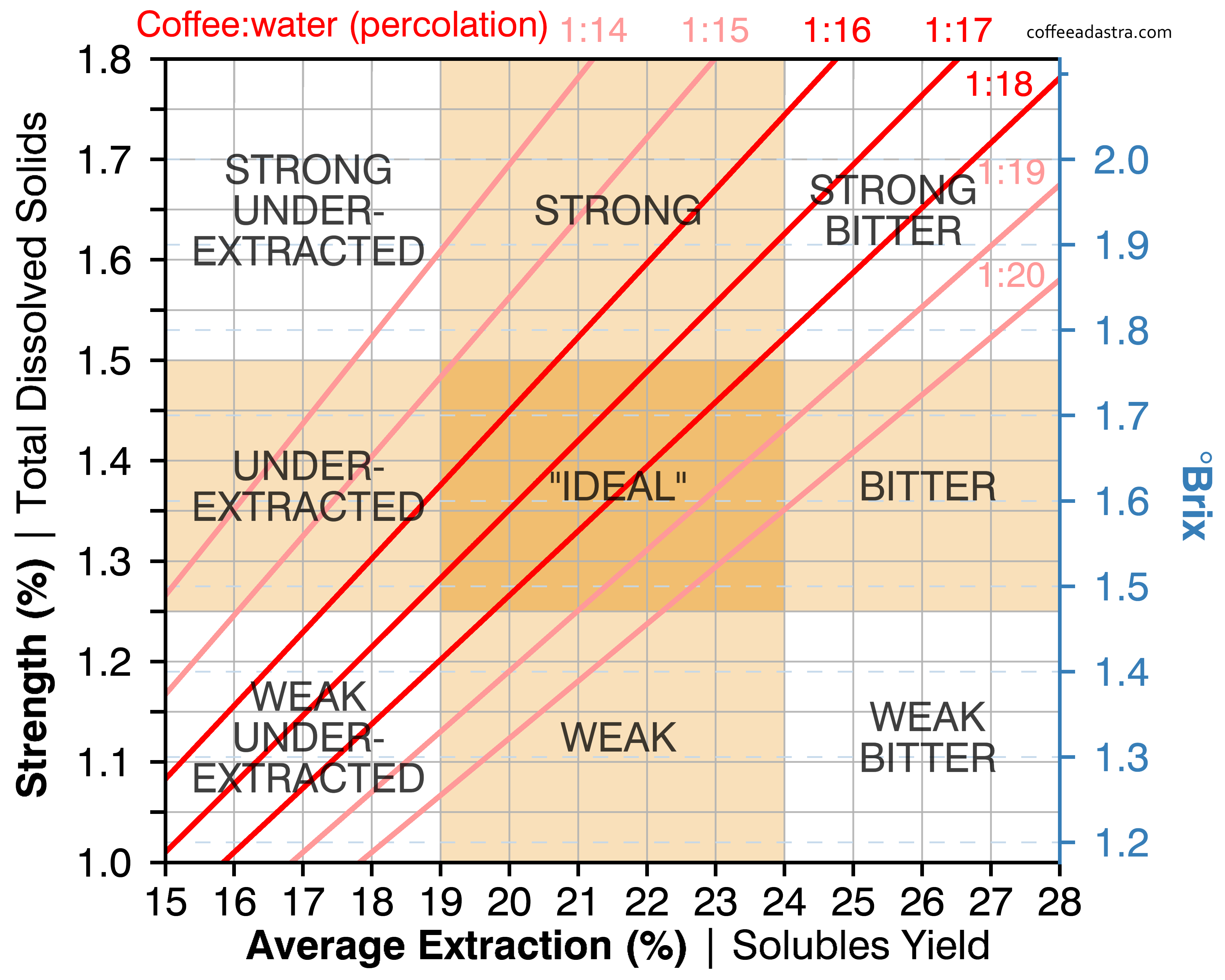
As you can see, the chart maps the parameter space of coffee brewing. Your goal is to land in that "IDEAL" region by manipulating your brewing variables. Now, let's look at the primary variables that allow you to navigate this space.
The Three Core Variables
While dozens of factors can influence a brew, three have the most significant and predictable impact. Mastering them is the key to consistent results.
1. Coffee-to-Water Ratio
The brew ratio is the ratio of the mass of dry coffee grounds to the mass of water used for brewing. This variable is the primary controller of strength (TDS).
- A tighter ratio (more coffee relative to water, e.g., 1:15) will produce a stronger, more concentrated cup.
- A wider ratio (less coffee relative to water, e.g., 1:17) will produce a weaker, more delicate cup.
In the previous lesson, we established the need for a scale. Using precise, weight-based ratios is non-negotiable for repeatability. Volumetric measures like "scoops" are unreliable due to variations in bean density and grind size.
For filter coffee like V60, a great starting point is 60 grams of coffee per 1 liter of water. This is equivalent to a 1:16.67 ratio. From here, you can adjust to your personal preference for strength. The following video from James Hoffmann offers a compelling argument for this approach and explains how ratio and extraction are separate concerns.
Coffee Brewing Ratios Explained
In this video, James Hoffmann explains why he advocates for a "grams per liter" approach and clarifies the crucial difference between adjusting for strength (ratio) versus adjusting for taste quality (extraction).
First, watch from his explanation of the "right amount" of coffee, where he establishes that ratio is about preference for strength. Then, pay close attention to the following section from his primer on extraction, where he argues that you should only change your ratio to adjust strength after you are happy with the extraction quality.
The key insight is this: if your coffee is weak and tastes bad (sour), the problem is under-extraction, not ratio. You should fix the extraction first (we'll see how next) before increasing the amount of coffee.
2. Grind Size
Grind size is the most powerful tool you have for controlling extraction yield.
The principle is straightforward: a finer grind creates more surface area. This allows water to extract compounds from the coffee more quickly and efficiently. Additionally, a finer grind provides more resistance to water flow, increasing the overall contact time between water and coffee, which further increases extraction.
- Finer Grind → Higher Extraction (moves you right on the control chart, towards bitterness)
- Coarser Grind → Lower Extraction (moves you left on the control chart, towards sourness)
Finding the right grind size is the most common adjustment you will make when "dialing in" a new coffee. For V60, a good starting point is a medium-fine consistency, similar to table salt. From there, you adjust based on taste. If your brew is sour, grind finer. If it's bitter, grind coarser.
Understanding Coffee Brewing with Your V60 - Prima Coffee Equipment
This section of the Prima Coffee article concisely explains the dual impact of grind size on both extraction rate and flow rate.
Please read the short paragraph under the "Mastering Your V60" heading that begins with the word "Grind".
3. Water Temperature
Water temperature governs the rate of extraction. Hotter water has more energy and dissolves compounds more effectively and quickly than cooler water.
- Hotter Water → Faster Extraction Rate (promotes higher extraction)
- Cooler Water → Slower Extraction Rate (promotes lower extraction)
The standard recommendation from the Specialty Coffee Association (SCA) is a temperature range of 90°C–96°C (195°F–205°F). For most light to medium roast coffees, brewing with water just off the boil (around 96°C) is a safe and effective starting point. The water will cool slightly as it hits the V60 and the coffee grounds, landing it squarely in the ideal extraction zone.
Using water that is too cool is a common cause of under-extraction, leading to sour coffee.
Understanding Coffee Brewing with Your V60 - Prima Coffee Equipment
This final reading explains the direct relationship between temperature and extraction rate and provides the standard temperature guidelines.
Read the paragraph that starts with the word "Temperature" to solidify your understanding of this variable.
A Unified View of Brewing Variables
You now have your three main input variables: ratio, grind, and temperature. The image below provides a useful mental model for how these and other variables compare in terms of their overall impact on the final cup and how predictable that impact is.

Notice that Grind Setting and Brew Ratio are in the top left quadrant, indicating high impact but slightly lower predictability than, say, mineral composition. This reinforces that they are your primary levers for adjustment. Water Temperature is also high-impact and moderately predictable. By focusing on these three, you are controlling the most important factors in your brew.
Conclusion
In this lesson, we have moved from the "what" of equipment to the "how" of brewing theory. We have defined the brewing process as an optimization problem: manipulating a set of input variables to achieve a balanced extraction.
Key Takeaways:
- The Goal is Balance: Brewing aims for an ideal extraction that balances acidity with sweetness, avoiding sourness (under-extraction) and bitterness (over-extraction).
- Strength vs. Extraction: Strength (TDS) is the concentration of flavor, while extraction yield is the character of flavor. They are the two primary dimensions of coffee quality.
- The Core Variables:
- Brew Ratio is your primary control for strength. A good start is 60g of coffee per 1 liter of water (or a ~1:16 ratio).
- Grind Size is your primary control for extraction yield. Finer means more extraction; coarser means less.
- Water Temperature controls the rate of extraction. Hotter water extracts faster and more efficiently. Aim for 90°C–96°C.
You now have the complete theoretical foundation needed to brew your first cup of V60 coffee. In the next module, we will put this all into practice. The first lesson will guide you through executing a complete brew, describing each phase of the process, and the second will teach you how to taste the result and decide which variable to adjust for your next attempt.