Welcome to our next lesson on the ideal Bose gas. In our previous session, we accomplished a crucial task: calculating the critical temperature, , which marks the threshold for Bose-Einstein condensation. We established that below this temperature, the excited quantum states are no longer capable of accommodating all the particles in the system. This leads to a fascinating consequence: a macroscopic number of particles must accumulate in the single lowest-energy state.
Today, we will quantify this phenomenon. Our primary goal is to compute the condensate fraction, which is the fraction of total particles that occupy the ground state as a function of temperature for . This quantity is not just a number; it serves as the defining characteristic of the condensed phase and will be our first example of an order parameter, a central concept in the modern theory of phase transitions that you will explore in depth later in this course.
1. The Breakdown of the Continuum Approximation
Let's begin by revisiting the core issue we face when . Our standard method for calculating the total number of particles, , involves converting the sum over discrete quantum states into an integral over a continuous energy spectrum:
In the last lesson, we found that this integral, with the chemical potential at its maximum possible value (), gives us the total number of particles at the critical temperature, .
What happens if we lower the temperature to some ? The number of available slots in the excited states decreases. The maximum number of particles the excited states can hold at this new, lower temperature is:
As we will soon see, this integral evaluates to a value less than . This creates a paradox: where do the "missing" particles, , go?
The resolution lies in a subtlety of the continuum approximation. By replacing the sum with an integral , we assign zero weight to any single point in k-space, including the ground state at (). Above , this is justifiable as the occupation of any single state is negligible. Below , however, the ground state becomes macroscopically occupied, and failing to account for it is a critical error.
The following notes provide an excellent discussion of this "paradox" and its resolution.
The Ideal Bose Gas and Bose-Einstein Condensation
These notes from the University of Rochester clearly lay out the mathematical issue and its physical resolution.
Begin by reading the first page. Follow the derivation up to Eq. (3.11.10) and the discussion of the "contradiction" that follows. This section clearly demonstrates why the integral for particle density, n = g3/2(z)/λ³, cannot hold for a fixed density n when T < T_c. Continue reading the explanation under the heading "The solution to this paradox". The key takeaway is that we must explicitly separate the ground state term from the sum before converting the rest to an integral, leading to Eq. (3.11.14).
2. Calculating the Condensate Fraction
Having established the need to treat the ground state separately, we can now write the total particle number as the sum of particles in the ground state, , and particles in all excited states, :
For any temperature , the system adjusts such that the chemical potential is pinned at in the thermodynamic limit. This means the excited states are filled to their maximum capacity at that temperature. The number of particles in these excited states is therefore:
We've evaluated this integral form before. In the last lesson, we found that at , it gives the total particle number :
The expression for at has the exact same structure, just with instead of :
This tells us that the maximum number of particles the excited states can accommodate scales as .
Now, the derivation of the condensate fraction becomes straightforward. We can find the fraction of particles in the excited states by taking the ratio of to :
The remaining particles must be in the ground state. The fraction of particles in the condensate, , is therefore:
This is our main result. It elegantly describes how the macroscopic ground-state occupation grows from zero at to encompass all particles at .
The following video provides a clear, step-by-step walkthrough of this derivation.
PHYS 3113 Lecture 12 - Bose-Einstein Condensation cont'd
This lecture from UNSW Physics provides a concise derivation of the condensate fraction.
Please watch from the beginning of the review up to the final plot. The lecturer clearly shows how the expression for N_{ex} leads directly to the (T/T_c)^{3/2} relationship and the final formula for the ground state fraction.
For a more mathematically compact and generalized perspective, Nobel laureate Anthony Leggett's notes are highly recommended.
Bose statistics and Bose-Einstein condensation.
These notes provide a rigorous and elegant derivation of the condensate fraction.
Read the section beginning with "What happens for T < Tc?". Pay attention to how Eq. (9) is set up, separating N_0(T) from the integral. The derivation quickly leads to the general formula in Eq. (10), which gives our specific result for a free 3D gas where the exponent n=3/2.
3. Visualizing the Condensate and the Order Parameter
The formula represents a continuous phase transition. Below , the system is fundamentally different; it has a macroscopic quantum object—the condensate—coexisting with a "normal" gas of thermally excited atoms.
This dramatic change is not just a theoretical construct; it has been stunningly observed in experiments. The image below shows absorption images of a cloud of sodium atoms being cooled through the critical temperature. These images effectively map the momentum distribution of the atoms.
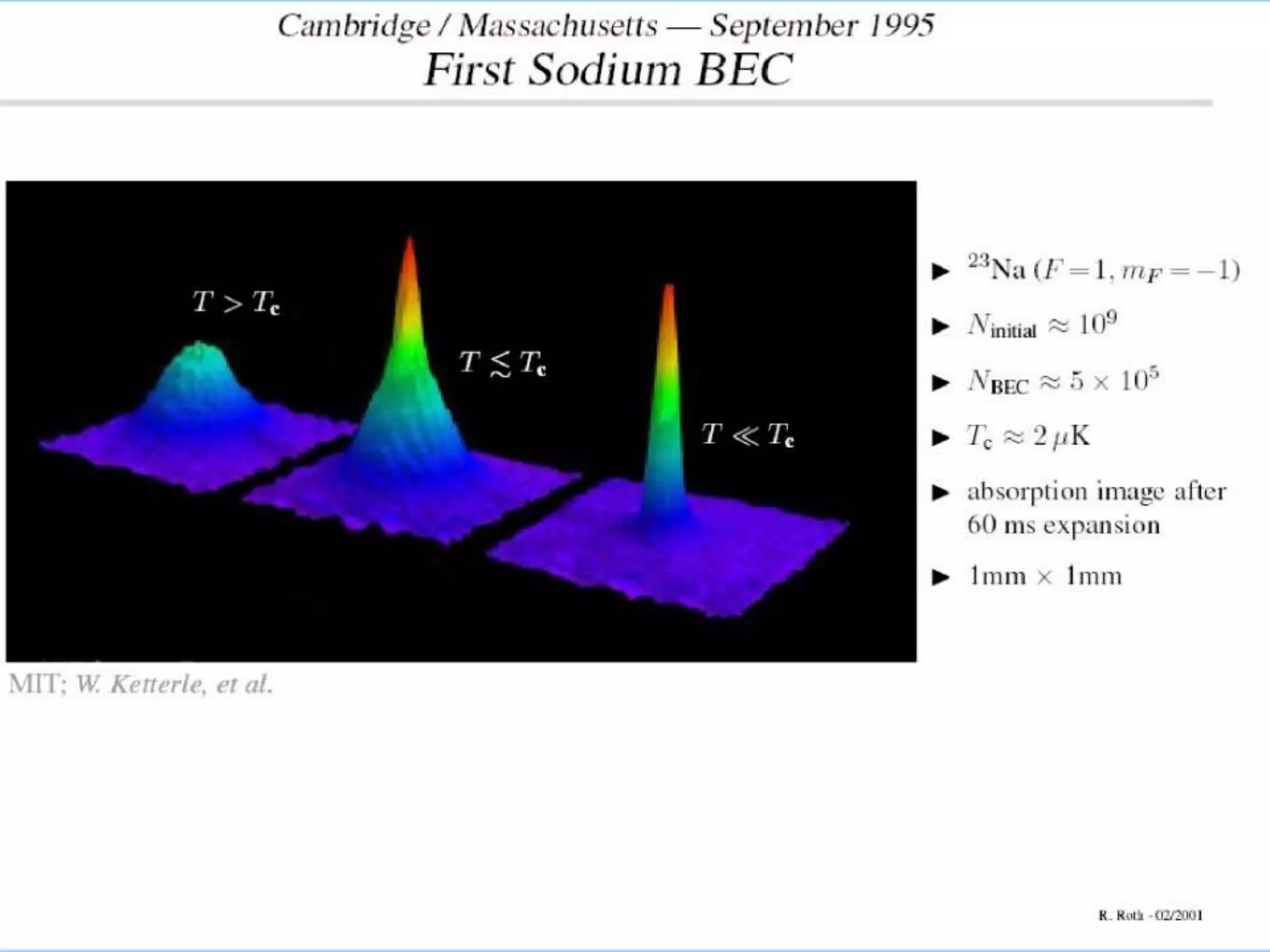
The quantity we derived, the condensate fraction , is the order parameter for the BEC transition. An order parameter is a quantity that is zero in one phase (the disordered, high-temperature phase) and non-zero in the other (the ordered, low-temperature phase). It quantifies the degree of "order" in the system.
- For , (disordered phase, normal gas).
- For , (ordered phase, BEC).
This concept is profoundly important and general. In a ferromagnet, the order parameter is the average magnetization. In a superconductor, it's related to the complex value of the superconducting wavefunction. Your study of BEC provides a clean, calculable introduction to this cornerstone idea of modern condensed matter physics.
Conclusion
In this lesson, we have derived one of the central results in the study of ideal Bose gases: the temperature dependence of the condensate fraction.
Key Takeaways:
- Below the critical temperature , the continuum approximation for the density of states fails because it neglects the macroscopic occupation of the ground state.
- By explicitly separating the ground state population () from the excited state population (), we can correctly describe the system for .
- The number of particles in excited states scales as .
- The condensate fraction is given by .
- The condensate fraction acts as the order parameter for the BEC phase transition, a key concept for describing phases of matter.
We have now characterized the particle distribution in a Bose gas both above and below . The next logical step is to explore the thermodynamic consequences of this phase transition. In our next lesson, we will derive the temperature dependence of the heat capacity, where we will find a distinct signature—a cusp—at , providing thermodynamic evidence for the transition we have just described.