Introduction
In our previous lesson, we explored the deep reasons for universality using the Renormalization Group, concluding that critical phenomena are governed by the properties of RG fixed points, not microscopic details. We also established that mean-field theories, like the one we are about to study, correspond to a simpler "Gaussian" fixed point, which correctly describes transitions in high dimensions but fails when fluctuations become dominant (for ).
Despite its limitations, which we now understand from a fundamental perspective, Landau's phenomenological theory of phase transitions remains an indispensable tool. It provides a universal language for describing phase transitions based on the two principles we identified as paramount: symmetry and dimensionality. This lesson will focus on the constructive aspect of the theory. Our goal is to learn the "recipe" for building the Landau free energy for any given system. We will see how to identify a suitable order parameter and, most importantly, how to use symmetry arguments to constrain the mathematical form of the free energy as a polynomial expansion.
The Landau-Ginzburg Approach: A Physicist's Guess
The core idea of Landau theory is to write down an effective free energy, not by a rigorous microscopic derivation, but by a physically motivated construction. We focus on the most important degree of freedom—the order parameter field—and write down the simplest possible form for its free energy that is consistent with the symmetries of the problem.
Prof. Mehran Kardar provides an excellent overview of this philosophy. He justifies the approach by drawing an analogy to the central limit theorem and emphasizes the role of locality and symmetry in constraining the form of the effective Hamiltonian.
2. Lec 1 (continued); The Landau-Ginzburg Approach Part 1
This video provides the conceptual foundation for constructing the Landau-Ginzburg free energy. It explains why we can expect an analytical expansion and how symmetry dictates the allowed terms.
Please watch the segment from the beginning of the construction. Pay close attention to these key ideas: The concept of an effective Hamiltonian (or free energy) as a functional of the order parameter field, \beta H[M(\mathbf{x})]. The justification for an analytical expansion in powers of the order parameter M and its gradients, which relies on the averaging inherent in defining the coarse-grained field M(\mathbf{x}). The crucial role of symmetry. For a ferromagnet in zero field, the free energy must be invariant under rotations of the magnetization vector \mathbf{M} and spatial coordinates \mathbf{x}. This forces terms to appear as rotationally invariant combinations, such as M^2, M^4, and (\nabla M)^2.
The Landau Recipe
As motivated by the video, Landau's approach can be distilled into a four-step procedure. This recipe allows us to systematically construct the free energy for a vast range of phase transitions.
The lecture notes by Peter D. Olmsted provide a clear and concise summary of this recipe.
Lectures on Landau Theory of Phase Transitions
This section formalizes the procedure for constructing the Landau free energy.
Please read the section titled The Recipe. This outlines the four essential steps: Define an order parameter, \psi: This is a quantity that is zero in the disordered (high-symmetry) phase and non-zero in the ordered (low-symmetry) phase. Assume a free energy functional: Postulate that the free energy can be written as an analytical expansion (a power series) in the order parameter. Construct the functional, F_L(\psi), based on symmetry: This is the most critical step. The expansion must only include terms that are invariant under the symmetries of the disordered phase. Incorporate temperature dependence: Assume that the coefficient of the lowest-order (quadratic) term is the primary one that changes with temperature, vanishing at a critical temperature T_c.
Let's now apply this recipe to several key physical systems.
Example 1: The Ising Magnet (Continuous Transition)
The simplest, yet most illustrative, example is a system with Ising symmetry, like a uniaxial ferromagnet or the liquid-gas transition.
-
Step 1: Order Parameter. We choose the scalar magnetization, . In the paramagnetic phase (), . In the ferromagnetic phase (), a spontaneous magnetization appears.
-
Step 2 & 3: Symmetry and Expansion. The crucial symmetry is that the physics is unchanged if all spins are flipped. In the absence of an external magnetic field, this means the free energy density, , must be invariant under the transformation . Therefore, must be an even function of . The most general polynomial expansion containing only even powers is:
We truncate the series at the fourth order. The coefficient must be positive () to ensure the free energy is bounded from below for large , guaranteeing thermodynamic stability.
-
Step 4: Temperature Dependence. We make the standard Landau assumption that only the coefficient of the quadratic term is sensitive to the proximity to the transition. We expand near :
where . This ensures that for , , and the minimum of is at . For , , and the term favors a non-zero magnetization.
This construction is detailed in the Olmsted notes.
Lectures on Landau Theory of Phase Transitions
This section applies the Landau recipe to the Ising magnet.
Please read the section Free Energy. It walks through the choice of order parameter, the M \to -M symmetry, and the resulting even-powered free energy expansion.
Example 2: First-Order Transitions and Cubic Invariants
What happens if the symmetry of the system does allow for odd-powered terms? The presence of a cubic term fundamentally changes the nature of the transition.
Consider the isotropic-nematic transition in liquid crystals. The molecules are rod-like and have head-tail symmetry (). The ordered nematic phase is characterized by a collective alignment, while the isotropic phase has no preferred direction.
-
Order Parameter: A simple scalar like is insufficient. The proper order parameter is a traceless, symmetric tensor:
where is the director (average alignment axis) and is the scalar degree of order. is zero in the isotropic phase and non-zero in the nematic phase.
-
Symmetry and Expansion: The free energy must be a scalar and invariant under rotations. This means it can only be built from scalar invariants of the tensor . The possible low-order invariants are and . Unlike the Ising case where the symmetry forbade odd powers, here the symmetry allows for a cubic term. The expansion is:
The cubic term, , is permitted and, as it turns out, is responsible for the transition being first-order.
The presence of this cubic term leads to a discontinuous jump in the order parameter at the transition temperature, which is characteristic of a first-order transition.
Lectures on Landau Theory of Phase Transitions
This example shows how a tensor order parameter and the presence of a cubic invariant lead to a first-order transition.
Read through the section 4.3 Nematic Liquid Crystals. Focus on understanding: Why a tensor order parameter Q_{\alpha\beta} is necessary. How rotational invariance leads to an expansion in terms of tensor invariants like Tr(Q^2) and Tr(Q^3). The statement that the presence of the cubic term (Tr(Q^3)) results in a first-order transition. You don't need to follow every step of the algebra, but grasp the physical argument.
Visualizing the Transitions
The difference between continuous (second-order) and first-order transitions is beautifully captured by plotting the shape of the Landau free energy.
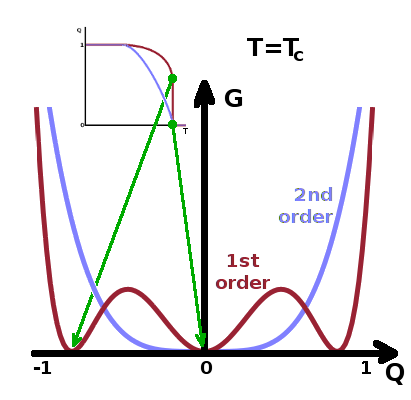
-
Second-order (Continuous): The blue curve shows the potential for an even-powered expansion like at (where ). The minimum is uniquely at . Just below , two new minima will emerge and move continuously away from zero. This corresponds to the smooth onset of magnetization shown in the inset.
-
First-order: The red curve shows a potential with a cubic term. At the transition temperature, there are three coexisting minima with the same free energy: one at (the disordered phase) and two at (the ordered phase). This degeneracy allows the system to jump discontinuously from the state to an state, corresponding to the discontinuous jump in the order parameter shown in the inset.
Other Types of Order Parameters
The power of Landau theory is its generality. The same principles apply to systems with more complex order parameters.
-
Vector Order Parameter (Heisenberg Model): For a 3D magnet where the spin can point in any direction, the order parameter is a vector . Rotational symmetry dictates that the free energy can only depend on the scalar invariant . This leads to an expansion in even powers of , similar to the Ising model:
You can read about this in section 4.2 of the Olmsted notes. -
Complex Order Parameter (Crystals, Superfluids): In systems where a periodic density wave appears, like in the formation of a crystal, the order parameter is the complex Fourier amplitude of the density modulation, . Translational invariance of the disordered phase requires that the free energy cannot depend on the phase of . It must depend only on the modulus, . This again leads to an even-powered expansion:
This is also discussed in section 4.4.1 of the Olmsted notes. This same form, with being the complex wavefunction of the condensate, is used to describe the superfluid transition.
Conclusion
In this lesson, we have established the systematic procedure for constructing the Landau free energy. This phenomenological approach powerfully distills the physics of a phase transition into a simple polynomial, with the allowed terms dictated entirely by the symmetries of the system.
Key Takeaways:
- Landau theory provides an effective free energy as a polynomial expansion in an order parameter, .
- The order parameter is a quantity that is zero in the high-symmetry (disordered) phase and non-zero in the low-symmetry (ordered) phase.
- Symmetry is paramount: The free energy must be invariant under all symmetry operations of the disordered phase. This principle determines which powers of are allowed in the expansion.
- For systems with an inversion-like symmetry (), only even powers appear, typically leading to a continuous (second-order) transition.
- If the symmetry allows for a cubic invariant, the transition is typically first-order, characterized by a discontinuous jump in the order parameter.
- The transition is driven by the coefficient of the quadratic term, , which is assumed to change sign at .
We have now learned how to write down the free energy. In the next lesson, we will put it to use. By minimizing this free energy, we will calculate the behavior of thermodynamic quantities near the critical point and derive the famous mean-field critical exponents.