Introduction
In our previous lesson, we explored how the simplest symmetric Landau free energy, with , successfully models continuous (or second-order) phase transitions. By minimizing this potential, we saw the order parameter grow continuously from zero below and derived the universal mean-field critical exponents. Today, we turn our attention to another major class of phase transitions: first-order transitions.
First-order transitions, such as melting, boiling, or certain structural changes in solids, are defined by a discontinuous change in the order parameter and the release or absorption of latent heat. Our goal is to understand how the flexible framework of Landau theory can be extended to model this behavior. To do so, the free energy landscape must feature coexisting minima, allowing the system to jump from one to another at the critical temperature. This lesson will demonstrate how including higher-order terms in the free energy expansion creates precisely this feature, providing a powerful model for first-order phenomena.
First-Order vs. Continuous Transitions
Before constructing the model, let's briefly formalize the distinction. In the Ehrenfest classification, phase transitions are categorized by the lowest-order derivative of the free energy that is discontinuous at the critical temperature .
- First-order transition: The first derivatives of the free energy, such as entropy or magnetization , are discontinuous. This discontinuity in entropy, , implies a latent heat . The order parameter itself jumps at .
- Second-order (continuous) transition: The first derivatives are continuous, but the second derivatives, like specific heat or susceptibility , are discontinuous or divergent. The order parameter grows continuously from zero.
Our task is to shape the Landau potential such that the location of its global minimum, , changes discontinuously with temperature. We will explore two principal ways to achieve this.
Case 1: First-Order Transition via Symmetry Breaking
The simplest way to engineer a first-order transition is to break the symmetry of the free energy. If the underlying physics does not possess this symmetry (e.g., in the presence of an external field that favors one orientation, or in crystal structures lacking inversion symmetry), an odd-powered term, typically , is allowed in the expansion.
Let's consider the free energy density:
Here, we assume and for stability. The cubic term explicitly favors positive , breaking the symmetry. The equilibrium states are the minima of , found by setting :
This gives one solution at and two other potential solutions from the quadratic factor. As the coefficient (which we assume is the primary temperature-dependent term, ) is varied, the free energy landscape evolves, creating a competition between the minimum at and another minimum at .
The first-order transition occurs at a temperature where these two minima become degenerate, i.e., they have the same free energy value. The following resource provides the complete derivation of the conditions for this transition.
This section of Prof. Assa Auerbach's lecture notes details how a cubic term in the Landau expansion leads to a first-order transition. It derives the critical condition by finding where the two competing minima of the free energy become degenerate.
Please read the subsection Cubic terms in Landau theory. Focus on the two key conditions that are solved simultaneously: The condition for an extremum, \partial f / \partial m = 0. The condition for degeneracy at the transition, f(m) = f(0). Pay close attention to how these lead to the critical value of the coefficient a and the discontinuous jump in the order parameter m. The figure 1.6 in this section provides an excellent visualization of the free energy's evolution.
As the reading shows, the first-order transition occurs when . At this point, the order parameter jumps discontinuously from to . A crucial insight here is that since , the transition occurs at a temperature , where is the temperature at which the curvature at would have changed sign. The first-order transition, driven by the cubic term, preempts the would-be second-order transition.
Case 2: First-Order Transition with Symmetry
What if the system's Hamiltonian respects the symmetry? In this case, odd powers of are forbidden. We saw in the last lesson that if the quartic coefficient is positive, the transition is second-order. However, the coefficients in the Landau expansion are phenomenological and can themselves depend on external parameters like pressure. If the quartic coefficient becomes negative, the term alone cannot stabilize the system. We must include the next symmetric term, , with a positive coefficient, for the free energy to be bounded.
The free energy density is now:
with . Let's assume and consider what happens when is negative. The positive term creates a minimum at , while the negative term favors a non-zero . This competition can lead to a "double-well" structure with a central minimum, as depicted in the image below.
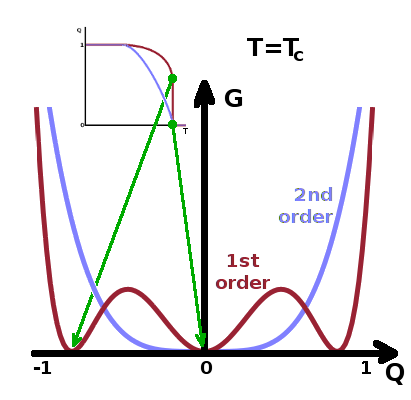
The transition occurs at a temperature where the minima at and at a non-zero value become degenerate, as shown by the red curve. The following resource walks through the algebra required to find the conditions for this transition.
[PDF] Landau theory of phase transitions
This document provides a step-by-step analysis of a first-order transition arising from a negative quartic coefficient. Note that the notation is slightly different: our a, c, d correspond to their b, c, d.
Read through slides 7 to 12. You can navigate using the table of contents or page numbers. Start with the general expansion on slide 7, approximating A as a sixth-order polynomial. Slide 8 shows the free energy landscape, illustrating the coexisting minima. Slide 9 defines the first-order transition via the discontinuous jump in m. Slides 10 and 11 present the core derivation. They establish the two key equations: the extremum condition \partial A / \partial m = 0 and the degeneracy condition A(T_c, m_0) = A(T_c, 0). Follow the algebra where these are solved simultaneously to find the critical parameters. Slide 12 provides a concise summary of the conditions for both first- and second-order transitions.
From the derivation, we find two crucial results at the transition temperature :
- The value of the order parameter jump is given by .
- The condition that defines is .
This model reveals a rich structure. If we consider the coefficients and as tunable parameters (representing, for example, temperature and pressure), we can map out a phase diagram.
- When , a second-order transition occurs as passes through zero.
- When , a first-order transition occurs at some .
- The special point is known as a tricritical point. It is a higher-order critical point that separates a line of second-order transitions from a line (or surface) of first-order transitions.
Hysteresis
A hallmark of first-order transitions is hysteresis: the state of the system depends on its history. If you cool a system through , it can remain in the state even for . This is because the state, while no longer the global minimum, is still a local minimum (a metastable state) protected by an energy barrier. The system will only jump to the stable, non-zero state when this local minimum disappears or is overcome by a sufficiently large fluctuation. Similarly, when heating from below , the system can remain in the ordered state for . This leads to different transition temperatures upon heating versus cooling, a classic experimental signature.
Conclusion
In this lesson, we have extended the Landau formalism to describe first-order phase transitions. We've seen that by modifying the polynomial expansion of the free energy—either by breaking symmetry with an odd-powered term or by including higher-order even terms—we can create the essential feature of coexisting, competing free energy minima.
Key Takeaways:
- First-order transitions are characterized by a discontinuous jump in the order parameter, corresponding to an abrupt switch between distinct free energy minima.
- In Landau theory, this can be modeled in two primary ways:
- Including a cubic () term: This breaks the symmetry and causes the transition to be preempted, occurring before the curvature at the origin changes sign.
- Using a negative quartic () term and a positive sextic () term: This preserves symmetry but allows for coexisting minima at and when the quadratic coefficient is still positive.
- The point in the parameter space separating second-order from first-order behavior is called a tricritical point.
- First-order transitions are typically accompanied by hysteresis, where the system can persist in metastable states, causing the observed transition point to depend on the direction of temperature change.
So far, our order parameter has been a real scalar. However, many physical systems, like superfluids, superconductors, or certain liquid crystals, require a more complex description. In our next lesson, we will apply Landau theory to the superfluid transition in Helium-4, which will necessitate the introduction of a complex order parameter, further showcasing the theory's versatility.