Introduction
In our last lesson, we established a formal classification for phase transitions, distinguishing between first-order transitions, which involve latent heat and discontinuous changes in quantities like entropy and volume, and continuous transitions, where the change is gradual and marked by divergences in response functions like heat capacity. This distinction, based on the non-analytic behavior of the free energy, provides the "what" of phase transitions. Today, we address the "how"—how do we quantitatively describe the emergence of a new, ordered phase?
This lesson will introduce the crucial concept of the order parameter, a macroscopic quantity that elegantly captures the degree of order within a system and serves as the central variable in modern theories of phase transitions. Our goal is to define the order parameter, understand its connection to symmetry, and survey its application to a variety of physical systems, from magnets and fluids to liquid crystals and solids. This concept bridges the macroscopic classification we just learned with the microscopic behavior of a system, setting the stage for a quantitative description of critical phenomena.
The Essence of an Order Parameter: Spontaneous Symmetry Breaking
At a high temperature, systems are typically in a disordered state possessing a high degree of symmetry. For instance, the atoms in a liquid are arranged randomly, so the system looks the same after any arbitrary translation or rotation. A paramagnet has spins pointing in all directions, so there is no preferred magnetic axis; the system is rotationally invariant.
As the temperature is lowered through a critical point , the system often "chooses" a specific configuration that has less symmetry than the high-temperature state. The liquid freezes into a crystal, breaking continuous translational symmetry and leaving only a discrete set of lattice translations. The paramagnet becomes a ferromagnet, with its spins aligning along a particular, spontaneously chosen axis, breaking rotational symmetry. This phenomenon is called spontaneous symmetry breaking.
The order parameter is a macroscopic observable designed to quantify this change.
Quantum phase transitions, spontaneous symmetry breaking, mean field theory
This video provides an excellent conceptual introduction to spontaneous symmetry breaking and the formal definition of an order parameter.
Please watch the following segments: The introduction, which frames phase transitions as a change from a high-symmetry, disordered state to a low-symmetry, ordered state. This part notes that phase transitions are characterized by macroscopic observables. The core definition, where the order parameter is formally defined as a macroscopic quantity that is zero in the disordered (high-symmetry) phase and becomes finite in the ordered (low-symmetry) phase, signaling spontaneous symmetry breaking. This segment reinforces the ubiquitous nature of this concept.
As the video explains, the defining characteristics of an order parameter, often denoted by or , are:
- in the disordered (symmetric) phase, typically for .
- in the ordered (less symmetric) phase, typically for .
The way in which becomes non-zero determines the order of the transition, connecting back to our previous lesson.
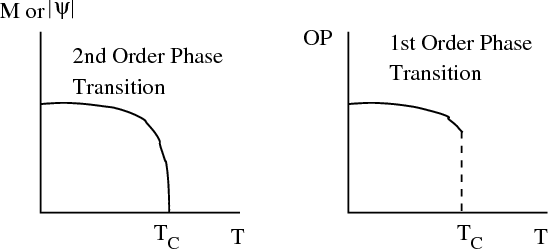
Now, let's make this abstract concept concrete by examining the order parameters for several key physical systems.
A Gallery of Order Parameters
The choice of an order parameter is not arbitrary; it must be tailored to the specific symmetries being broken in a given phase transition.
Lectures on Landau Theory of Phase Transitions
This document by Peter D. Olmsted provides a concise overview of different phase transitions and their corresponding order parameters, and then gives a formal "recipe" for Landau theory which starts with defining this crucial quantity.
First, read the "Examples" subsection in Section 2.1, from this list of examples. It provides a quick survey of order parameters for various systems. Next, read the first step in "The Recipe" in Section 3.1, which formally states the role of the order parameter in the Landau framework.
Let's explore these examples in more detail.
1. Ferromagnets: The Archetype
The transition from a paramagnet to a ferromagnet is the simplest and most intuitive example.
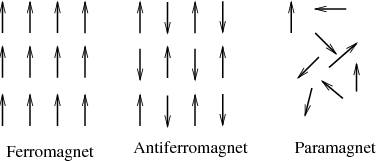
The order parameter is the magnetization, the average magnetic moment per unit volume or per site.
- High Temperature (): Paramagnetic Phase. The thermal energy overwhelms any interaction between spins. They point in random directions, so the vector sum of their moments averages to zero. . The system is isotropic (rotationally symmetric).
- Low Temperature (): Ferromagnetic Phase. Interactions cause the spins to spontaneously align along a common, arbitrary direction. This breaks the rotational symmetry. .
The nature of the order parameter depends on the microscopic model:
- For the Ising model, where spins can only point up or down (), the order parameter is a scalar, . The broken symmetry is the discrete spin-flip symmetry ().
- For the Heisenberg model, where spins are 3D vectors, the order parameter is a vector, . The broken symmetry is the continuous rotational symmetry.
2. Liquid-Gas Transition: A Familiar System, A Subtle Order Parameter
For the liquid-gas transition, what symmetry is broken? The distinction is not one of spatial symmetry but of density. The order parameter is taken as the difference in density between the liquid and gas phases:
This quantity is non-zero along the coexistence curve below the critical point, but it vanishes precisely at the critical point (), where the distinction between liquid and gas disappears.
A more general choice, useful for describing the entire critical region, is the deviation of the density from its value at the critical point, . This is zero in the uniform phase above and becomes non-zero (with opposite signs for liquid and gas) below .
A powerful insight comes from the lattice gas model, which maps the liquid-gas system onto an Ising model.
[PDF] Mean Field Theory - Physics Courses
This text demonstrates the deep connection between the liquid-gas transition and the Ising model via the lattice gas model, showing the equivalence of their order parameters.
Please read the subsection "Lattice gas description of a fluid," from this passage. This shows how a discretized fluid can be described by an Ising Hamiltonian. Then, read the section "Phase diagrams and critical exponents," focusing on the correspondence between the systems and the explicit definition of the fluid's order parameter as \Psi \propto (v_{vap} - v_{liq}), which is equivalent to \rho_L - \rho_G.
This equivalence is a profound example of universality, a theme we will explore later. It shows that the order parameter for a fluid plays the same role as the magnetization for a magnet.
3. Crystals: A Complex Order Parameter
When a liquid freezes into a crystalline solid, it breaks continuous translational and rotational symmetry. The order appears as a periodic modulation of the mass density. The order parameter is therefore related to the Fourier components of the density function .
Here, is the set of reciprocal lattice vectors for the crystal structure. The order parameter is the set of complex Fourier amplitudes . In the liquid phase, for all . In the crystal phase, these amplitudes become non-zero for the specific wavevectors that define the crystal lattice, appearing as Bragg peaks in a scattering experiment.
Lectures on Landau Theory of Phase Transitions
Olmsted's notes give a clear progression from simple to complex crystalline order parameters.
Start with the subsection "Lamellar Systems" and read from the beginning to the end. This explains the simplest case of a 1D crystal, where the order parameter is a single complex amplitude \rho(q). Then, move to "Two and Three Dimensional Crystals" and read the first paragraph to see how this generalizes to a set of amplitudes corresponding to a "star" of wavevectors.
This example shows that an order parameter need not be a single number but can be a field or a set of numbers, capturing more complex spatial structures.
4. Nematic Liquid Crystals: A Tensor Order Parameter
Your research experience in soft matter gives you a good footing for this fascinating example. Nematic liquid crystals, composed of rod-like molecules, exhibit a phase with long-range orientational order but no positional order.
At high temperatures, the rods are randomly oriented (isotropic phase). Upon cooling, they spontaneously align along a common axis, the director , breaking rotational symmetry.
Since the molecules typically have head-tail symmetry (), an order parameter like would average to zero. We need a quantity that is quadratic in the molecular orientation. The appropriate choice is a traceless, symmetric tensor:
Here, is a scalar magnitude of order (related to ), and the tensor structure encodes the average direction of alignment . In the isotropic phase, and . In the nematic phase, .
Lectures on Landau Theory of Phase Transitions
This section provides a detailed construction of the tensor order parameter for nematic liquid crystals.
Please read the subsection "Nematic Liquid Crystals," focusing on the construction of the tensor order parameter Q_{\alpha\beta}.
This tensor can describe not only the simple uniaxial alignment but also more complex biaxial phases, demonstrating the power and flexibility of the order parameter concept.
The Role of the Order Parameter in Modern Theory
The concept of the order parameter is not just a descriptive label; it is the cornerstone of the Landau and Landau-Ginzburg theories of phase transitions.
2. Lec 1 (continued); The Landau-Ginzburg Approach Part 1
This excerpt from an MIT OpenCourseWare lecture frames the order parameter as the fundamental "statistical field" in the Landau-Ginzburg approach.
Please watch from this segment. The lecturer explains how, instead of tracking all microscopic degrees of freedom, we can construct an effective theory for a coarse-grained field—the order parameter. Pay attention to how the same framework can describe different systems by varying the number of components 'n' of the order parameter (e.g., n=1 for fluids, n=3 for magnets).
By identifying the correct order parameter and its symmetries, we can construct a phenomenological free energy as a polynomial expansion in powers of the order parameter. Minimizing this Landau free energy then allows us to predict the phase diagram and the behavior of the system near the transition, as you saw previously with mean-field theory. The fluctuations of this order parameter field are what drive the physics at the critical point, a topic that leads directly to the Renormalization Group.
Conclusion
In this lesson, we have defined the order parameter as the key macroscopic variable that quantifies the emergence of order at a phase transition. It is a direct consequence of spontaneous symmetry breaking.
Key Takeaways:
- An order parameter is a macroscopic observable that is zero in a system's high-temperature, symmetric (disordered) phase and non-zero in its low-temperature, less-symmetric (ordered) phase.
- The choice of order parameter depends on the symmetries broken during the transition.
- Order parameters can take various mathematical forms:
- Scalar: Magnetization in the Ising model; density difference in a fluid.
- Vector: Magnetization in the Heisenberg model.
- Complex Field: Fourier amplitudes in a crystal; the condensate wavefunction in a superconductor.
- Tensor: The alignment tensor in a nematic liquid crystal.
- The order parameter is the central variable in Landau theory, where the free energy is expanded in its powers. Its fluctuations become the dominant degrees of freedom near a continuous phase transition.
Now that we have this quantitative measure of order, our next step is to analyze precisely how it and other related quantities behave as we approach a continuous phase transition. This singular behavior is described by a set of universal numbers called critical exponents, which will be the subject of our next lesson.