Introduction
Welcome to the next lesson in our module on stock valuation. In the previous lessons, we focused on relative valuation, using ratios like P/E and P/B to determine if a stock is cheap or expensive compared to its peers. You learned how to use these multiples to identify potentially under or overvalued stocks, but also to be wary of "value traps."
Today, we shift our perspective from relative to absolute valuation. Instead of comparing a company to others, we will try to calculate its intrinsic value based on its own financial characteristics. This lesson will equip you to explain the conceptual framework of the Dividend Discount Model (DDM), a foundational method for valuing dividend-paying stocks.
The DDM is particularly relevant for an investor in the Colombo Stock Exchange (CSE), as many established Sri Lankan companies are mature businesses that pay regular dividends. Understanding this model adds a powerful, independent tool to your analytical toolkit.
Let's begin by recalling the core purpose of valuation: to estimate a stock's intrinsic value and compare it to its market price.
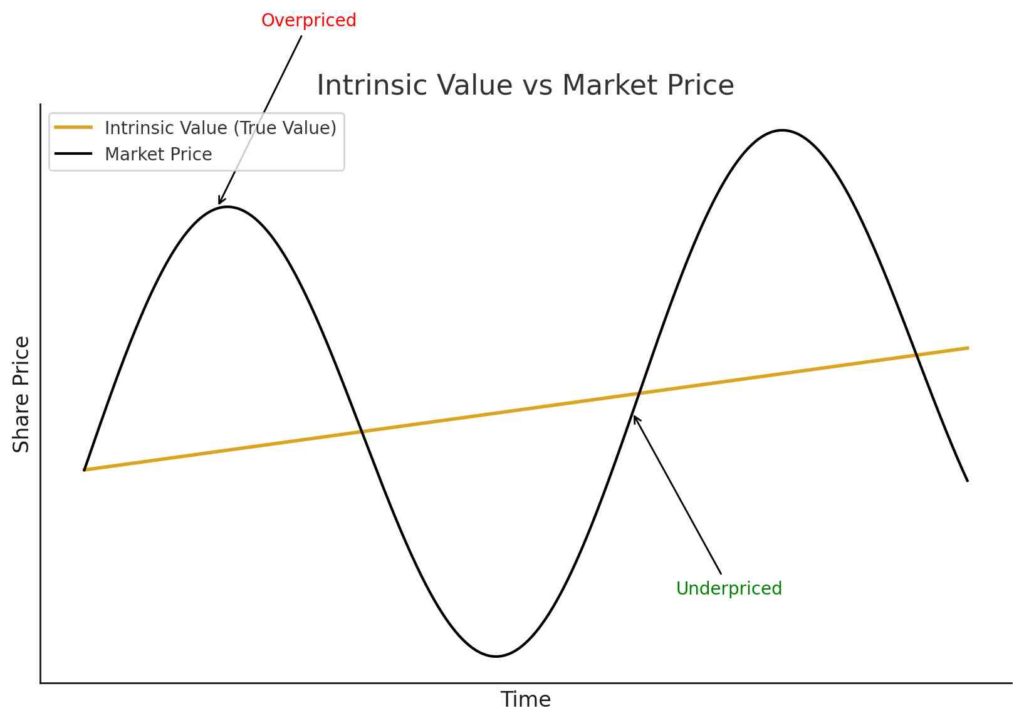
1. The Core Concept: A Stock Is Worth Its Future Dividends
The fundamental idea behind the Dividend Discount Model is simple yet profound: the intrinsic value of a stock is the sum of all the future dividends you expect to receive from it, with each of those future payments adjusted for the time value of money.
The Time Value of Money (TVM)
This is a critical concept in all of finance. It states that money available today is worth more than the same amount in the future. Why? Because you could invest the money you have today to earn a return, making it grow. Therefore, to find the value of a future cash flow (like a dividend) in today's terms, we must "discount" it back to its present value.
Your background in technology involves building systems and models that operate on clear rules and inputs. The DDM functions similarly: it's a logical model built on the principle of TVM.
To solidify your understanding of this principle and how it underpins the DDM, please read the following sections from a detailed Investopedia article.
Understanding the Dividend Discount Model
This article, 'Understanding the Dividend Discount Model', provides an excellent explanation of the core theory, starting with the time value of money.
Please read the sections 'What Is the Dividend Discount Model (DDM)?' and 'How the Dividend Discount Model Works', down to the heading 'Estimating Future Dividends for DDM'. Focus on how the time value of money is the foundation for discounting future dividends to find a stock's present value.
As the article explains, the DDM takes all the dividends a company is expected to pay out from now until forever and calculates their total value in today's money.
2. The Gordon Growth Model: A Practical DDM
While the concept of summing up infinite dividends is good in theory, we need a practical formula. The most popular version of the DDM is the Gordon Growth Model (GGM), which assumes that a company's dividends will grow at a constant, stable rate forever.
This video provides a clear and concise explanation of the GGM and its components.
The YouTube channel Edspira offers a great introduction to the Dividend Discount Model, focusing on the practical Gordon Growth Model formula.
Watch the first two minutes of the video (0:00 - 02:35). The first minute sets the conceptual stage, and the second minute introduces the Gordon Growth Model formula and its variables. Pay close attention to what each variable represents.
The Gordon Growth Model simplifies the infinite sum of discounted dividends into one elegant formula:
Let's break down the inputs, which are the essential components of this model:

- : The expected dividend per share one year from now. This is often calculated by taking the most recent annual dividend () and growing it by the growth rate (), so .
- : The required rate of return (also called the cost of equity). This is the minimum annual return an investor expects to receive for taking on the risk of investing in this particular stock.
- : The constant growth rate of dividends. This is the rate at which you expect the company's dividend to grow, in perpetuity.
To see this in a local context, let's turn to a guide published by the Colombo Stock Exchange.
Stock Selection and Decision Making
The CSE's own guide, 'Stock Selection and Decision Making', provides examples using Sri Lankan Rupees (LKR), making the concept more tangible.
Please read Section 11.2, 'Constant Growth Model' (page 16). Review the formula and the example provided. Notice how they calculate the intrinsic value of a share based on the given inputs.
As you saw in the CSE guide's example, if a stock currently pays a dividend of LKR 2.00 (), is expected to grow it by 5% (), and you require a 20% return (), the calculation would be:
- Calculate next year's dividend:
- Apply the DDM formula:
This LKR 14.00 is the estimated intrinsic value. You would then compare this to the stock's current market price to decide if it's potentially undervalued.
3. Key Assumptions and Limitations
Like any model, the DDM is built on assumptions that you must understand to use it wisely. A model's output is only as reliable as its inputs and the validity of its assumptions.
The Edspira video you watched earlier has an excellent segment on this.
Let's return to the Edspira video to understand the critical assumptions and limitations of the DDM.
Please watch the segment from 4:30 to 7:23, which discusses the issues and caveats of the DDM. Focus on understanding why this model is considered a rough estimate.
To summarize the key limitations:
- Only for Dividend-Paying Companies: The model is useless for companies that do not pay dividends, such as many high-growth tech companies that reinvest all their profits.
- Constant Growth Assumption: The assumption that dividends will grow at a constant rate forever is unrealistic. Real companies go through different life cycles. More complex "multi-stage" DDM models exist to address this, but the basic GGM relies on this simple assumption.
- Sensitivity to Inputs: The output value is extremely sensitive to small changes in the required rate of return () and the growth rate (). A slight change in your assumptions can lead to a vastly different valuation.
- Mathematical Constraint: The model breaks down if the growth rate () is expected to be greater than or equal to the required rate of return (), as this would result in a negative or infinite price, which is not possible.
Conclusion
In this lesson, you have explored the conceptual framework of the Dividend Discount Model, a cornerstone of absolute stock valuation. You have moved beyond simply comparing companies to one another and learned the logic behind valuing a company based on its own ability to generate cash for shareholders.
Key Takeaways:
- The DDM is an absolute valuation model that estimates a stock's intrinsic value based on the present value of its future dividends.
- The model is built on the fundamental finance principle of the Time Value of Money.
- The most common version, the Gordon Growth Model, uses a simple formula () that assumes dividends grow at a constant rate forever.
- The DDM's strength lies in its simplicity, but it is limited by its strong assumptions and is best suited for mature, stable, dividend-paying companies.
Preview of the Next Lesson:
We have now covered both relative valuation (P/E, P/B) and a classic absolute valuation method (DDM). You are building a solid foundation for analyzing stocks. In the next module, we will zoom out from valuing individual companies to the broader topic of portfolio construction. We will begin by exploring the fundamental concept that governs all investing: the risk-return tradeoff, and how to assess your own tolerance for risk. This will set the stage for learning how to combine different investments to build a diversified portfolio that aligns with your financial goals.