Welcome to your first Dutch lesson! I'm excited to guide you on your journey to reaching B1 proficiency. This course is structured to take you from the very foundations of the language all the way to the complex skills you'll need for the telc B1 exam.
Today, we will start at the very beginning by focusing on our first learning outcome: to recite the Dutch alphabet and pronounce each letter correctly. Mastering the alphabet is the essential first step. It is the foundation for your pronunciation, reading, and listening skills. While many letters will look familiar from English, their Dutch sounds can sometimes be quite different. This lesson will help you learn the name of each letter and its most common pronunciation.
1. A First Look at the Dutch Alphabet
Let's begin with a simple overview. The Dutch alphabet uses the same 26 letters as the English alphabet. Take a look at the image below, which shows each letter and provides a simple English-based phonetic guide for how its name is pronounced.
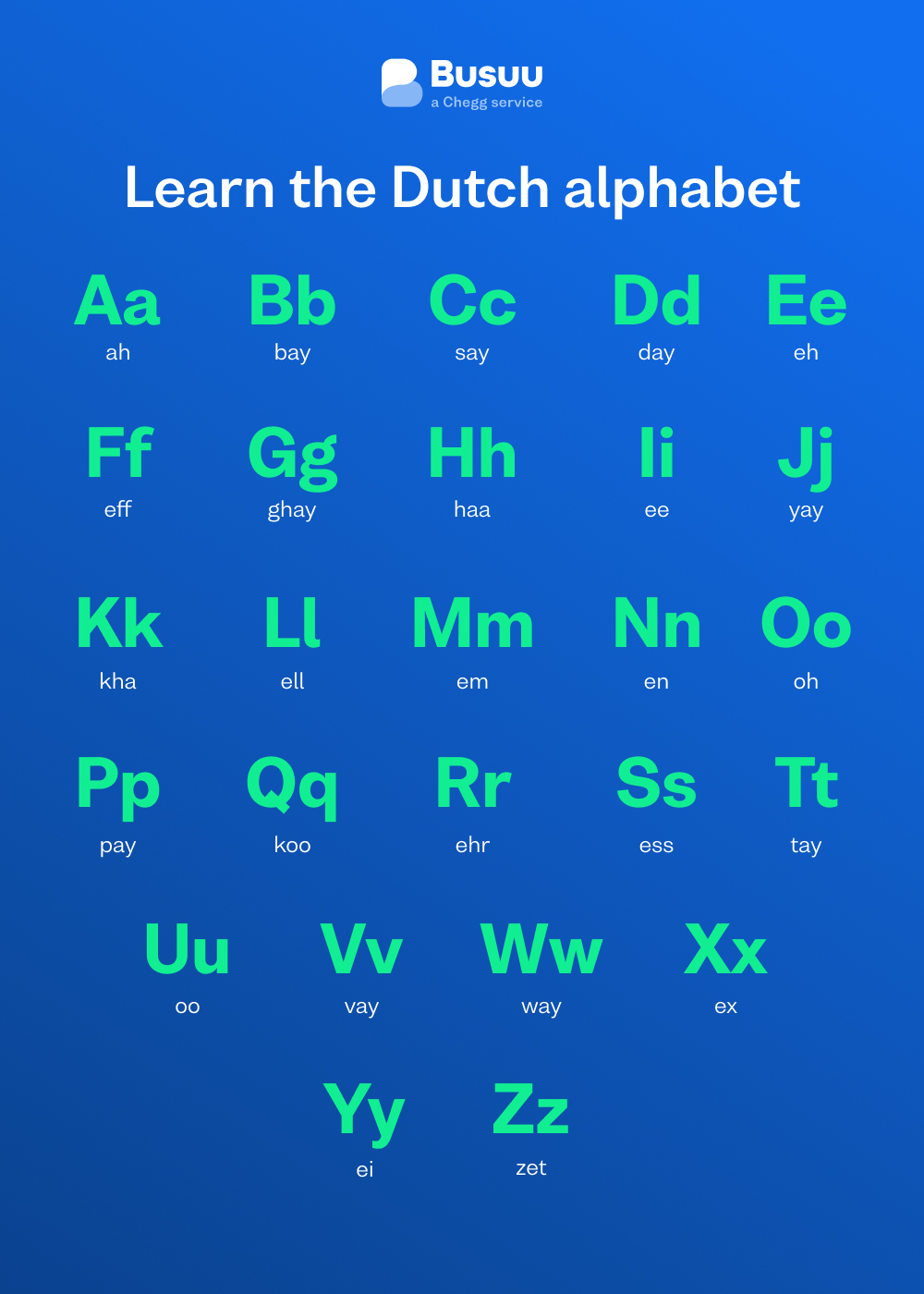
This chart is a useful reference, but to truly learn the sounds, we need to hear them from a native speaker.
2. Learning the Letter Names in Context
Instead of just memorizing the letters from A to Z, let's learn them in a more engaging way. We'll use some famous Dutch words that you might have heard before. The next video uses words like "Gouda", "Heineken", and "Van Gogh" to introduce the letters. This approach helps connect the abstract letter names to concrete examples.
DUTCH SOUNDS & the ALPHABET // Dutch for BEGINNERS les 4 (NT2 - A1)
Watch the following sections from the "DUTCH SOUNDS & the ALPHABET" video by Dutchies to be - Learn Dutch with Kim. She provides a creative and memorable introduction to the alphabet.
First, watch the main part of the lesson from spelling famous words. Pay attention to how she says the name of each letter while spelling out words like "Gouda" and "Schiphol". Don't worry about understanding every word she says; just focus on the letter names. After that, listen as she quickly recites the full alphabet to tie everything together. Try repeating the letters along with her.
3. A Detailed Guide to Pronunciation
Now that you've heard the names of the letters, let's dive deeper into how each letter is actually pronounced within a word. This is where Dutch starts to show its unique character. The following video provides a systematic, letter-by-letter guide to pronunciation, explaining important rules like the difference between short and long vowels.
Learn Dutch Alphabet + Pronunciation
The video "Learn Dutch Alphabet + Pronunciation" from the channel Learn Dutch with Bart de Pau is an excellent, detailed resource. We will focus on the main section where he discusses each letter individually.
Please watch the section from the detailed letter breakdown. As you watch, pay close attention to the following points, which are crucial for beginners: Vowel Length: Notice how he explains the difference between short and long sounds for the vowels a, e, o, u. For example, the 'a' in kat (cat) is short, while the 'a' in raam (window) is long. This is one of the most important concepts in Dutch pronunciation. The 'G' sound: Listen carefully to the pronunciation of 'g' (e.g., in groot). It's a sound made in the back of the throat. Since you are a native Arabic speaker, this sound may be familiar to you, similar to the Arabic letters 'خ' (khāʾ) or 'غ' (ghayn). The 'V' and 'W' sounds: Note the subtle difference. The Dutch 'v' (veel) is softer than in English, almost like an 'f'. The Dutch 'w' (water) is often closer to the English 'v' sound. The 'J' sound: This is consistently pronounced like the 'y' in the English word "year" (e.g., jaar). Letters at the end of a word: Notice that the letter 'd' at the end of a word is pronounced like a 't' (woord), and 'b' is pronounced like a 'p' (web).
4. The Special Case of 'IJ'
One unique feature of Dutch is the letter combination 'ij'. While it looks like two letters, it is often treated as a single letter. It has its own key on some Dutch keyboards and is always capitalized together, as in IJsselmeer.
To understand this better, let's consult a short text.
This resource from heardutchhere.net explains the unique status of the letter 'ij'.
Read the first few paragraphs on the page, starting from the explanation of 'ij'. This will clarify why you might see it referred to as the 25th letter of the alphabet. You will also see it has a name, lange ij ('long ij'), to distinguish it from ei (korte ei), even though they are pronounced identically.
Key Takeaways and Practice
Let's consolidate what you've learned. Here are the most important points from this lesson:
- The Dutch alphabet has the same 26 letters as English.
- The names of the letters are pronounced differently (e.g., A is "ah", E is "eh", I is "ee").
- Several consonants have distinct sounds:
- G/CH: A guttural sound from the back of the throat.
- J: Always like the 'y' in "year".
- V: A soft sound, like a weak 'f'.
- W: Often like the English 'v'.
- R: Can be rolled with the tip of the tongue (similar to Arabic) or in the back of the throat (like a French 'r'). Both are correct.
- IJ is a unique digraph that often functions as a single letter.
Practice Exercise:
Let's put your new knowledge to the test. Try to say the letters to spell out these words.
- Your own first name.
- The city Amsterdam: A - M - S - T - E - R - D - A - M
- The name Van Gogh: V - A - N / G - O - G - H
Try to pronounce the full names as well, remembering the 'g' sound! (Van Gogh is pronounced roughly as "fun KHOKH").
Conclusion
Congratulations on completing your first lesson! You have taken the crucial first step of learning the Dutch alphabet and the fundamental sounds of the language. This knowledge is the bedrock upon which all your future learning will be built.
In our next lesson, we will build directly on this foundation. We will focus specifically on pronouncing the Dutch vowels, including the differences between short and long vowels and the tricky combinations known as diphthongs (like ui, ij, and oe). This will further sharpen your pronunciation and listening skills. Keep practicing the alphabet