Welcome back! In our last lesson, you learned how to introduce yourself by sharing your name, origin, and where you live. Now that you can start a conversation, this lesson will help you make those interactions smoother and more polite.
We will focus on four essential words that are the bedrock of courtesy in any language: "please," "thank you," "sorry," and "pardon." By the end of this lesson, you'll be able to use the Dutch expressions alstublieft, dank u wel, sorry, and pardon correctly in various social situations. These phrases are small but powerful, showing respect and making your conversations much more pleasant.
1. Please and Thank You: Alstublieft & Dank u wel
In Dutch, as in English and Arabic, saying "please" and "thank you" is fundamental. However, Dutch has some nuances you'll want to know, particularly concerning formality and one word that has two key meanings.
Alstublieft: The Dual-Purpose Word
The word alstublieft is incredibly useful. It can mean both "please" and "here you are."
-
Meaning "Please": You use it when you are requesting something.
- Een koffie, alstublieft. (A coffee, please.)
- Mag ik het menu, alstublieft? (May I have the menu, please?)
-
Meaning "Here you are": A shopkeeper, waiter, or anyone handing something to you will also use
alstublieft.- When a barista hands you your coffee, they will say: Alstublieft.
Like many phrases in Dutch, there's a formal and an informal version. This distinction depends on whether you are using the formal "you" (u) or the informal "you" (jij/je).
- Formal/Standard:
Alstublieft(from als het u belieft - if it pleases you) - Informal:
Alsjeblieft(from als het je belieft - if it pleases you)
As a beginner, if you are ever unsure, using alstublieft is always a safe and polite choice.
Dank u wel: Expressing Gratitude
Saying "thank you" also has formal and informal variations.
- Formal:
Dank u wel(Thank you very much) - Informal:
Dank je wel(Thank you very much)
You can also use the shorter and slightly more versatile word Bedankt, which works in both formal and informal contexts.
The image below gives a fantastic overview of the different ways to say "thank you." Notice the clear separation between informal and formal phrases.
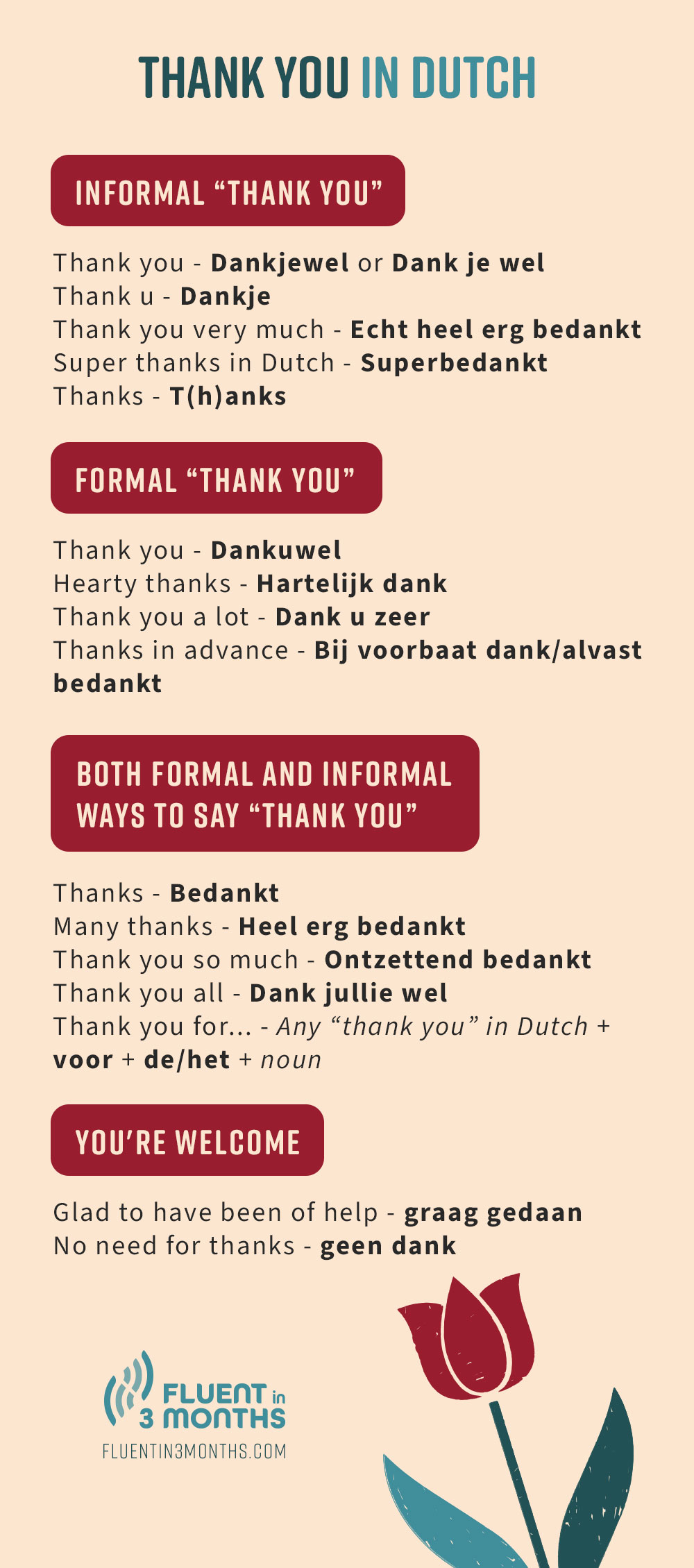
As you can see in the infographic, a common response to "thank you" is Graag gedaan, which means "You're welcome" or "It was my pleasure." Another simple option is Geen dank, meaning "No need for thanks."
This second image also lists some of these basic polite phrases, showing how central they are to everyday communication.

2. Apologizing and Getting Attention: Sorry & Pardon
Now let's look at how to apologize or get someone's attention. While sorry and pardon might look familiar from English, their use in Dutch has specific cultural contexts.
Let's start with a short video from DutchPod101.com that introduces the main words for apologizing.
Learn Dutch - Dutch in Three Minutes - Making Apologies
This video provides a quick overview of the key phrases for apologizing and getting attention in Dutch.
Watch the video from the beginning until the main explanation. Pay attention to the four different words introduced and the situations they are used in: pardon, excuseer, sorry, and het spijt me.
As the video explained, you have several options depending on the situation and how sorry you actually are. Let's explore this in more detail.
The following article from Preply gives an excellent breakdown of how to use these words correctly, including important cultural notes.
How to say sorry in Dutch: phrases, examples, pronunciation
This article explains the nuances between different Dutch apology phrases and provides cultural context on Dutch directness.
First, read the introduction and the section "Casual everyday apologies" to understand the two most common words for apologies. Focus on the difference between Sorry and Het spijt me. Next, read the section "Polite interruptions and minor slip-ups." This covers the words you use to get attention or ask someone to repeat themselves. Pay attention to the examples for Excuseer and Pardon. Finally, read the section "Dutch directness and apologizing culture." This short section is very important. It explains why Dutch people apologize less often than English speakers, which will help you use these phrases more naturally.
Let's summarize the key points from the video and the article:
-
Sorry: This is used for minor incidents, just like in English. If you accidentally bump into someone, a quick "Sorry!" is perfect. It's casual and understood by everyone. -
Pardon/Excuseer: These are not primarily for apologizing, but for getting someone's attention or asking for clarification.- Use
pardonorexcuseerto politely get past someone in a crowd. Example: Pardon, mag ik erlangs? (Pardon me, may I get by?) - Use
pardonif you didn't hear what someone said. Example: Pardon, wat zei u? (Pardon, what did you say?)
- Use
-
Het spijt me: This literally means "It gives me sorrow" or "I regret it." This is what you use for a sincere, heartfelt apology when you have done something wrong and you feel bad about it. For example, if you are late to meet a friend, you could say: Het spijt me dat ik te laat ben. (I'm sorry that I'm late.)
Understanding the cultural context from the article is key. In Dutch culture, directness is valued. Apologies are reserved for when you are genuinely at fault. Using het spijt me for a minor issue might sound overly dramatic.
Conclusion
Excellent work today. Mastering polite expressions is a huge step toward sounding natural and respectful in a new language. You've not only learned the words but also the important social and cultural rules that govern their use.
Key Takeaways:
Alstublieft/Alsjeblieft: Use for "please" when requesting something, and expect to hear it when someone gives you something ("here you are").Alstublieftis the formal/standard choice.Dank u wel/Dank je wel: The standard way to say "thank you." Useufor formal situations andjefor informal ones.Bedanktis a versatile alternative.Sorry: For quick, casual apologies for minor accidents.Pardon/Excuseer: To get attention politely or to ask someone to repeat themselves. Not for expressing regret.Het spijt me: For sincere apologies when you have made a mistake and feel regret.
In our next lesson, we will shift gears and tackle a fundamental building block of any language: numbers. You will learn to count from 0 to 100, a skill essential for everything from shopping to scheduling.