Welcome back. In our last lesson, we mastered the MODI method, a powerful tool for testing and optimizing transportation plans. We took an initial, suboptimal schedule for our boudoir photoshoot and iteratively improved it until we proved its optimality, ensuring the "regret cost" was minimized. This was about allocating quantities of time.
Today, we shift from allocation to pure assignment. We'll address the learning outcome: Apply the Hungarian Method to optimally assign specific outfits to photoshoot time slots to maximize total 'sexiness' score. This scenario is a classic assignment problem: you have a set of tasks (time slots) and a set of agents (outfits), and your goal is to create the perfect one-to-one pairing to achieve the best overall result. The Hungarian Method provides an elegant and efficient algorithm for finding this optimal match.
A key challenge we'll tackle is that the Hungarian Method is designed for minimization, but our goal is to maximize the total sexiness score. We will begin by learning how to transform a maximization problem into an equivalent minimization problem, a critical first step in applying this technique correctly.
Framing the Photoshoot Assignment Problem
Let's imagine our boudoir photoshoot is divided into four distinct time slots, each with unique lighting and mood:
- Golden Hour: Soft, warm, outdoor light.
- Studio Midday: Bright, high-contrast, indoor light.
- Twilight: Cool, blue, ethereal light.
- Night: Dark, dramatic, artificial light.
We also have four signature lingerie outfits to feature:
A. Red Lace Bodysuit
B. Black Silk Robe
C. White Corset Set
D. Sheer Negligee
Based on experience, style, and the desired aesthetic, you've estimated a "sexiness score" (on a scale of 1 to 20, where higher is better) for each possible outfit-timeslot pairing. This forms our effectiveness matrix:
| Golden Hour (1) | Studio Midday (2) | Twilight (3) | Night (4) | |
|---|---|---|---|---|
| Outfit A | 12 | 8 | 15 | 9 |
| Outfit B | 7 | 11 | 10 | 14 |
| Outfit C | 10 | 18 | 13 | 16 |
| Outfit D | 9 | 14 | 12 | 8 |
Our objective is to assign each outfit to exactly one time slot to maximize the sum of the scores. Simply picking the highest score (18 for Outfit C in Studio Midday) isn't enough, as that might leave a suboptimal assignment for the remaining outfits. We need a systematic approach.
The Hungarian Algorithm: A Step-by-Step Guide
The Hungarian Method finds the assignment with the minimum total cost. Since we want to maximize our score, our first step must be to convert our effectiveness matrix into an opportunity loss or regret matrix.
Exactly how the Hungarian Algorithm works
This article from ThinkAutonomous.ai provides a clear guide to the algorithm and its nuances. We will start by focusing on how to handle our specific type of problem: maximization.
In the section "How to deal with the 'Edge Cases'?", please read the subsection on converting maximization problems. This explains the simple but crucial transformation that makes the Hungarian Method applicable to our goal.
As the resource explains, the method is straightforward:
- Find the highest value in the entire matrix. In our case, this is 18.
- Subtract every element in the matrix from this highest value.
Let's perform this conversion. Our new regret matrix is:
Original Matrix (Scores)
Regret Matrix (Costs to Minimize)
Now, we can apply the standard Hungarian algorithm to this regret matrix. Minimizing the total regret will be equivalent to maximizing the total sexiness score.
The algorithm proceeds in a series of reductions and checks.
How to Solve an Assignment Problem Using the Hungarian Method
This video from Zach's Math Zone provides an excellent, clear walkthrough of the entire mechanical process. We will follow these steps precisely for our photoshoot problem.
Watch the entire process unfold from the beginning of the method. Pay close attention to these key stages: Row and Column Reduction: Creating zeros in the matrix (Step 1 & 2). Covering Zeros: The crucial test for optimality (Step 3). Matrix Improvement: What to do if the solution isn't yet optimal (Step 4). Making the Assignment: How to read the final solution from the matrix (Step 5).
Let's apply these steps to our regret matrix.
Step 1: Row Reduction
Subtract the minimum value of each row from all elements in that row.
- Row 1 (min=3):
[3, 7, 0, 6] - Row 2 (min=4):
[7, 3, 4, 0] - Row 3 (min=0):
[8, 0, 5, 2] - Row 4 (min=4):
[5, 0, 2, 6]
The matrix becomes:
Step 2: Column Reduction
Subtract the minimum value of each column from all elements in that column.
- Col 1 (min=3):
[0, 4, 5, 2] - Col 2 (min=0):
[7, 3, 0, 0] - Col 3 (min=0):
[0, 4, 5, 2] - Col 4 (min=0):
[6, 0, 2, 6]
The matrix becomes:
Step 3: Test for Optimality (Cover Zeros)
Draw the minimum number of lines to cover all zeros.
- A line through Column 1 covers the zero at (1,1).
- A line through Column 2 covers the zeros at (3,2) and (4,2).
- A line through Column 4 covers the zero at (2,4).
We can cover all the zeros with 3 lines.
- Line 1: Column 1
- Line 2: Column 2
- Line 3: Column 4
Since the number of lines (3) is less than the order of the matrix (n=4), the solution is not yet optimal. We must proceed to Step 4.
Step 4: Improve the Matrix
-
Find the smallest uncovered value. The uncovered values are
[7, 0, 6],[3, 4, 0],[0, 5, 2]. Wait, my columns were wrong. Let me re-draw the lines.- Line over Row 3 (covers two 0s)
- Line over Row 4 (covers two 0s)
- Line over Col 1 (covers one 0)
- Line over Col 4 (covers one 0)
This is 4 lines. Let's find a better way. - Line over Col 2 (covers two 0s). Matrix:
- Line over Row 1 (covers the remaining 0).
- Line over Row 2 (covers the remaining 0).
So, Col 2, Row 1, Row 2. That's 3 lines.
Let's try again. - Col 2 (covers two 0s)
- Col 4 (covers one 0)
- Row 1 (covers one 0)
That's 3 lines. This seems minimal. Okay, let's proceed with this covering.
Lines: Column 2, Column 4, Row 1.
Uncovered elements are:
4, 4(Row 2),5, 5(Row 3),2, 2(Row 4).
The smallest uncovered value is 2. -
Subtract 2 from all uncovered elements.
-
Add 2 to elements at the intersection of lines. Intersections are at (1,2) and (1,4).
Let's apply this:
- Uncovered elements:
4-2=2,4-2=2,5-2=3,5-2=3,2-2=0,2-2=0. - Intersection elements:
7+2=9,6+2=8. - Other covered elements remain unchanged.
The new matrix is:
Step 3 (Again): Test for Optimality
Let's try to cover the zeros.
- Line on Row 4 (covers three 0s)
- Line on Col 4 (covers one more 0)
- Line on Row 3 (covers one more 0)
- Line on Row 1 (covers the last 0)
This takes 4 lines. Since the number of lines (4) equals the order of the matrix (n=4), an optimal assignment is now possible.
Step 5: Make the Optimal Assignment
We look for rows and columns with a single zero to make assignments.
-
Row 2: Has only one zero, at (2,4).
- Assign Outfit B to Night (4).
- Cross out other zeros in Column 4. (There are none).
-
Row 3: Has only one zero, at (3,2).
- Assign Outfit C to Studio Midday (2).
- Cross out other zeros in Column 2. This eliminates the zero at (4,2).
-
Now examine the matrix again.
-
Row 1: Has two zeros at (1,1) and (1,3). Let's skip it.
-
Row 4: Now has two zeros at (4,1) and (4,3). Let's skip it.
-
Column 1: Has two zeros at (1,1) and (4,1).
-
Column 3: Has two zeros at (1,3) and (4,3).
We have a choice, which indicates there might be multiple optimal solutions. Let's make a choice.
- Assign Outfit A to Golden Hour (1).
- This eliminates the zero at (4,1).
- This leaves only one zero for Row 4: at (4,3).
- Assign Outfit D to Twilight (3).
Our final assignment is:
- Outfit A -> Golden Hour (1)
- Outfit B -> Night (4)
- Outfit C -> Studio Midday (2)
- Outfit D -> Twilight (3)
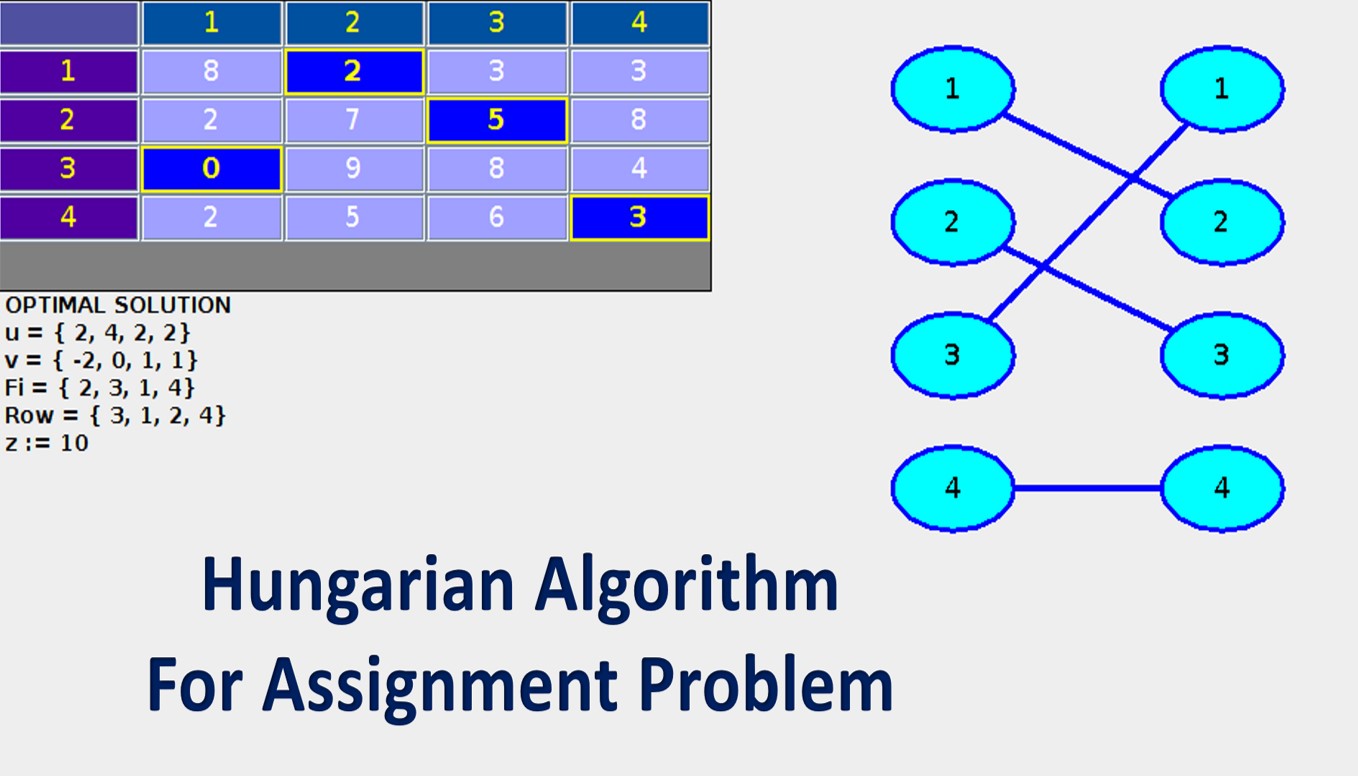
Calculating the Maximum Score
To find our total "sexiness score", we sum the values from our original effectiveness matrix for the assigned pairs:
- Outfit A @ Golden Hour: 12
- Outfit B @ Night: 14
- Outfit C @ Studio Midday: 18
- Outfit D @ Twilight: 12
Total Maximum Sexiness Score = 12 + 14 + 18 + 12 = 56
Any other combination of one-to-one assignments would result in a total score less than or equal to 56.
Conclusion
In this lesson, we successfully applied the Hungarian Method to solve a maximization assignment problem. We saw that the key is to first convert the problem into a minimization task by creating a "regret" matrix. From there, the algorithm provides a clear, step-by-step process of row/column reduction and optimality testing to find the one-to-one pairing that yields the best possible outcome.
Key Takeaways:
- Assignment vs. Transportation: The Assignment Problem is a special case of the Transportation Problem where all supplies and demands are exactly 1. It requires finding the best one-to-one matching.
- Maximization to Minimization: To solve a maximization problem with the Hungarian Method, you must first convert the effectiveness matrix into a cost/regret matrix by subtracting all elements from the matrix's maximum value.
- The Algorithm: The core steps involve reducing the matrix to create zeros, covering those zeros with minimum lines to test for optimality, and systematically improving the matrix until an optimal assignment can be made.
- Optimal Solution: The final assignment corresponds to a set of independent zeros in the matrix, and the total value is found by referring back to the original matrix.
In our next lesson, we will expand on this concept to tackle a more complex allocation scenario. We will explore how to model the allocation of the hotwife's available time blocks to different encounter types as a Generalized Assignment Problem (GAP) to maximize total satisfaction within capacity constraints. This will move beyond simple one-to-one matching to scenarios where "agents" have different capacities and "tasks" have different requirements.