Bonjour! Welcome back to our course.
Introduction
In our last two lessons, we learned how to produce the core sounds of French—the vowels, and the more challenging consonants like 'R', 'CH', and 'GN'. Now that you can pronounce sounds inside words, it's time to learn the names of the letters themselves.
Today's lesson directly addresses the learning outcome: recite the French alphabet to spell out names and reference codes. This is a skill you will use every single day in a call center. When a customer's name is unclear or you need to provide a complex reference number (e.g., REF-A83Z), simply saying the letters is not enough. You need to be able to spell them out clearly and professionally.
By the end of this 60-minute lesson, you will know the names of all 26 letters and, more importantly, how to use the French phonetic alphabet to spell information accurately over the phone.
Part 1: Pronouncing the Letters of the Alphabet
First, let's learn the name of each letter. The French alphabet has the same 26 letters as English, but their names are pronounced differently. Some can be tricky for English speakers, especially distinguishing between 'G' and 'J', or 'E' and 'I'.
The following video provides a clear pronunciation guide for each letter. The instructor also gives helpful tips for forming some of the more difficult sounds.
🇫🇷 Easy French Alphabet Pronunciation Guide for Beginners (5 min)
Watch this video from the 'Easy French with Umut' channel to hear each letter pronounced clearly. The instructor highlights common points of confusion.
Watch the segment from 0:13 to 3:15. Listen carefully and repeat each letter after the instructor. Pay special attention to the pronunciation of the letters E, G, J, I, and U.
Quick Reference Table
Here is a table summarizing the letters. Keep it handy for practice. The "Pronunciation hint" is a guide based on English sounds.
| Letter | French Name | Pronunciation Hint |
|---|---|---|
| A | a | ah |
| B | bé | bay |
| C | cé | say |
| D | dé | day |
| E | e | uh (like 'e' in 'the') |
| F | eff | eff |
| G | gé | jhay |
| H | ache | ash |
| I | i | ee |
| J | ji | jhee |
| K | ka | kah |
| L | elle | ell |
| M | emme | emm |
| N | enne | enn |
| O | o | oh |
| P | pé | pay |
| Q | ku | koo |
| R | erre | air (with a guttural R) |
| S | esse | ess |
| T | té | tay |
| U | u | (No English equivalent) |
| V | vé | vay |
| W | double vé | doobla-vay |
| X | iks | eeks |
| Y | i grec | ee-grek (means "Greek i") |
| Z | zède | zed |
A common point of confusion: Notice how the French 'G' (gé) sounds like the English 'J', and the French 'J' (ji) sounds like the English 'G'. This is a critical distinction to master for phone conversations.
Part 2: Spelling Professionally with the Phonetic Alphabet
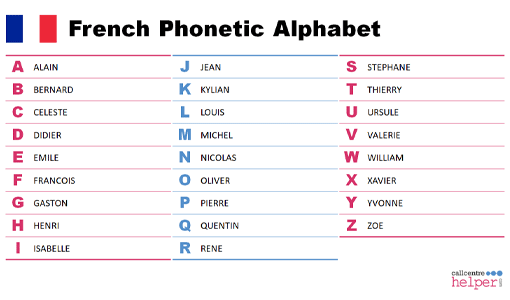
On a phone call, especially if the connection is poor, saying just gé could be misheard as ji. To prevent this, professionals use a phonetic spelling alphabet, just like the "Alpha, Bravo, Charlie" system used internationally in English.
The French system uses common names to clarify letters. Instead of saying "A", you say "A comme Anatole" ("A as in Anatole").
This image gives you a quick visual overview of the standard French phonetic alphabet.
Now, let's dive into a more detailed resource specifically designed for professional telephone communication in French.
The following document, 'Téléphoner en français', is an excellent guide for professional phone skills. We will focus on the section that details the international telephone alphabet used in France.
Please open the PDF and go to page 25. Study the table titled 'ALPHABET TELEPHONIQUE INTERNATIONAL'. Notice the 'Français' column, which lists the code words (Anatole, Berthe, Célestin, etc.). Listen to a few of the pronunciations you are unsure of by reading them phonetically.
Using this system makes spelling foolproof. For example, to spell the name DUBOIS:
- D comme Désiré
- U comme Ursule
- B comme Berthe
- O comme Oscar
- I comme Irma
- S comme Suzanne
Test your understanding!
Using the phonetic alphabet from the PDF, how would you spell out the reference code RF-78G over the phone? Remember the tricky G/J distinction!
Show answer
You would say:
"R comme Raoul, F comme François, (trait d'union), sept, huit, G comme Gaston."
Notice: For numbers, you just say the number. For symbols like the hyphen (-), you say its name, trait d'union. We'll cover numbers and symbols in more detail in a future lesson. For now, focus on the letters.
Part 3: Putting It Into Practice: A Call Center Scenario
Now it's time to apply what you've learned. In your job, you'll constantly ask for and confirm spellings. Here are the key phrases you'll need.
- To ask someone to spell their name:
Pourriez-vous épeler votre nom, s'il vous plaît ?(Could you spell your name, please?)
- To confirm the spelling you've heard:
D'accord, je confirme : ... C'est bien ça ?(Okay, I confirm: ... Is that correct?)
Let's use the exercises in the Téléphoner en français PDF to practice. These are designed for exactly the situations you will face.
Let's return to the 'Téléphoner en français' document for some practical exercises.
First, go to page 27, under the heading 'Épelez les noms suivants'. Pick 3-4 names from the list and practice spelling them out loud using the 'A comme Anatole' format. Next, go to page 29. Find the exercise that says: 'Épelez votre nom en français en utilisant l’alphabet téléphonique français'. Complete this exercise by spelling your own first and last name out loud.
This practice is the most important part of the lesson. Don't just do it in your head—say it out loud. You can even record yourself on your phone to check your pronunciation and flow.
Conclusion
Excellent work today! You have mastered a fundamental and practical skill for your future career. Being able to spell names and codes clearly and confidently over the phone is non-negotiable for excellent customer service.
Key Takeaways:
- You can now pronounce the names of all 26 letters of the French alphabet.
- You understand the critical importance of the phonetic alphabet (
A comme Anatole) to avoid confusion on calls. - You can use key phrases like
Pourriez-vous épeler ?to ask for spelling and can confirm information by spelling it back to the customer.
Preview of the Next Lesson:
So far, we've focused on individual sounds and letters. However, spoken French often flows together in a way that can be surprising. In our next lesson, "Apply liaison and elision in common spoken phrases," we will explore how and why French speakers link words together or drop vowels. Mastering this will make your speech sound much more natural and fluid, bringing you another step closer to sounding like a native speaker on your calls.
À la prochaine fois! (Until next time!)