Introduction
In our last lesson, we mastered the backward induction algorithm for pricing European options on a multi-period binomial tree. The core principle was that a European option's value at any point is the discounted risk-neutral expectation of its future value. Today, we'll adapt this powerful technique to price American options.
The defining feature of an American option is the right to exercise it at any time up to and including its expiration date. This introduces a critical new decision for the option holder at every step: is it better to exercise the option now or to hold it for a while longer? This lesson will teach you how to incorporate this "early exercise" decision into the binomial pricing model. The algorithm is a direct extension of what you already know, adding a simple but crucial comparison at each node of the tree.
The Early Exercise Decision
For a European option, the only choice is to exercise at maturity if the option is in-the-money. For an American option, at every single node in our binomial tree before expiration, the holder must decide between two actions:
- Exercise Immediately: Realize the option's intrinsic value, which is for a call or for a put.
- Continue Holding: Forgo immediate exercise to retain the option. The value of holding is what we previously calculated for a European option—the discounted expected value of the option in the next period. This is often called the continuation value.
The principle of no-arbitrage dictates that the option's value at any node must be the greater of these two choices. Therefore, our backward induction algorithm gets a simple modification:
At each node at time , the American option value is:
where the Continuation Value is .
This extra flexibility—the right, but not the obligation, to exercise early—means an American option's price must be greater than or equal to that of an otherwise identical European option.
The following video from Patrick Boyle offers a clear, high-level overview of this modification.
Pricing American Options using the Binomial Tree Method. - Options Trading Classes
This video, "Pricing American Options using the Binomial Tree Method," explains the fundamental change in the pricing algorithm.
First, watch the introduction from 0:39 to 2:07 to solidify the distinction between American and European options. Then, focus on the core logic explained from 5:11 to 7:57. This is the most important part of the video. The presenter clearly demonstrates how, at an intermediate node, you must compare the calculated continuation value with the immediate exercise (intrinsic) value and take the higher of the two. This is the central mechanism for pricing American options.
A Step-by-Step Numerical Example
Let's now work through a complete numerical problem to see this in action. The following video prices a 3-period American put option from start to finish. It's an excellent, practical demonstration that aligns perfectly with your preference for applied examples.
Pricing an American Option: 3 Period Binomial Tree Model
This video from finCampus, "Pricing an American Option: 3 Period Binomial Tree Model," provides a comprehensive walkthrough.
We will work through this video step-by-step. Problem Setup: Watch the first part from the beginning to 3:53. The presenter sets up the stock price tree and calculates the option payoffs at the terminal nodes. This is identical to the process for a European option. Backward Induction with a Choice: Now, observe the process of working backward. The key is the comparison at each node. At the node where S=96 (6:39-8:02), the continuation value is 9.96, while the immediate exercise value is \max(100-96, 0) = 4. Since 9.96 > 4, it is optimal to hold the option. The node value is 9.96. Now, watch the crucial segment for the node where S=64 (8:02-10:32). Here, the continuation value is 33.6, but the immediate exercise value is \max(100-64, 0) = 36. Since 36 > 33.6, it is optimal to exercise the option. The node value becomes 36. Notice the elegant no-arbitrage argument the presenter makes: if the option were priced at 33.6, an arbitrageur could buy it, immediately exercise it for 36, and lock in a risk-free profit. Completing the Tree: Continue watching from 10:32 to the end to see how the rest of the tree is valued, always using the max(intrinsic, continuation) rule, until the final price of 11.29 is found at time 0.
Visualizing the Early Exercise Region
If we perform this calculation for every node in a larger tree, we can map out a clear "early exercise region." The image below shows an 8-period binomial tree for an American put option.
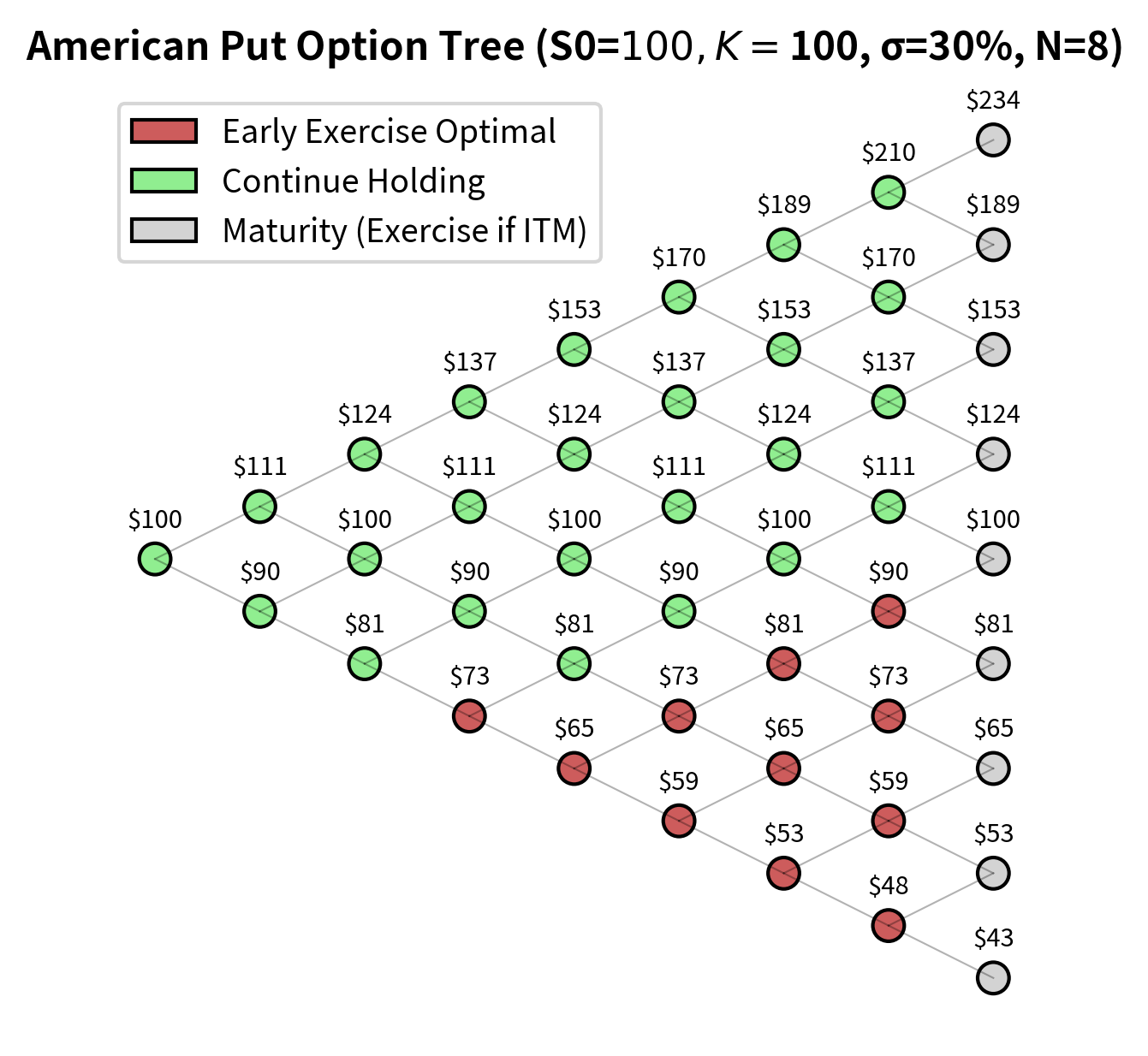
This visualization provides a powerful mental model. Your pricing algorithm is effectively discovering the boundary between the "hold" region (green) and the "exercise" region (red). For a put option, this region naturally occurs where the stock price is low.
When is Early Exercise Optimal?
Your statistical intuition might lead you to ask under what conditions this early exercise becomes rational. The decision hinges on a trade-off.
-
For American Puts: Exercising a deep in-the-money put option gives you the exercise price, , in cash now (in exchange for the stock, worth ). This cash can be invested to earn the risk-free rate. However, you forfeit the "time value" of the option—the insurance it provides against the stock price rising again. When an option is very deep in-the-money (S is very low), the potential interest earned on the exercise proceeds can be more valuable than the slim chance of the stock price recovering significantly. This is why we see the red exercise region for low stock prices in the diagram.
-
For American Calls on Non-Dividend-Paying Stocks: It is never optimal to exercise an American call on a stock that pays no dividends. The logic is simple: an American call must be worth at least its intrinsic value (). But since there is still time until expiration, it also has time value. Therefore, its price will be strictly greater than . An owner who wants to cash out is always better off selling the option in the market than exercising it.
-
For American Calls on Dividend-Paying Stocks: Dividends are the game-changer. A large cash dividend causes the stock price to drop on the ex-dividend date. A call holder does not receive the dividend. To capture the dividend, the holder must exercise the call before the ex-dividend date to become a shareholder. This creates a trade-off: is the value of the captured dividend greater than the option's remaining time value that would be forfeited upon exercise? If so, early exercise is optimal.

To reinforce these concepts, you can review some of the worked examples in the following document.
Chapter 10 - Binomial Option Pricing
This PDF from Ohio State University provides several solved problems related to binomial pricing.
Review Question 10.8 to see a case where the American put is never exercised early and has the same value as its European counterpart. Then, examine Question 10.9 (parts b and c). Here, you can see a clear instance where the value of early exercise at node 'dd' (20.404) exceeds the continuation value (17.904), forcing the option value at that node to be updated. This change then propagates back to the initial price.
Conclusion
You have now extended your knowledge of binomial pricing to cover American options. The core adjustment is both simple and profound, turning the pricing algorithm into a dynamic optimization problem at each node.
Key Takeaways:
- Pricing an American option requires a modification to the backward induction algorithm used for European options.
- At each time step before expiration, the value of an American option is the maximum of its intrinsic value (from immediate exercise) and its continuation value (from holding).
- Early exercise of an American put can be optimal when it is deep in-the-money, as the interest earned on the proceeds may outweigh the remaining time value.
- Early exercise of an American call is generally only optimal right before an ex-dividend date on a dividend-paying stock.
In our next lesson, we will explore a different but related perspective on option pricing: the replicating portfolio. We will learn how to construct a portfolio of the underlying asset and cash that perfectly mimics the option's payoffs, a process known as the 5-step method. This will give you a deeper understanding of the hedging principles that underpin all of derivative finance.