Hello! Welcome to your first lesson. I'm excited to start this journey with you as you begin to explore the world of DJing and music production, with the goal of developing a style inspired by the great Makoto.
This first module is all about building a solid foundation. Before you can mix or create music, you need to deeply understand the genre you love. Today, we'll focus on exactly that. Our goal is to identify the key characteristics of liquid drum and bass music, breaking it down into three core components: its speed (tempo), its foundational beat (rhythm patterns), and the sounds and instruments it uses (sonic elements).
Think of it like learning the fundamental syntax and structure of a new programming language before writing your first application. Understanding these building blocks is the essential first step for both analyzing tracks for a DJ set and knowing what ingredients you'll need to produce your own music later on.
Let's get started.
The Feel and Speed of Liquid D&B
First, let's get a general sense of the genre. Liquid drum and bass (also known as liquid funk) is often described as the soulful, melodic side of the broader drum and bass genre. It balances the high energy of the drums with a smooth, often emotionally uplifting or reflective atmosphere.
To hear this in context, watch the following segment from a video by producer STRANJAH. He gives a great overview of liquid D&B and provides some classic and modern examples.
Top Subgenres of DNB Explained (w/ examples)
This video breaks down several drum and bass subgenres. We will focus only on the section about liquid D&B to understand its unique feel and characteristics.
Watch the section on Liquid Drum & Bass, which starts around 0:42 and ends at 3:23. As you listen to the examples, pay attention to the overall mood and the specific sounds he mentions, like 'soulful vocals', 'lush pads', and 'rolling baselines'.
As you just heard, the feel is crucial, but it's built on a specific technical foundation.
Tempo
The first and most straightforward characteristic is tempo, or speed. Drum and bass is a fast genre, and liquid is no exception.
- Tempo Range: Liquid D&B tracks almost always fall between 170 and 175 beats per minute (BPM). A very common tempo you'll see is 174 BPM.
This high speed provides the energetic "drum" foundation, over which the smoother "liquid" elements can flow.
You can read a quick confirmation of this in the two resources below. You don't need to read the full articles, just the specific sections that define the tempo.
This resource, 'Liquid Funk' from Melodigging, gives a concise summary of the genre. We'll just look at the section on tempo.
Read the first bullet point under the 'Tempo and Groove' heading. It will give you a precise BPM range.
How To Make Liquid Drum & Bass: The Ultimate Guide ...
The guide from EDMProd also provides a standard tempo used by many producers.
Read the paragraph under the 'Phase #0: The Standards' heading that begins with 'Secondly, the tempo...'.
The Rhythm Pattern: The Two-Step Beat
Now for the rhythm. The driving energy of D&B comes from its distinctive drum pattern. While there are many variations, the most common and fundamental pattern is the "two-step" beat.
In its simplest form, the pattern places a kick drum and a snare drum in the following sequence over a bar of music:
- Beat 1: Kick
- Beat 2: Snare
- Beat 3: Kick (often slightly offset)
- Beat 4: Snare
This creates a feeling of constant forward motion. Here is a simple visual representation of a similar pattern. The Kick plays on the first and third beats, while the Snare plays on the second and fourth.

Of course, a real track is more complex. Producers layer this basic pattern with fast-paced hi-hats, shakers, and fragments of sampled drum loops (called "breakbeats") to create a "rolling," fluid, and groovy feel.
This image shows how those layers might look in a DJ or production software. You can see the foundational Kick and Snare, with a more complex "Shuffle" layer (containing hi-hats and other percussion) on top to create the rolling feel.
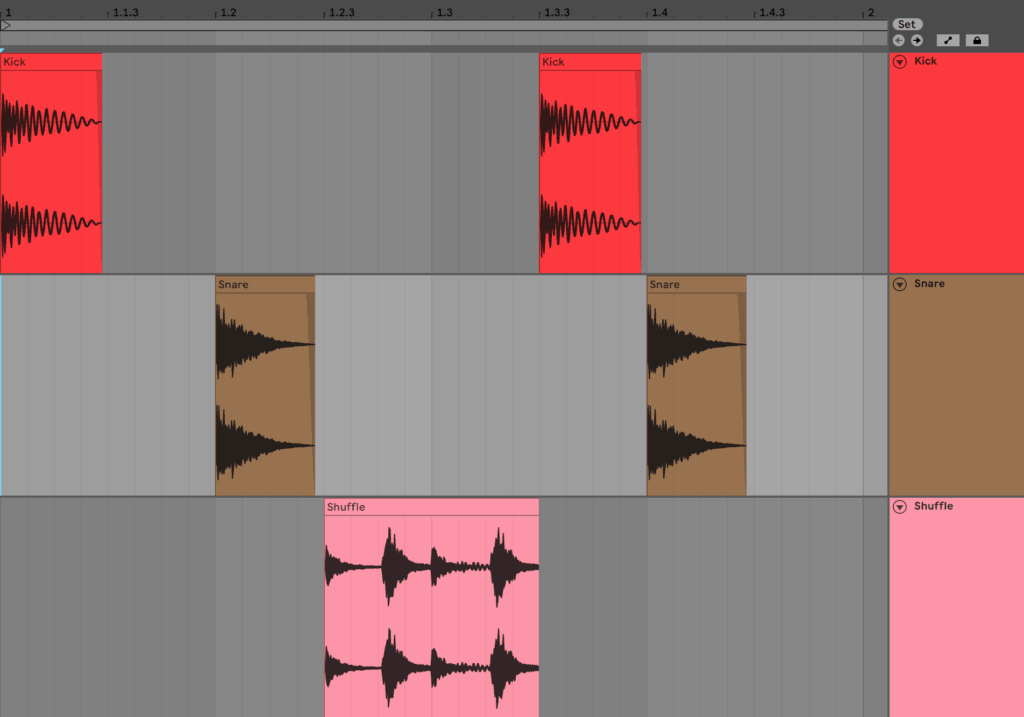
To see this in action, the following video walks through creating a liquid D&B drum pattern from scratch.
How to Make Vocal Liquid Drum and Bass (Liquid DnB Tutorial)
This production tutorial from NonWeary Music demonstrates how to build a liquid D&B beat. Watching this will help you understand how the two-step pattern and percussion layers come together.
Watch from 0:30 to 3:25. Focus on how the producer starts with a simple kick and snare (the two-step), and then adds hi-hats, shakers, and extra snares to make the beat feel groovy and complete.
The Sonic Elements: The "Liquid"
This is what truly defines the subgenre and gives it its name. Unlike more aggressive D&B styles that focus on complex, heavy bass design, liquid D&B is all about melody, harmony, and atmosphere.
The key sonic elements are:
-
Deep, Smooth Basslines: The bass in liquid D&B is foundational. It’s typically a warm, rolling sub-bass that provides groove and weight without being overly aggressive or distorted. The focus is on the musical notes and the rhythm of the bassline, not on gritty sound design.
-
Lush Harmonies and Melodies: This is the heart of liquid. You'll hear rich musical elements layered over the drums and bass. Common sounds include:
- Jazzy or soulful piano/electric piano (like a Rhodes).
- Lush, atmospheric pads (sustained background chords).
- Expressive vocals, which can be full songs or just short, catchy phrases.
- Other real instruments like guitars, strings, or saxophones.
-
Atmosphere and Space: Producers use effects like reverb and delay to make the melodic elements feel wide, spacious, and ethereal. This creates a sense of depth and contrasts beautifully with the tight, driving drums.
The production tutorial you watched earlier is a perfect demonstration of these elements being built. If you wish, you can re-watch the following sections to connect these concepts to the practical creation process:
- Piano melodies: 3:53 - 4:54
- Deep bassline: 4:54 - 6:17
- Atmosphere & Vocals: 6:17 - 7:46
Test your understanding!
You are listening to a track that has a tempo of 174 BPM and a clear two-step drum pattern. However, the track has almost no melodic elements like pianos or vocals. The main focus is a very loud, complex, and distorted bass sound that changes its texture constantly.
Based on what you've learned, is this likely a liquid drum and bass track? Why or why not?
Show answer
No, it is unlikely to be liquid drum and bass.
While the tempo and drum pattern are correct for the genre, the defining characteristic of liquid D&B is its focus on musical and atmospheric elements (lush pads, soulful melodies, smooth bass). A track that minimizes these in favor of a loud, complex, and distorted bassline is more characteristic of other D&B subgenres like neurofunk or jump-up.
Key Takeaways
You've just completed the first step in deconstructing your goal genre. Excellent work. Let's summarize what we've learned.
Liquid drum and bass is defined by a combination of three key characteristics:
- Tempo: A fast pace, typically between 170-175 BPM.
- Rhythm Pattern: A foundation built on the two-step drum pattern, which is then layered with hi-hats and percussion to create a "rolling" feel.
- Sonic Elements: A focus on smooth, musical sounds over raw aggression. This includes deep sub-basslines, lush melodic and harmonic content (pianos, pads, vocals), and a strong sense of atmosphere.
Next time
In our next lesson, we will put this knowledge to the test. Now that you can identify the core components of liquid D&B, we'll work on distinguishing liquid drum and bass from other D&B subgenres by ear. This is a critical skill for a DJ, as it will allow you to quickly categorize music and find the right tracks for your collection.