Welcome to the first lesson of your course! I'm here to guide you through the fundamentals of affiliate and CPA marketing, helping you build the skills to achieve your goal of driving traffic and earning commissions.
This initial lesson focuses on the core concepts of affiliate marketing. We'll break down exactly how it works, from the relationships between the key players to the technology that makes it possible. We will also explore the different ways you can get paid by identifying the most common commission models. Mastering these foundations is the essential first step before we start applying to networks and promoting offers.
What is Affiliate Marketing?
At its heart, affiliate marketing is a form of performance-based advertising. A business (often called a 'merchant' or 'brand') pays a commission to an individual or company (the 'affiliate' or 'publisher') for generating sales, leads, or other desired actions.
For a clear and simple definition, start by reading this short introduction.
The Beginner's Guide to Affiliate Marketing
The article 'The Beginner's Guide to Affiliate Marketing' from Breezy.io provides a great starting point. This first section defines the core concept in simple terms.
Read the section titled 'Hang on, what even is affiliate marketing?'. Focus on understanding why it's considered a 'risk-free' model for businesses.
As the article notes, you only get paid when you deliver a result. This is the fundamental principle that makes this model so powerful for both businesses and marketers like you.
The Three Key Players
Every affiliate marketing transaction involves three main parties. Understanding their roles is key to seeing the whole picture.

To understand these roles in more detail, let's return to the Breezy.io article.
The Beginner's Guide to Affiliate Marketing
This next section from the same article breaks down the roles of the three parties involved.
Read the section 'Okay, but how does affiliate marketing work?' down to the end of the subsection '3. The customer'. Pay attention to the different names used for the 'brand' and the 'affiliate marketer'.
To summarize:
- The Brand (or Merchant): This is the company that creates and sells the product or service. They want to increase their sales and are willing to pay a commission to affiliates who help them do so.
- The Affiliate (or Publisher): This is you. Your job is to promote the brand’s product to an audience using various marketing channels.
- The Customer: The person who sees your promotion, clicks your affiliate link, and completes the desired action (usually making a purchase).
How the Process Works, Step-by-Step
So, how does the brand know that a specific customer came from you? The entire system works because of special tracking links.
Here is the typical flow of events:
- You join an affiliate program or network and choose a product to promote.
- You are given a unique affiliate link that contains a special tracking ID.
- You place this link in your promotional content (e.g., in a forum post, an article, or an ad).
- A customer clicks on your affiliate link.
- The affiliate network records the click and places a small file called a cookie on the customer's browser. This cookie identifies you as the referring affiliate.
- The customer is redirected to the brand's website and makes a purchase.
- The affiliate network's tracking system scans for the cookie, finds your tracking ID, and credits your account with the sale.
- After the sale is confirmed (e.g., past the refund period), you receive a commission.
This diagram provides a great visual summary of the entire process from start to finish.
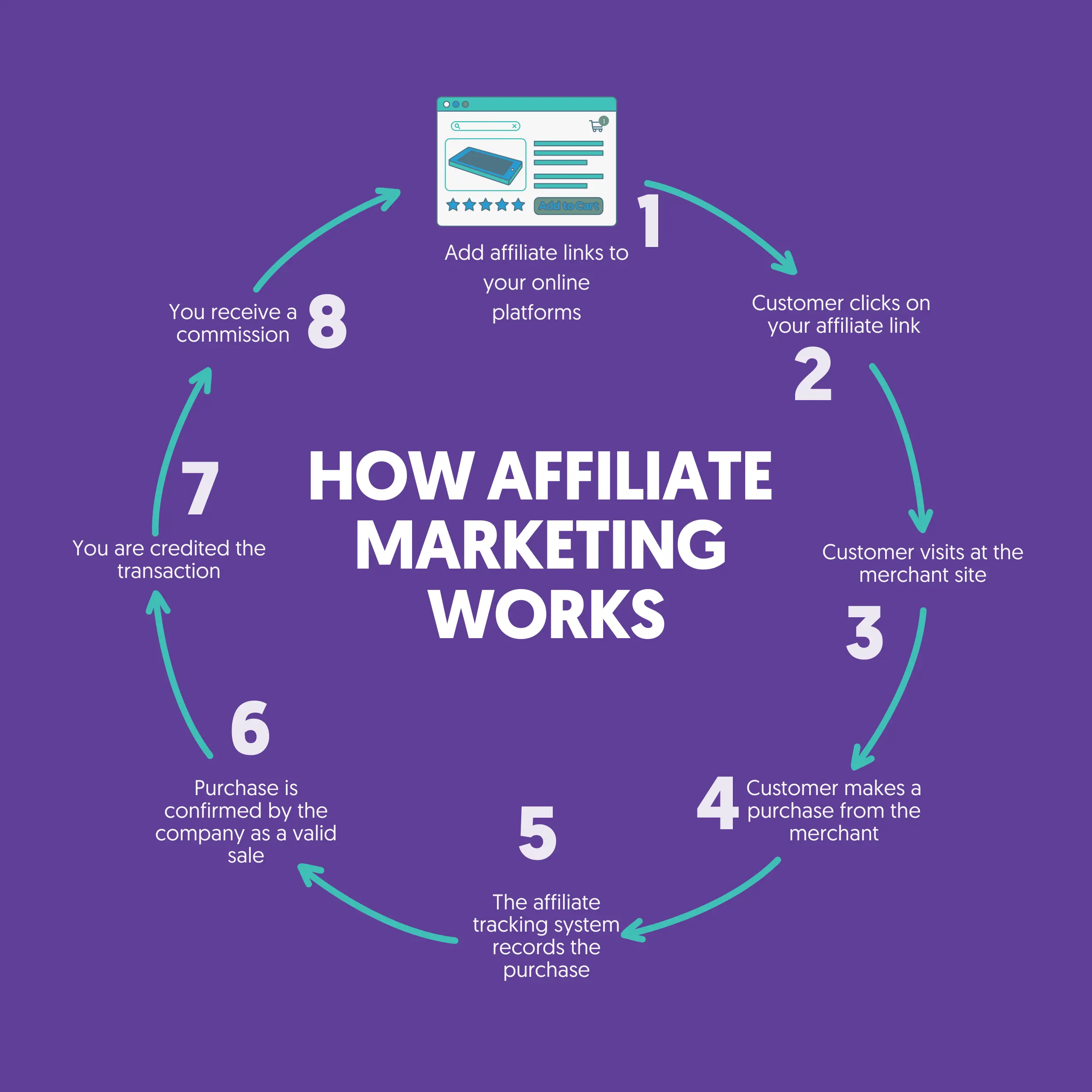
To see a practical example of an affiliate link and understand the technology behind it, let's look at two resources. First, a short reading on how the links and cookies function, followed by a video showing where you get these links in the real world.
The Beginner's Guide to Affiliate Marketing
This section from the Breezy.io guide explains the technical side of how affiliate links and cookies work to ensure you get credited.
Read the section 'Sorry, how exactly do affiliate links work?'.
Now, watch this short video clip to see what this looks like on a real platform, Amazon Associates.
How To Start Affiliate Marketing For Beginners
In this clip from his video 'How To Start Affiliate Marketing For Beginners,' John Crestani demonstrates how to generate an affiliate link for a product on Amazon. This will give you a concrete visual of what an affiliate link is.
Watch the segment from 05:48 to 07:32. Notice how the Amazon 'Site Stripe' tool generates a unique link that contains tracking information.
How Do You Get Paid? Common Commission Models
Now that you understand how affiliate marketing works, let's talk about the money. How you get paid depends on the commission model specified by the affiliate program. Let's explore the most common ones.
The following guide provides an excellent overview of the different payment structures. We'll focus on the most important ones for now.
Affiliate Payment Models: Complete Guide to PPC, PPL, PPS & More ...
The 'Affiliate Payment Models' guide from PostAffiliatePro is a comprehensive resource. We'll use it to understand the main ways affiliates are compensated.
First, review the 'Core Payment Models Overview' table to get a quick summary. Then, read the detailed sections on 'Pay Per Sale (PPS) - The Industry Standard' and 'Recurring Commissions - Building Passive Income'.
Let's break down the two models mentioned in the learning outcome:
1. Pay-Per-Sale (PPS) or Cost-Per-Sale (CPS)
This is the most common model in affiliate marketing.
- How it works: You earn a commission only when a customer you refer makes an actual purchase.
- Commission type: It's usually a percentage of the sale amount (e.g., 50% of a $47 digital product) or a fixed flat fee (e.g., $100 for every sale).
- Best for: E-commerce, digital products, and most retail goods. It's low-risk for the merchant, as they only pay when they make money.
2. Recurring Commissions
This is a particularly attractive model for building a sustainable income.
- How it works: You earn a commission not just on the initial sale, but on every recurring payment the customer makes.
- Commission type: A percentage of the ongoing subscription fee (e.g., 30% of a $29/month software subscription, paid to you every month the customer stays active).
- Best for: Subscription-based services, such as software (SaaS), membership sites, or monthly subscription boxes. This model incentivizes you to promote high-quality products that customers will stick with long-term.
While PPS and Recurring are key, it's also useful to know about another common model, as it will be the focus of our next lesson.
- Pay-Per-Lead (PPL): With this model, you earn a commission for generating a 'lead'—for example, when a user fills out a form, signs up for a newsletter, or requests a quote. You get paid even if they don't buy anything immediately. This is the cornerstone of CPA (Cost Per Action) marketing, which we'll cover next.
Conclusion
In this lesson, we established the fundamental principles of affiliate marketing.
Key Takeaways:
- Affiliate marketing is a performance-based partnership between a brand, an affiliate (you), and a customer.
- The entire system is powered by unique affiliate links and cookies, which track clicks and sales to ensure you are credited for your referrals.
- The most common commission model is Pay-Per-Sale (PPS), where you earn a percentage or flat fee for each sale you generate.
- Recurring commissions offer a powerful way to build a stable, long-term income by promoting subscription-based products.
By understanding this framework, you are now ready to explore a closely related field that focuses more on actions than just sales.
Next Up:
In the next lesson, we will dive into CPA (Cost Per Action) marketing. We've already touched on one type of 'action' with the Pay-Per-Lead model. Next, we'll explore the various types of CPA offers and learn how CPA networks differ from the affiliate networks we've discussed today.