Hello! Welcome to the first lesson in Module 6: "Communication & Player Management."
In our previous module, we focused on the practical application of your set-piece plans on the training pitch. You learned how to design effective drills and, crucially, how to integrate them into the team's wider training schedule. You now have a solid understanding of the when and how of coaching set pieces. But the most brilliant routine is useless if the players can't understand or remember their roles. This brings us to the core of coaching: communication.
Today, we will address the learning outcome: Deliver set piece instructions using clear, concise language and consistent terminology. We'll explore the principles that separate confusing instruction from impactful coaching, ensuring your tactical ideas are translated perfectly from the whiteboard to the pitch.
1. The Foundation: Simplicity and Clarity
At the professional level, players are bombarded with information throughout the week—from tactical analysis and individual feedback to physical data. A key skill for any coach, especially a specialist, is to cut through this noise. Your instructions must be simple, direct, and memorable.
Will Still, a highly-regarded young coach known for his work at Reims, is a fantastic example of a modern communicator. He emphasizes making complex tactical ideas as simple as possible for his players.
How to deliver clear and simple tactical presentations
This LinkedIn post by Ross Jackson analyses a presentation by coach Will Still, highlighting his communication style. It provides an excellent model for how a professional coach delivers tactical information.
First, read the main body of the post itself. Then, find the section where the presenter asks Will Still how long his presentations are. It starts with '...how long would you normally have get the players to sit through something like that?'. Focus on the core principles: avoiding jargon and keeping presentations brief.
As the post highlights, the goal is to be "clear, concise and structured." Notice the key takeaways:
- Avoid "ridiculous jargon": Use language that is universally understood within the team.
- Keep it short: Will Still aims for a maximum of 7-8 minutes for a pre-match presentation. Any longer, and you risk losing the players' attention.
- Give them the key details: Don't overload them. Focus only on the most critical information they need to perform their roles effectively.
This "less is more" approach is the foundation of effective set-piece coaching.
2. The Science of Instruction: Internal vs. External Cues
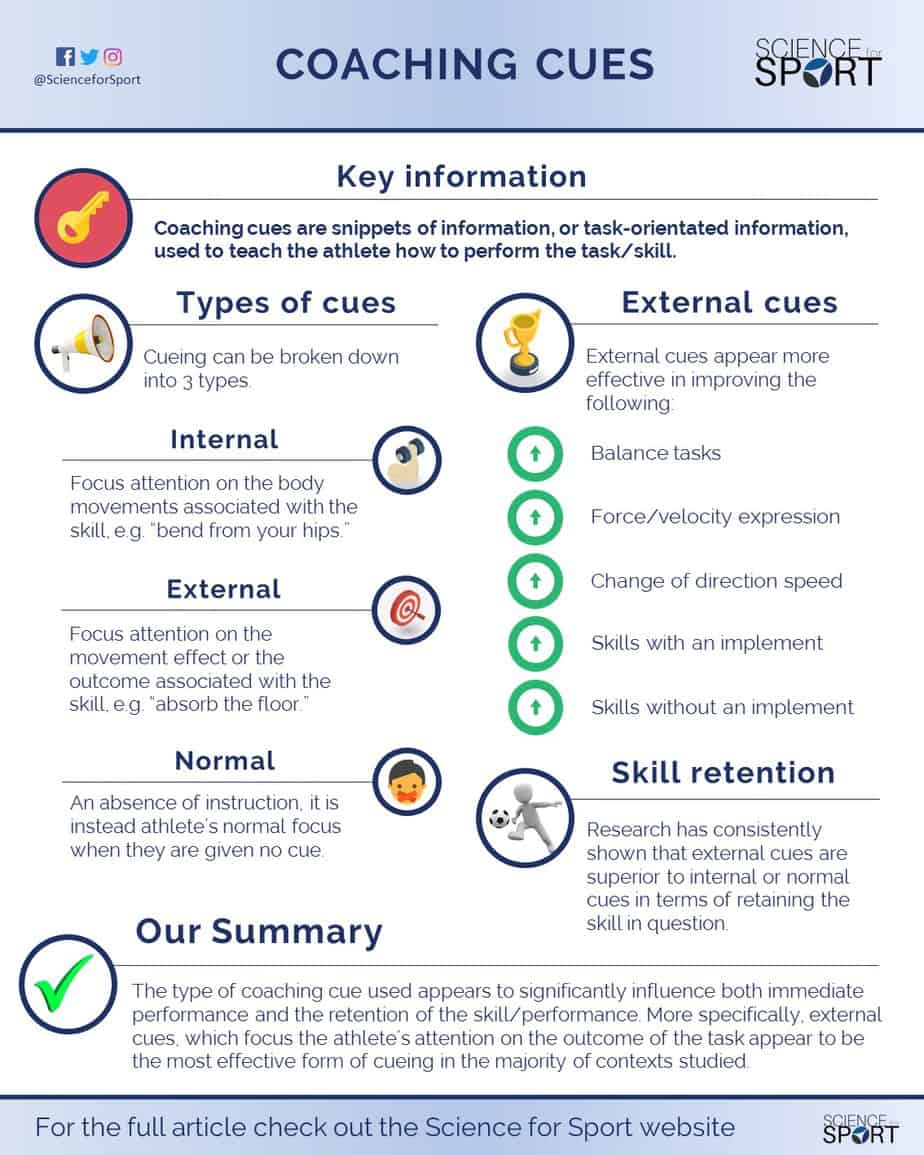
Now that we understand the importance of simplicity, let's look at the type of language we should use. In sports science, coaching instructions are often broken down into two categories: internal cues and external cues. Understanding the difference is transformative for a coach.
- Internal Cues: Focus on the athlete's own body movements.
- Example: "Extend your leg fully when you shoot."
- External Cues: Focus on the effect the athlete's movement has on the environment or an object.
- Example: "Drive your foot through the back of the ball."
Research overwhelmingly shows that external cues are more effective for skill learning, performance, and retention. They allow the player's brain to self-organise the movement subconsciously, rather than consciously thinking about body parts, which can lead to stiff, unnatural actions.
This article provides a superb breakdown of the concept.
3 Crucial Ideas on Better Coaching, Cueing, and Athlete Performance
Let's dive into the theory behind effective instruction with this article, '3 Crucial Ideas on Better Coaching, Cueing, and Athlete Performance' from Just Fly Sports.
Read the section titled '2. External cues beat internal cues'. It begins just after the first image. Pay close attention to the definitions and the examples provided, like the discus thrower study and the swimming story.
To summarise this powerful concept, here is a helpful infographic.
Let's translate this to football set pieces.
| Situation | Internal Cue (Less Effective) | External Cue (More Effective) |
|---|---|---|
| Attacking a Cross | "Bend your knees and jump high." | "Explode up and head the ball over the line." |
| Blocking a Marker | "Get your body between him and the space." | "Shield the space." / "Be a wall." |
| Taking a Free Kick | "Lock your ankle and follow through." | "Whip the ball around the wall." / "Hit the top corner." |
| Defending a Zone | "Keep your body shape open to the ball." | "See the ball and your man." / "Protect this area." |
By focusing on the outcome (the external cue), you empower the player to find the most effective way to achieve it.
3. Communication in Action
Let's see how these principles look and sound on the training pitch and in planning documents.
On the Pitch: Live Instruction
Delivering instructions during a live drill requires you to be incredibly concise. You need short, memorable phrases that reinforce the main objective.
Watch how Northern Ireland's head coach, Ian Baraclough, communicates with his players during a set-piece drill.
Ian Baraclough, Northern Ireland head coach • Set-pieces coaching course • CV Academy
In this video from Coaches' Voice, 'Ian Baraclough, Northern Ireland head coach • Set-pieces coaching course', we get a masterclass in live communication.
First, watch from 0:08 to 01:25. Notice how he sets up the drill with clear numbers ('four of you go in') and defined phases. Then, watch from 01:25 to 02:40, where he gives live feedback. Listen for his short, sharp, external cues.
Baraclough's initial instructions are clear and structured ("four going in," "second phase," "third phase"). This establishes the plan.
During the drill, his feedback is a series of short, powerful, and mostly external cues:
- "First contact!" (Focuses on the outcome of winning the first header)
- "Stay alive!" (An instruction to be ready for the second ball)
- "Readjust!" (Tells players to react to the ball's movement)
- "Hit the target." (A clear, external goal for the shooter)
This is a perfect example of keeping communication sharp, simple, and action-oriented.
On Paper: Building a Consistent Vocabulary
Your communication isn't just verbal. The diagrams and documents you prepare are also crucial. They are where you establish the consistent terminology that will form your team's set-piece language. Every role and every area should have a name that everyone understands.

Look at the legend in this diagram. It doesn't use long, complex sentences. It uses a consistent vocabulary:
- "Man 4 Man": Every player immediately knows this means strict man-marking.
- "6 Yard Box, no mark": This defines a zonal role and a specific area of responsibility.
- "Edge of box 'cut back'": Names a player's position and primary defensive responsibility.
By using terms like "blocker," "near-post flicker," "short option," or "edge player" consistently across your diagrams, meetings, and on-pitch instructions, you build a shared language. This reduces confusion and allows players to process information and organise themselves much faster during a game.
Conclusion
Effective communication is not a "soft skill"; it is a fundamental coaching competency. As a set-piece specialist, your ability to distill complex plans into simple, actionable instructions is what will determine your success. It's the vital link between your analysis and the team's performance.
Key Takeaways:
- Simplicity is Strength: Keep your verbal and visual instructions as clear and simple as possible. Respect players' limited attention spans by keeping presentations short and focused (7-8 minutes max).
- Cue Externally: Frame your instructions around the desired outcome (e.g., "Attack the ball") rather than the player's body movements (e.g., "Jump higher"). This promotes better learning and more natural athletic solutions.
- Be Concise and Action-Oriented: Use short, sharp cues on the training pitch, like "Stay alive!" or "First contact!", to provide impactful real-time feedback.
- Build a Consistent Language: Use diagrams and meetings to establish a clear and consistent terminology for player roles, runs, and responsibilities. This shared vocabulary is essential for quick organisation during matches.
Preview of the Next Lesson:
We've touched on the importance of diagrams and video today. In our next lesson, we will go a step further and focus on how to use visual aids (diagrams, video) to explain complex routines effectively. You'll learn the practical skills of creating and presenting visual information to ensure your players can not only hear your plan, but see it too.