Hello! Welcome back.
In our last lesson, we started designing attacking corner routines, focusing on how different patterns of movement—man-oriented, zonal, and hybrid—can be used to counter various defensive setups. We introduced core concepts like screens and blocks as ways to defeat man-marking.
Today, we're going to zoom in and dissect those space-creation techniques in detail. Our learning outcome is to analyse space creation techniques such as blocks, screens, and decoy runs. This is a crucial skill for a set-piece coach. Being able to not only design these movements but also teach the fine details and identify them when scouting an opponent is what separates good coaches from great ones. We'll explore the mechanics of how these movements create advantages and look at examples from the highest level.
The Art of the Screen: Creating Space by Obstruction
The most direct way to create space for a teammate is to get in the way of their defender. In football, the terms 'block' and 'screen' are often used interchangeably to describe the act of legally impeding an opponent's movement to free up an attacker. It's a fundamental tactic borrowed from sports like basketball and American football.
To begin, let's establish a clear understanding of what screens are and the different purposes they serve.
Controlled Chaos: Everton's Set Piece Chance Creation
The article 'Controlled Chaos: Everton's Set Piece Chance Creation' from Analytics FC offers an excellent breakdown of how an elite team uses screens as a core part of their set-piece strategy.
Please read the initial section of the article, titled 'Use of Screens'. As you read, focus on: The main purpose of screens, particularly against man-marking systems. The different targets of a screen: are they only used on outfield players? The role of a dedicated 'screener' like Abdoulaye Doucouré in the provided examples.
As the article highlights, screens are not just a brutish tool; they are a nuanced way to create chaos and break down a defensive structure. We can categorise their function into three main types:
- Player Screen: The most common type, where an attacker blocks the path of a specific defender who is man-marking the primary target. The goal is to create separation for the target player.
- Zonal Screen: An attacker positions themselves to obstruct a defender covering a specific zone. This can open up a running lane for another attacker or clear the flight path of the ball.
- Goalkeeper Screen: A player is tasked with legally impeding the goalkeeper, making it difficult for them to move, jump, or come out to claim the ball. This effectively shrinks the area the goalkeeper can control.
Let's see these different types of screens in action.
Arsenal's CORNER TACTICS Explained | Tactical Analysis
This tactical analysis of Arsenal's corner routines by The Tactics Guy shows several of these screening concepts being executed with precision.
Watch the following three clips, paying close attention to who is being screened and for what purpose: Pinning the first defender (00:38 - 00:59): This is a classic zonal screen. One player's job is to neutralise the first defender in a zonal system. The 'Shield' (00:59 - 01:24): This is a more complex screen where multiple players form a barrier to seal off an entire zone, allowing a teammate to attack it freely. Pinning the goalkeeper (01:29 - 01:50): Notice how William Saliba's primary role is to occupy the goalkeeper, a textbook goalkeeper screen.
Here is a static image of a routine that uses a screen to free up an attacker. You can see how the attacker's block (light blue circle) on the defender is designed to allow the target player (black circle) to attack the space created.

Decoy Runs & Movement Combinations
While a screen uses obstruction to create space, a decoy run uses motion. The goal of a decoy runner is not to attack the ball, but to pull defenders out of position, creating space for others to exploit. When you combine well-timed decoy runs with effective screens, you can create highly effective routines.
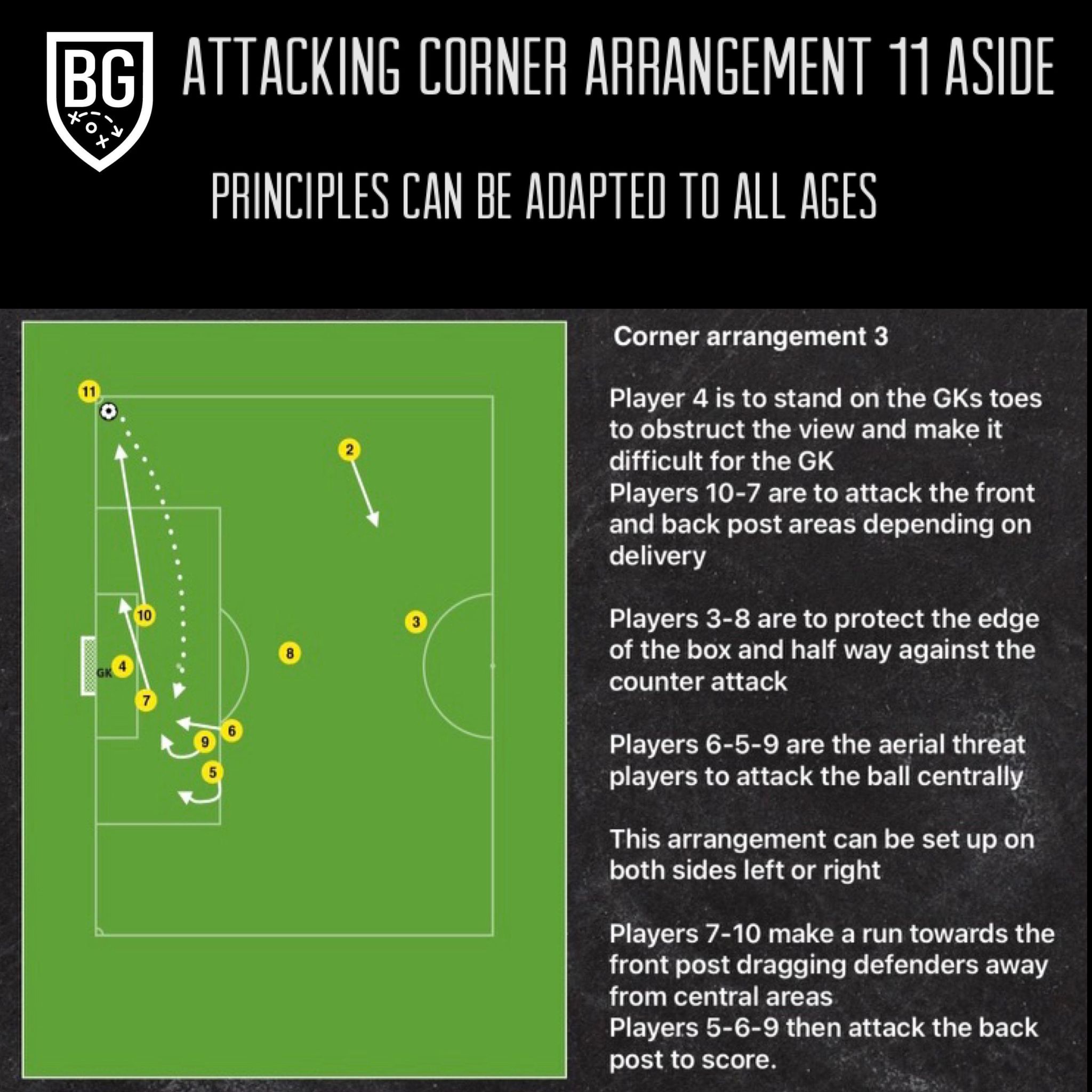
To add more layers to your routines, you can draw inspiration from movement concepts in other sports.
Using NFL Plays To Improve Set-Pieces In Football (Part 2)
Creative coaches often look outside of football for new ideas. This article from Total Football Analysis, 'Using NFL Plays To Improve Set-Pieces In Football', translates concepts from American Football to create clever set-piece movements.
Please read two sections from this article that detail advanced dismarking movements: Start at the heading 'Running plays' and read until the start of the section 'The Wham'. Focus on the 'cut-back run' concept. How does feinting in one direction and then cutting back create an open lane? Read the section titled 'Stick play'. Pay attention to how a sharp change of direction after a vertical run ('sticking') can be used to shake a marker. \nThese are excellent examples of individual movements that can be integrated into your routines.
The key ideas here are about creating separation through deception and explosive changes of direction:
- The Cut-Back Run: An attacker initiates a run in one direction to sell a threat and force defenders to shift their weight and position. They then sharply cut back into the space that has been vacated. This is a brilliant way to use a decoy movement on your own run.
- The Stick Play: This involves a vertical run directly at a defender to put them on their back foot, followed by a sudden, explosive horizontal cut. This change of pace and direction is extremely difficult for a man-marker to defend.
Let's watch a clip that combines multiple runs to create this kind of misdirection and confusion.
Arsenal Tactical Analysis | Arteta’s Build-Up & Corner Strategies
This Arsenal corner routine demonstrates how coordinated runs from a single starting point can disrupt a defense.
Watch the clip from 04:23 to 05:01. Notice the group of four players starting at the far post. Their coordinated runs in different directions cause confusion, and because the runs come from behind the defenders' line of sight, they are very difficult to track. This is coupled with a goalkeeper screen to create a high-quality chance.
Your Turn: Analyse a Routine
Now it's time to put on your analyst hat. You're going to watch a clip of a sophisticated routine and break it down, identifying the specific space-creation techniques we've just discussed.
Arsenal's CORNER TACTICS Explained | Tactical Analysis
Arsenal famously uses a 'trap' routine where they lull the opposition into a false sense of security before striking. Your task is to identify the sequence of techniques they use.
Watch the clip from 01:50 to 02:21 carefully. Then, write down your answers to the following questions: What is the initial decoy action that Arsenal repeats multiple times? What is the specific blocking technique used to 'trap' the defenders in that area? How does this combination of decoy and block create the final overload and scoring chance?
Click here to see a breakdown of the routine.
Here is a step-by-step analysis of the routine:
- The Decoy: Arsenal delivers their first seven corners to the front zone. This acts as a repeated decoy, conditioning the Manchester United defenders to expect the ball there and to move towards that area to defend it.
- The Block/Screen: On the final corner, once the United defenders have committed to moving towards the front zone, Arsenal's players deploy the 'Shield'. This is a group screen where multiple players (Saliba and Kiwior) form a wall, physically blocking the defenders and 'trapping' them in the front zone, preventing them from recovering.
- The Result: With the majority of defenders trapped at the front post by the screen, Arsenal creates a massive numerical advantage (a 3v1 overload) at the back post, leading directly to a goal.
This routine is a masterful example of combining a long-term decoy with a perfectly timed screen to manipulate the entire defensive unit.
Conclusion
In this lesson, you've moved beyond simply knowing that routines exist to analysing how they work. This detailed understanding of the mechanics of space creation is fundamental to coaching set pieces at a high level.
Key Takeaways:
- Blocks and Screens are versatile tools used to obstruct a specific player-marker, a zonal defender, or the goalkeeper.
- Decoy Runs are designed to manipulate defenders by drawing them away from the true point of attack.
- Advanced movements like Cut-Backs and Stick Plays use deception and sharp changes of direction to create individual separation.
- The most effective routines combine these elements, using decoys and screens in a coordinated sequence to create overloads and free attackers in dangerous areas.
Preview of the Next Lesson:
We have now spent two lessons on attacking corners. To complete your understanding, you must also master the defensive side. In the next lesson, we will shift our focus and compare zonal, man-marking, and hybrid systems for defending corners. You'll learn the strengths and weaknesses of each system and the principles behind building a solid defensive structure.