Hello! Welcome to the next lesson in your advanced study of Gian Lorenzo Bernini.
Introduction
In our last lesson, we focused on the material reality of the Baldacchino. We examined the choice of bronze, the monumental casting process, and the controversy surrounding its sourcing from the Pantheon. You now have a solid understanding of the physical substance and creation of this masterpiece.
Today, we will decode the messages carved and cast onto its surface. We'll move from what it is to what it says. This lesson will deconstruct the Baldacchino's dense iconographic and political program, revealing how Bernini wove together symbols of religious authority with powerful statements of personal and familial prestige for his patron, Pope Urban VIII Barberini.
Today's Learning Outcome: By the end of this lesson, you will be able to deconstruct the iconographic and political program of the Baldacchino, linking its motifs to the patronage of Pope Urban VIII.
Time to complete: Approximately 50 minutes.
1. The Overarching Message: Papal Supremacy
Before we zoom in on the details specific to the patron, it's crucial to understand the Baldacchino's primary function in the context of the Counter-Reformation.
Please watch this first segment from a familiar video, focusing on how the monument's very existence and placement serve a powerful theological and political purpose.

- Watch from 01:01 to 01:48. Pay attention to the argument being made about the legitimacy of the Catholic Church and the role of St. Peter.
As the video explains, by monumentally marking the tomb of St. Peter—the first Pope, appointed by Christ himself—the Baldacchino makes an unequivocal statement about the singular authority and divine right of the Roman Catholic Church and its leader, the Pope. In an era still reeling from the Protestant Reformation, this was a powerful reassertion of supremacy.
Bernini layered this with even deeper symbolism. The structure itself was intended to evoke the Temple of Solomon in Jerusalem.
- The altar beneath the canopy represented the Crucifixion.
- The triumphant cross at the very top signified the Resurrection.
- Michelangelo's dome soaring above was symbolic of Christ's Ascension to heaven.
In this light, the Baldacchino is not just a canopy but a theological engine, transforming the crossing of St. Peter's into a representation of Jerusalem and the central tenets of the faith.
2. The Patron's Program: Glorifying the Barberini
While the Baldacchino served the institution of the Papacy, it was also very much a personal monument for the man who commissioned it: Maffeo Barberini, who reigned as Pope Urban VIII. Bernini saturated the structure with emblems of the Barberini family, ensuring that their legacy would be forever fused with that of St. Peter himself.
Please watch this next short clip, which introduces this personal dimension.
- Watch from 02:32 to 03:02. This section explicitly identifies the Pope and his family's insignia.
Now, let's examine those emblems more closely. Please read the section titled "Description and history" in the following resource. It details the key Barberini motifs.
St. Peter's Baldachin by Wikipedia
- Reading time: ~3 minutes.
As you've just read, and can see in the images below, the structure is alive with Barberini propaganda:
- Bees: The most famous Barberini symbol, representing divine eloquence and hard work. They swarm over the entire monument.
- Laurel Leaves: A classical symbol of victory and honor, the laurel vines climb the colossal columns, suggesting that the Barberini family's glory is intertwined with the Church's triumph.
- Radiant Sun: Another key Barberini emblem, representing divine grace and enlightenment, shines down from the center of the canopy's underside, directly above the spot where the Pope would celebrate Mass.
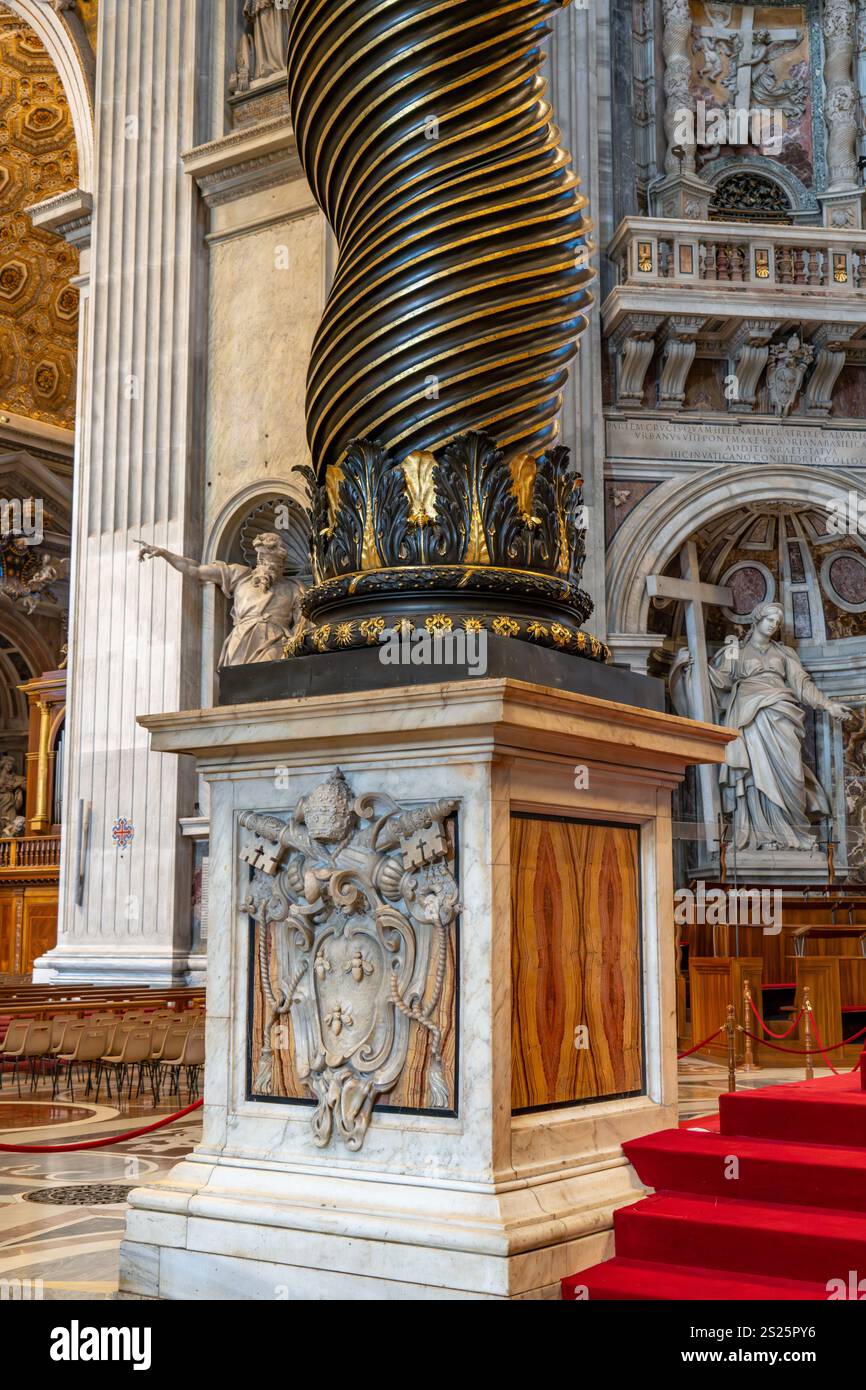 The marble plinth of the Baldacchino, showcasing the Barberini coat of arms with its three bees, surmounted by the papal tiara and keys. This is the most direct statement of patronage.
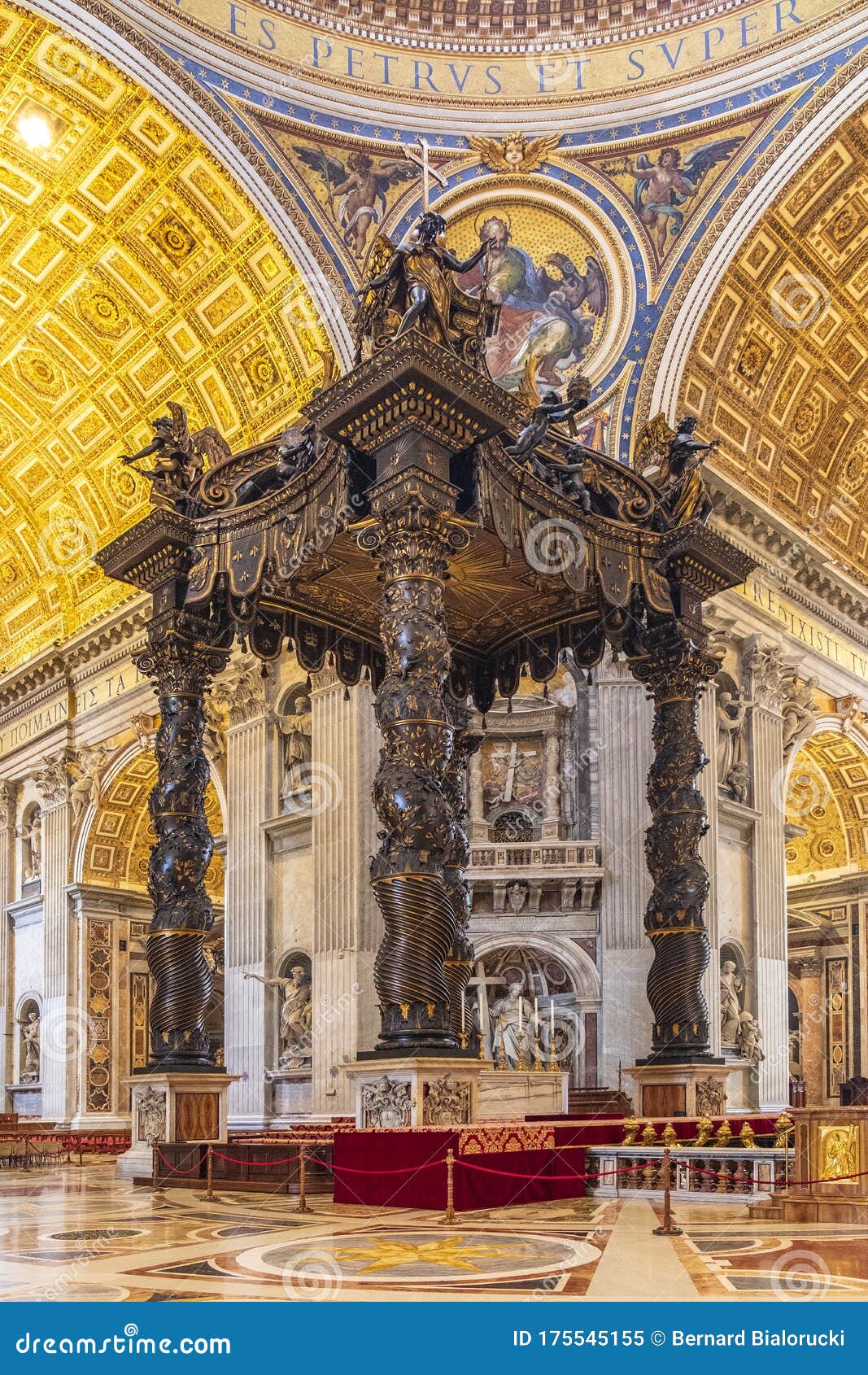 Notice how the gilded laurel vines appear to grow up and around the spiraling bronze columns, visually lifting the entire structure.
By embedding his family's heraldry so completely into the most sacred spot in Christendom, Urban VIII was making a bold political statement: the glory of the Barberini and the glory of the Church were one and the same.
3. A Narrative in Stone: The Mystery of the Plinths
Perhaps the most fascinating and debated part of the Baldacchino's iconography is a story that unfolds across the eight marble plinths that support the columns.
To understand this complex narrative, please read the dedicated section "Plinths and the Barberini coats of arms" in the Wikipedia article.
St. Peter's Baldachin by Wikipedia
- Reading time: ~5 minutes.
As the article explains, the sequence of eight coats of arms depicts a startlingly graphic progression. The woman's face atop the shield contorts from mild discomfort to screaming agony, while the shield itself appears to swell, before the face is finally replaced by that of a serene, smiling baby or putto.
Art historians have proposed three main interpretations for this "childbirth sequence":
- The Allegorical: It symbolizes the "labor" of the papacy or the earthly Church in its struggle to bring forth salvation. This is the most abstract and theological reading.
- The Personal Vow: It commemorates a vow made by Urban VIII for the successful delivery of a child by his niece, who had a difficult pregnancy. This interpretation grounds the monument in a specific family event.
- The Political Revenge: It is a cryptic reference to a scandal involving an illegitimate child born to the Pope's nephew, Taddeo Barberini. In this reading, the sequence becomes a form of public commentary or even revenge by Bernini.
This narrative, which unfolds sequentially as a viewer walks around the monument, is a remarkable feature. You might find a parallel here with your study of time perception. As the film director Sergei Eisenstein noted, it functions like a "montage," a series of discrete shots that together create a temporal story. It requires the viewer to move and experience it through time, transforming a static object into a dynamic narrative.
4. The Political Climate: "Bees Reassemble at the Sound of a Bell"
The Baldacchino's political program wasn't just about self-glorification; it was also a product of the notoriously treacherous world of papal politics. A pope's power was absolute, but his family's fortune could evaporate the moment he died.
A fascinating anecdote reveals Bernini's acute awareness of this reality. Please read the second paragraph of the section "Baldachino and Transcept of the Basilica" (starting with "Of a particularly conspicuous nature...") in the following resource.
View Article: Bernini's work at St. Peter's by Julia M. Triolo
- Reading time: ~2 minutes.
Bernini's cryptic remark—"Yes, they are scattered, but as you know, bees reassemble at the sound of a bell"—is a brilliant piece of political commentary. The "bell" was the one announcing a pope's death and the start of a conclave to elect a successor. The "bees"—the Barberini cardinals who had fled into exile after Urban VIII's death—would indeed "reassemble" in Rome for this event, ready to negotiate their influence. This comment shows that Bernini understood the Baldacchino not just as a timeless work of art, but as a statement of power within a very specific and volatile political moment.
Conclusion
Today, we have peeled back the layers of meaning on the Baldacchino's surface. You can now see it not just as a magnificent object, but as a complex document of theology, power, and personality.
Key Takeaways:
- The Baldacchino's primary program is to assert the universal supremacy of the Catholic Church and the Pope, marking the tomb of St. Peter.
- It is also an unprecedented monument to the personal and familial glory of its patron, Pope Urban VIII, saturated with Barberini emblems like bees, laurel leaves, and the sun.
- The narrative sequence on the marble plinths, depicting what appears to be childbirth, adds a layer of rich, debated symbolism, connecting theological allegory with personal family history.
- The iconography reflects the precarious political reality of a papal family, whose power was immense but temporary, as captured in Bernini's own witty and insightful comments.
Preview of the Next Lesson:
We have now analyzed the Baldacchino's architecture, materials, and iconography in depth. But Bernini conceived of it as the centerpiece of a larger artistic and theological program. In our next lesson, we will widen our view to the four colossal niches in the piers supporting the dome, and analyze how Bernini's sculptural treatment of the saints within them (Longinus, Helena, Veronica, and Andrew) creates a dynamic and unified narrative with the Baldacchino at its heart.