Hello! Welcome to your first lesson in our advanced study of Gian Lorenzo Bernini. I'm excited to guide you through the multifaceted world of this Baroque master.
Introduction
This lesson kicks off our second module, "The 'Bel Composto' and the Vatican Stage." We will explore one of Bernini's most significant contributions to art history: the concept of the bel composto, or "the beautiful whole."
Given your background in philosophy, you'll find this concept particularly fascinating. It represents a fundamental shift in the relationship between the artwork, the space it inhabits, and the person experiencing it. We'll move from art as a discrete object of perception to art as an all-encompassing, immersive environment designed to create a total experience.
Today's Learning Outcome: By the end of this lesson, you will be able to trace the development of the bel composto concept in Bernini's thought, explaining how it marks a departure from the approach in his early Borghese sculptures.
Time to complete: Approximately 50-60 minutes.
1. The Early Approach: The Self-Contained Drama of the Borghese Sculptures
Before Bernini began orchestrating entire chapels, he first established his reputation with a series of breathtakingly dynamic, standalone sculptures for his early patron, Cardinal Scipione Borghese. Created in the early 1620s, these works are masterpieces of technical skill and narrative intensity.
Their primary focus is on capturing a single, pivotal moment of a story—what Bernini himself called il bel momento—with maximum emotional impact. While intensely theatrical, they are self-contained dramas. The sculpture is the entire performance. They are objects to be placed within a room, designed to be admired from multiple viewpoints, but they do not seek to transform the room itself.
Take a moment to examine these two famous examples from the Borghese collection. Notice how the drama is entirely contained within the figures and their interaction.
 In this early work (1618-19), Bernini masterfully captures a moment of crisis and familial duty from the Aeneid. The focus is on the physical strain and the narrative conveyed through the figures alone.
 Completed just a few years later (1621-22), this sculpture is a whirlwind of emotion and action. The virtuosity is astonishing—especially Pluto's hand sinking into Proserpina's flesh—but the drama is entirely enclosed within the marble form.
These works established Bernini's genius, but his ambition was already moving beyond the limits of a single block of marble.
2. Defining the Bel Composto: The "Beautiful Whole"
As Bernini's career progressed, he developed a more holistic and ambitious artistic philosophy. He became the great orchestrator of the Roman Baroque, seeking to unify the arts of sculpture, architecture, and painting into a single, indivisible, and overwhelming whole: the bel composto.
The core idea is a radical integration. In the Renaissance, the different arts might be placed harmoniously side-by-side in a chapel. In Bernini's bel composto, they merge and flow into one another to create a "grand total effect."
To get a precise, academic definition of this concept, please read the first three paragraphs of the following section from a scholarly article. It should take about 5 minutes.
- Gilles Deleuze and Bernini's Bel Composto by Maria João Moreira Soares & Clara Germana Gonçalves.
- Focus on: The section titled "The Baroque and the Extension and Integration of the Arts: The Bel Composto." Pay attention to how the author distinguishes the Baroque integration of arts from Renaissance and Medieval approaches and defines the bel composto's goal.
As the text explains, Bernini (or his biographers, at least) was credited with being the first to "unite architecture, sculpture and painting in such a way that they together make a beautiful whole." The artwork is no longer just the statue or the painting, but the entire environment, which becomes an "autonomous organism" for the viewer to experience.
3. The Bel Composto in Action: Creating a Theatrical World
The most famous and complete realization of the bel composto is the Cornaro Chapel in the church of Santa Maria della Vittoria, home to The Ecstasy of Saint Teresa. We will study this chapel in more detail in a later module, but for now, it serves as the perfect illustration of the bel composto concept.
Please watch this short video from Smarthistory. It provides an excellent visual and conceptual overview of how Bernini fused the different arts to create a single, immersive experience.
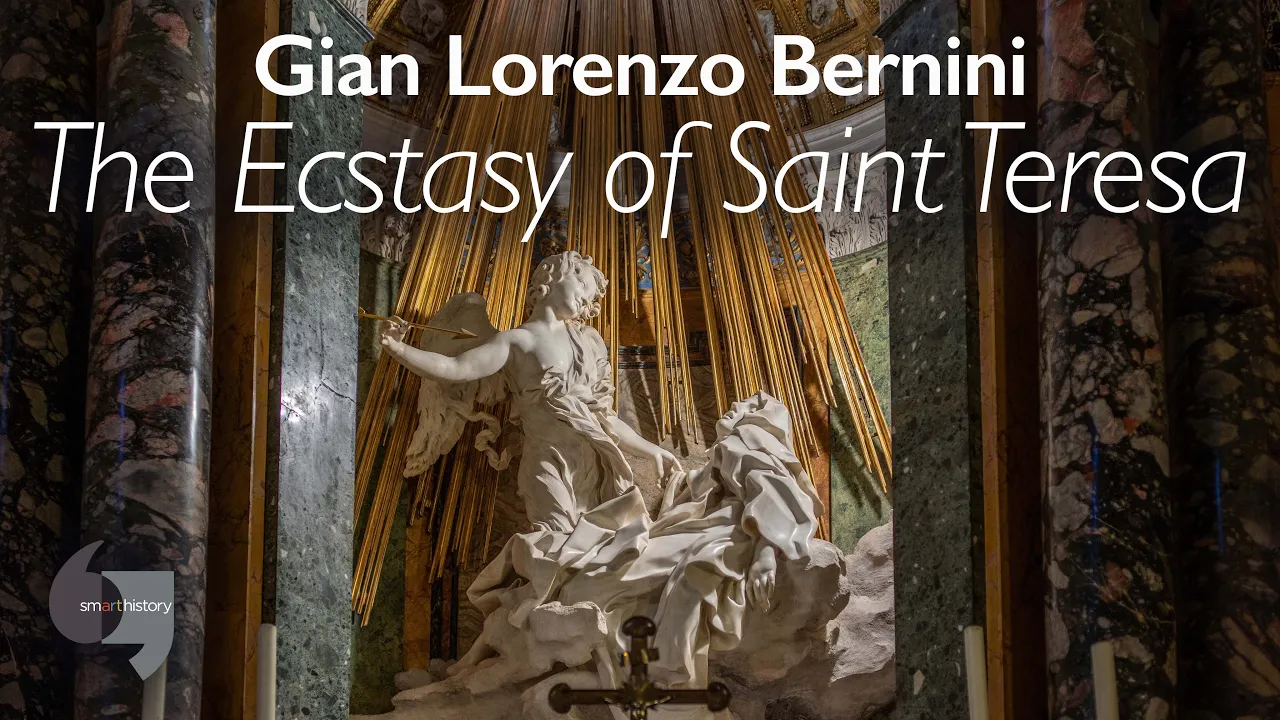
As you saw in the video, the bel composto is not just a theory; it's a set of practical techniques for creating a unified spectacle:
- Integration of Media: The central sculpture (marble) is set within a sculpted architectural frame (marble and stucco). Gilded bronze rays descend from above, seemingly illuminated by a fresco of the heavens (painting).
- Theatrical Staging: Bernini, a theater designer himself, treats the chapel like a stage. The main event (Teresa's ecstasy) is presented in a proscenium-like arch.
- Controlled Light: Most ingeniously, the divine light illuminating the sculpture isn't just symbolic; it's real light, channeled from a hidden window above. Light itself becomes a sculptural and architectural material.
- Audience Inclusion: The sculpted portraits of the patron family in "theater boxes" on the side walls serve a brilliant dual purpose. They act as witnesses to the miracle, but they also transform you, the viewer, into a fellow member of the audience. You are no longer just looking at a sculpture; you are participating in the witnessing of a sacred event.
This approach transforms the viewer from a passive observer into an active participant. The artwork is not an object to be analyzed from a distance, but an environment that envelops and acts upon you.
4. A Tale of Two Approaches: From Object to Experience
Let's now directly contrast the two approaches to fulfill our learning outcome. The development from the Borghese sculptures to the bel composto marks a profound shift in artistic intention.
| Borghese Sculptures (e.g., Proserpina) | Bel Composto Works (e.g., Cornaro Chapel) |
|---|---|
| Concept: A standalone, self-contained object. | Concept: An integrated, multi-media environment. |
| Viewer's Role: An external observer walking around the object. | Viewer's Role: A participant positioned within a constructed experience. |
| Theatricality: The drama is contained within the narrative of the sculpture. | Theatricality: The drama is created by the entire space—the architecture, lighting, and staging. |
| Medium: Primarily a single medium (marble), showcasing technical mastery of that material. | Medium: A synthesis of multiple media (marble, stucco, bronze, paint, light) to achieve a unified effect. |
| Goal: To represent a peak dramatic moment (il bel momento) with stunning realism. | Goal: To create an immersive, spiritual experience that engages the viewer's senses and emotions. |
This evolution from creating beautiful objects to crafting total experiences is arguably Bernini's greatest legacy and a defining characteristic of the High Baroque.
Conclusion
In this lesson, we have traced a crucial development in Bernini's artistic thought.
Key Takeaways:
- Bernini's early career, exemplified by the Borghese sculptures, focused on creating powerful, self-contained narrative works in marble.
- He later pioneered the concept of the
bel compostoor "beautiful whole," which sought to unify sculpture, architecture, painting, and even light into a single, immersive artwork. - This new approach transformed the artwork from a discrete object into a theatrical environment, and the viewer from a passive observer into an active participant in a staged spectacle.
Preview of the Next Lesson:
Now that you have a firm grasp of the bel composto as a concept, our next lesson will examine its application on a colossal scale. We will analyze Bernini's Baldacchino in St. Peter's Basilica, exploring its dual function as both a monumental sculpture and a piece of liturgical architecture that redefines the very heart of the church.