Hello! Welcome back to our course on agent development.
In our last lesson, we unpacked the core components of Agent Development Kits (ADKs), identifying the executors, memory stores, and tool integrations that make them so powerful. We saw how these components provide ready-made solutions to the complex engineering challenges of orchestration, state management, and external interactions.
Now, we zoom out from the what to the why and when. This lesson tackles one of the most fundamental strategic decisions you'll face as an agent developer: should you build a custom agent from scratch, or should you use an ADK?
Your background as a software engineer makes you uniquely equipped to appreciate this classic "build vs. buy" dilemma. By the end of this lesson, you will be able to compare the trade-offs between building custom agents versus using ADKs, enabling you to make informed architectural decisions based on your project's specific needs, timeline, and scale.
The "Build" Argument: Control, Transparency, and Performance
First, let's explore the argument for building an agent using your existing software engineering skills and standard libraries, without the heavy abstractions of a framework. The core philosophy here is that agentic logic is not magic; it's a sequence of well-defined programming steps.
Why Top AI Engineers Don't Use LangChain
This video, from AI engineer Zen van Riel, makes a compelling case against using high-level frameworks like the early versions of LangChain, arguing that they can introduce unnecessary complexity and cost. It's a strong articulation of the 'build-it-yourself' philosophy.
Please watch the following segments: Introduction (00:00 - 00:28): Listen for the core argument against frameworks. The Agentic Loop Explained (01:29 - 03:28): Pay close attention to the diagram. This is the most crucial part. It demystifies the agent loop, showing it as a simple interaction between your code (e.g., Python) and an LLM API. The Mental Model (10:24 - 11:26): This section reinforces the key takeaway: your code is the control center, not the LLM. This has significant implications for reliability and security.
The fundamental idea presented in the video is that an agent loop can be implemented directly and transparently:
- Your code calls the LLM: You make a standard API call to a model like Gemini or GPT-4.
- You provide tools: You pass a structured description of available functions (tools) as part of the prompt.
- The LLM returns instructions: The LLM's response is structured text (often JSON) indicating which tool to call and with what arguments. It does not execute code itself.
- Your code executes the tool: Your application parses the LLM's response, validates the inputs, and executes the corresponding function. Your code is in complete control.
- Repeat: The result of the tool execution is passed back to the LLM in a new API call, continuing the loop.

The primary advantages of this "build" approach are:
- Full Control & Transparency: You have line-by-line control over the entire process. Debugging is straightforward because there are no hidden abstraction layers. You know exactly what data is being sent and received.
- Performance & Efficiency: You avoid the latency overhead that can be introduced by a framework's abstractions. Your code is as lean as you make it, and you can optimize every step.
- Reliability & Security: Because your code is the sole executor, you can implement robust validation, error handling, and security checks before any tool is called.
- No Vendor Lock-in: You are not tied to a specific framework's architecture or release cycle. You can swap out LLMs or other components with minimal friction.
The "Buy" Argument: Speed, Scale, and Focus
While the "build" approach offers maximum control, it also carries the full burden of implementation and maintenance. This is where ADKs—the "buy" side of the argument—present their value proposition. They handle the undifferentiated, heavy lifting of agent infrastructure so your team can focus on what makes your agent unique.
Let's examine this trade-off through a structured guide.
Should You Build Custom AI Agent Infrastructure or Use a ...
The article 'Should You Build Custom AI Agent Infrastructure or Use a...' from Datagrid.ai provides an excellent, balanced breakdown of the build vs. buy decision. It frames the choice in terms of resource allocation and total cost of ownership.
Please read the following parts of the article: Start with the introduction, 'Why Build vs. Buy is a Critical AI Agent Infrastructure Question,' which summarizes the core pros and cons. Then, read through the '7 Criteria to Decide Build vs Buy AI Agent Infrastructure.' Focus on understanding the arguments for both 'custom building' and 'platform solutions' under each criterion. This is the heart of the trade-off analysis.
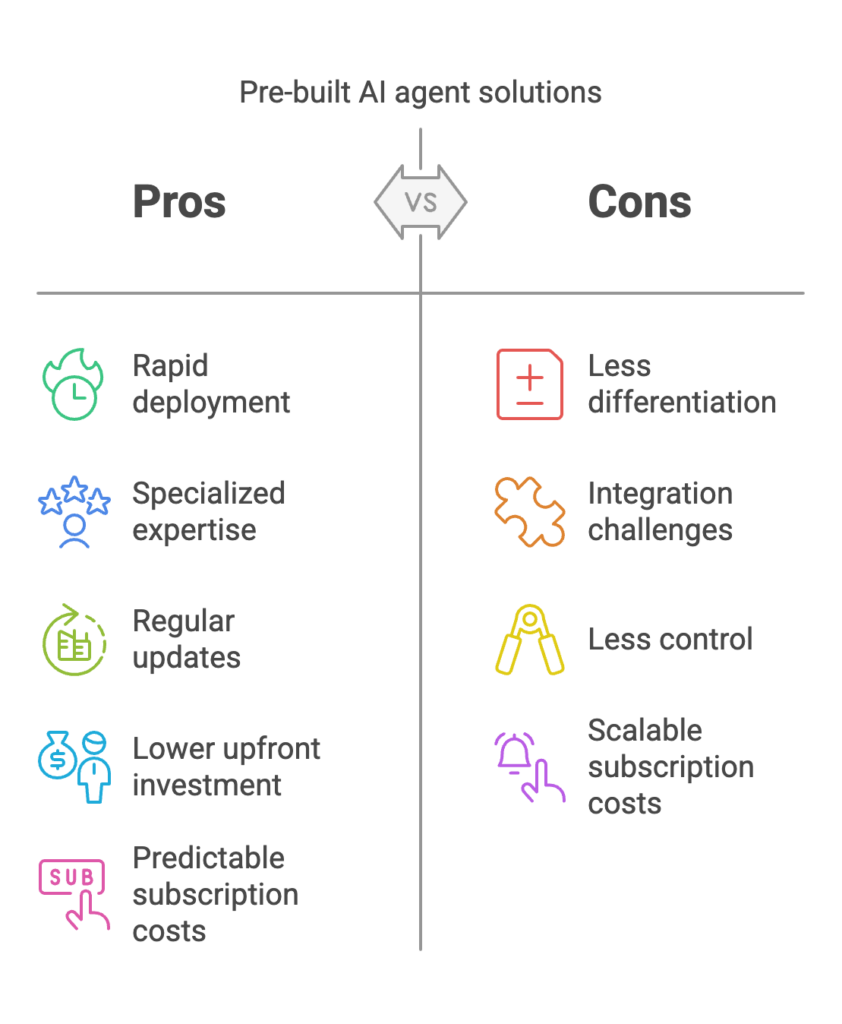
As the article details, the decision hinges on several factors. Here’s a summary of the key advantages of using an ADK:
- Timeline to Value: ADKs drastically reduce development time. With pre-built components for orchestration, memory, and tool integration, you can deploy a functional agent in weeks, not months or quarters.
- Reduced Maintenance Burden: When an external API changes, a security patch is needed, or a connector needs updating, the ADK vendor or open-source community handles it. In a custom build, that maintenance falls entirely on your team, and this burden grows exponentially as you add more integrations.
- Team Focus: ADKs allow your engineers to focus on high-value work—designing agent logic, refining reasoning, and solving business problems—rather than spending time on infrastructure "plumbing."
- Scalability & Expertise: ADKs are often designed with scalability in mind. You benefit from the collective expertise of the framework's developers who have already solved common scaling challenges.
- Lower Upfront Cost: While custom builds might seem cheaper initially (especially if engineer salaries are a sunk cost), the Total Cost of Ownership (TCO) is often much higher due to ongoing maintenance, infrastructure, and specialized knowledge retention. ADKs offer a more predictable cost structure.
The Production Reality: Where Abstractions Can Hurt
The choice isn't always binary. Many successful teams use ADKs for rapid prototyping and then evolve their stack as they move toward production. The reason for this evolution is that the very abstractions that make ADKs easy to use can become liabilities at scale.
Never Use Langchain in Production - Agentic AI Best Practices
This video, 'Never Use Langchain in Production,' highlights the specific challenges that can arise when taking an agent built with a high-abstraction framework into a production environment. It provides a valuable, real-world perspective on the limitations.
Watch the following key segments that detail common production pain points: Prototype vs. Production (00:00 - 02:19): Note the statistic about the drop-off in LangChain usage from experiment to production. Latency (03:07 - 03:58): Understand how abstractions can add significant delays. Debugging (03:58 - 04:52): See why debugging can become a 'nightmare' in opaque frameworks. Dependencies & Lock-in (05:50 - 06:40): This covers the software engineering challenge of dependency bloat. Conclusion (09:13 - 09:52): This summarizes the core message: production priorities (stability, speed, cost) differ from prototyping priorities.
As a software engineer, these production concerns are likely very familiar:
- Latency: Every layer of abstraction adds milliseconds of delay, which can be unacceptable in real-time applications.
- Observability: When an agent fails, opaque framework internals can make it incredibly difficult to trace the root cause. A custom build offers direct visibility into every step.
- Dependency Management: High-level ADKs can pull in dozens of dependencies, increasing your application's size, attack surface, and deployment time.
- Cost Overruns: Inefficient default behaviors, such as storing excessive conversation history, can lead to higher-than-necessary token usage and API costs.
This doesn't mean ADKs are bad; it means you must choose the right level of abstraction for your needs. Newer tools like LangGraph (which we'll build with later) were created specifically to address these issues, offering a "glass box" approach that combines the power of a framework with the transparency of custom code.
Test your understanding!
You are the lead engineer at a startup. Your goal is to build a "travel agent" bot.
Scenario A: Your CEO wants an internal-only proof-of-concept (PoC) in two weeks to show to investors. It only needs to connect to a flight search API and a hotel booking API. The development team is small.
Scenario B: Your company, now well-funded, needs to build a production-grade system to serve 100,000 users. It must integrate with 15 different APIs (airlines, hotels, car rentals, review sites), have less than 2-second response times, and have a 99.9% uptime guarantee. You have a dedicated platform engineering team.
For each scenario, would you recommend a Custom Build or an ADK-first approach? Justify your choice with one or two key trade-offs we've discussed.
Show answer
Scenario A: ADK-first approach.
- Justification: The primary constraint is Timeline to Value. An ADK with pre-built API connectors will allow the small team to build and demonstrate a working PoC in two weeks, which would be impossible with a custom build. The trade-offs of control and performance are acceptable for a non-production demo.
Scenario B: Custom Build (or a low-level, graph-based ADK).
- Justification: The primary constraints are Performance (latency), Reliability, and Scalability. To meet the strict <2s response time and 99.9% uptime, the team needs full control to optimize every part of the system. The "black box" nature of a high-level ADK would introduce unacceptable latency and debugging challenges. With a dedicated platform team, the company can afford the Maintenance Burden in exchange for maximum control and performance.
Conclusion
The "build vs. buy" decision is not a one-time choice but a spectrum that depends on your project's lifecycle, resources, and requirements.
Key Takeaways:
- Building a custom agent offers maximum control, transparency, and performance. This approach is ideal for production systems with strict performance requirements, unique logic, or when avoiding framework overhead is a priority. The cost is a significantly longer timeline and a permanent maintenance burden.
- Using an ADK offers maximum development speed and reduced maintenance by leveraging pre-built, standardized components. This is ideal for rapid prototyping, projects with standard integrations, and teams that want to focus on agent logic over infrastructure. The trade-offs are less control, potential performance overhead, and dependency on the framework.
- A Hybrid Path is Common: Many projects begin with a high-level ADK to quickly build a prototype and validate ideas. As the project matures and scales, teams often refactor critical components into custom code or migrate to lower-level orchestration tools to gain more control and improve performance.
You are now equipped with the mental model to weigh these critical trade-offs. In our next lesson, we will dive deeper into the "buy" side of the equation. We will compare the primary design philosophies of different ADKs—from code-first frameworks to graph-based orchestrators—and position popular tools like LangChain, LangGraph, and Google's ADK within this landscape. This will help you select the right tool for the job, no matter where you land on the build-vs-buy spectrum.