Hello and welcome to the third module of our course.
In the last lesson, we explored the significant software engineering hurdles you face when building an agent from scratch. We identified three major challenges:
- Orchestration: The need to write extensive boilerplate code to manage the agent's execution loop.
- State Management: The difficulty of creating a scalable memory system beyond the LLM's context window.
- Error Handling: The complexity of making a non-deterministic system reliable.
These challenges are precisely why Agent Development Kits (ADKs) exist. This lesson will show you how ADKs abstract away these common patterns and reduce development complexity, allowing you to build sophisticated agents more efficiently. Think of an ADK for an AI agent in the same way you think of a web framework like Django or Express for a web application; it handles the generic, complex plumbing so you can focus on your application's unique logic.
From Boilerplate to Building Blocks
The fundamental value of an ADK is that it provides a structured, high-level API for building agents. Instead of manually coding loops, parsing JSON, and dispatching function calls, you work with pre-built components that encapsulate this logic.
Let's start with a high-level introduction from the creators of Google's Agent Development Kit (ADK).
Introducing Agent Development Kit
Watch this short segment from the 'Introducing Agent Development Kit' video. Pay close attention to the core design principle mentioned by the tech lead.
Watch from 02:04 to 02:47. The key takeaway here is the explicit goal: 'to make agent development feel like software development' by using familiar patterns like classes and functions. This philosophy is central to how ADKs reduce complexity.
This idea of making agent development feel like familiar software development is achieved by providing a set of standardized agent types. These are like classes in an object-oriented language that you can instantiate and configure, rather than building from the ground up.
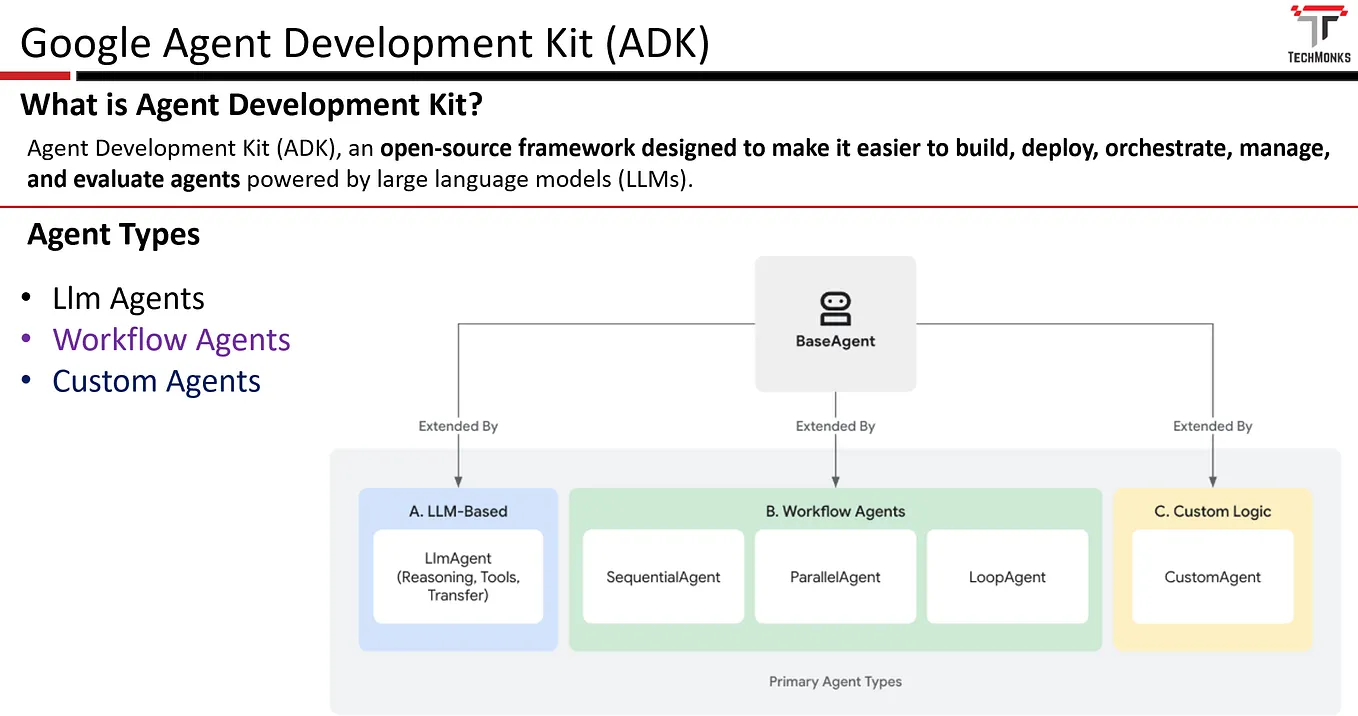
Let's break down what these abstractions do:
-
LlmAgent: This is the most common type. It encapsulates the entire ReAct (Reason-Act-Observe) loop we've discussed. You provide it with instructions and a set of tools, and it automatically handles the process of calling the LLM, parsing its thoughts and tool calls, executing the tools, and feeding the results back to the LLM. It completely abstracts away the orchestrationwhileloop you saw being built from scratch in the previous lesson. -
WorkflowAgent: This is a powerful abstraction for when you need deterministic control. Sometimes, you don't want the LLM to decide the next step; you already know the required sequence of tasks. Workflow agents manage this for you. Common types include:SequentialAgent: Runs a list of sub-agents one after another.ParallelAgent: Runs multiple sub-agents simultaneously.LoopAgent: Runs sub-agents iteratively until a condition is met.
By providing these ready-made building blocks, ADKs transform the task from low-level implementation to high-level composition.
Abstracting Workflows with Agent Design Patterns
As a software engineer, you're familiar with design patterns—reusable solutions to common problems within a given context. The agent types we just discussed are the building blocks for implementing agent design patterns.
These patterns provide proven architectures for structuring single and multi-agent systems. An ADK gives you the primitives to implement these patterns concisely.
Developer’s guide to multi-agent patterns in ADK
The Google Developers blog post 'Developer’s guide to multi-agent patterns in ADK' is an excellent resource that frames multi-agent systems using the language of software design patterns. It provides clear explanations and pseudocode for each.
Read the following sections to understand how ADK primitives map to common agent architectures: 'Sequential Pipeline Pattern (aka the assembly line)': Notice how the SequentialAgent primitive handles the entire orchestration. The output_key abstracts the state transfer between agents. 'Coordinator/Dispatcher Pattern (aka the concierge)': See how a parent LlmAgent can delegate tasks to sub-agents based on their description. The ADK handles the routing logic. 'Parallel Fan-Out/Gather Pattern (aka the octopus)': Understand how the ParallelAgent primitive abstracts away the complexity of running tasks concurrently. 'Generator and critic (aka the editor's desk)': This pattern shows how you can combine primitives (SequentialAgent within a LoopAgent) to create a quality-control loop, abstracting a complex conditional workflow.
Let's summarize how these patterns directly solve the challenges from our last lesson:
- Challenge: Orchestration Boilerplate
- ADK Solution: Instead of a manual
whileloop, you declare aSequentialAgentwith a list of sub-agents. The framework handles the execution flow and state handoff.
- ADK Solution: Instead of a manual
- Challenge: State Management
- ADK Solution: Instead of manually building a memory system, you use the
output_keyparameter. The ADK ensures the output ofAgent A(e.g.,"raw_text") is available in a shared state forAgent Bto use in its prompt (e.g.,"{raw_text}"). This abstracts away the need to manage a shared memory object directly.
- ADK Solution: Instead of manually building a memory system, you use the
- Challenge: Complex Logic
- ADK Solution: Instead of intricate
if/elsechains to decide what to do next, you can configure aCoordinatoragent whosesub_agentshave cleardescriptions. The parent LLM uses these descriptions to route the task, abstracting away the decision-making logic.
- ADK Solution: Instead of intricate
Test your understanding!
You need to build a system that takes a topic, searches for three different academic papers on it simultaneously, and then uses the content of all three papers to write a summary.
Which two ADK agent patterns from the reading would you combine to build this workflow, and why?
Show answer
You would combine the Parallel Fan-Out/Gather pattern and the Sequential Pipeline pattern.
- Parallel Fan-Out: You would use a
ParallelAgentto run three instances of a "ResearchAgent" simultaneously, each searching for one academic paper. This is efficient because the searches don't depend on each other. - Sequential Pipeline: The overall workflow is sequential. First, you perform the parallel search. Then, you take the combined results and pass them to a "SummarizerAgent". You would wrap the
ParallelAgentand theSummarizerAgentinside aSequentialAgentto ensure the summary is only written after all searches are complete.
How Abstraction Simplifies the Entire Development Lifecycle
ADKs don't just abstract the agent's logic; they simplify the entire process of building, debugging, and running agents. Let's see a more in-depth video that demonstrates this.
Getting started with Agent Development Kit
This 'Getting started with Agent Development Kit' video provides a practical look at how ADK features simplify common development tasks. We'll focus on how it handles workflows and provides debugging tools.
Please watch two segments from this video: Workflow Agents (08:56 - 12:02): Watch this section carefully. The developer first builds an agent that doesn't behave as expected (the parent agent only calls one sub-agent). Then, by simply swapping the parent LlmAgent for a LoopAgent, they enforce a deterministic workflow. This is a perfect example of how ADK abstractions provide powerful control with minimal code changes. Debugging Tools (06:17 - 07:44): Watch this segment to see the adk web command, which spins up a local UI. Notice the 'events' tab that provides a step-by-step trace of the agent's execution. This directly addresses the 'debugging in a stochastic fog' problem by providing observability out-of-the-box.
The video demonstrates two key benefits that stem from ADK abstractions:
-
Control and Predictability: By providing
WorkflowAgentprimitives, ADKs allow you to enforce deterministic behavior where needed. This is crucial for reliability. You are no longer at the mercy of an LLM to orchestrate every step; you can define rigid "scaffolding" for your agent's processes. -
Built-in Observability: The "stochastic fog" of debugging is one of the hardest challenges. ADKs often come with integrated debugging tools, like the web UI shown in the video. By abstracting the execution into a
Runner, the ADK can intercept everyEvent(tool call, LLM response, agent-to-agent transfer) and log it in a structured way. This gives you a clear trace of the agent's reasoning process, making it vastly easier to identify where something went wrong. You don't have to build this logging and tracing system yourself.
Conclusion
Today we saw that Agent Development Kits are not just simple libraries; they are comprehensive frameworks that provide powerful abstractions to solve the core engineering challenges of agent development.
The key takeaways are:
- Abstraction of Orchestration: ADKs replace manual execution loops with pre-built agent types like
LlmAgentandWorkflowAgent. - Abstraction of State: They handle the passing of information between agents through simple mechanisms like
output_key, abstracting away the complexities of shared memory management. - Abstraction of Workflows: They provide primitives (
SequentialAgent,ParallelAgent,LoopAgent) that allow you to implement common agent design patterns concisely and reliably. - Simplified Development Lifecycle: ADKs often include built-in tools for debugging and visualization, which are critical for working with non-deterministic systems.
By handling this "plumbing," ADKs let you, the developer, operate at a higher level of abstraction. You can focus on defining your agent's goals and capabilities, rather than getting bogged down in the low-level implementation details.
In our next lesson, we will dive deeper into the typical components provided by ADKs, such as executors, memory stores, and tool integrations, to get a complete picture of the toolkit at your disposal.