Hello! In our last lesson, we learned how to detect common agent failures using monitoring strategies like tracing and logging. We saw that one of the most frequent issues is a tool invocation misfire, where an agent's interaction with an external API fails.
Today, we transition from detecting this problem to actively solving it. We will focus on handling transient failures—temporary issues like network hiccups, rate limiting, or brief service outages. As a software engineer, you know these are unavoidable in distributed systems. Our goal is to make our agent resilient enough to handle them gracefully without failing the entire task.
By the end of this lesson, you will be able to implement automatic retries with exponential backoff to handle transient tool failures. This is a fundamental pattern for building production-ready, reliable agents.
1. The Retry Pattern: A Software Engineering Staple
Before diving into agent-specific implementations, let's ground ourselves in the core software engineering concept of the retry pattern. When an operation can fail for temporary reasons, instead of giving up immediately, you simply try again. This is a common strategy for any code that interacts with external services over a network.
To build a solid foundation, let's explore this pattern in a general Python context.
Retry Pattern: The Secret to Resilient Python Code
The video 'Retry Pattern: The Secret to Resilient Python Code' by ArjanCodes provides an excellent from-the-ground-up explanation of this concept. It will connect directly with your software engineering background.
Please watch the following segments: 00:00 - 01:25: Introduction to transient failures and the retry pattern. 01:38 - 05:18: Walkthrough of building a simple retry function. 07:13 - 09:27: Explanation of exponential backoff and how to implement it. 21:52 - 23:23: Crucial guidelines on when to use and when to avoid the retry pattern. Focus on the distinction between a simple retry with a fixed delay and a more sophisticated retry with exponential backoff.
As the video explains, blindly retrying immediately can be counterproductive. If a service is overloaded, rapid-fire retries can make the problem worse—a phenomenon known as a "thundering herd." This is where exponential backoff comes in.
2. Exponential Backoff and Jitter
Exponential backoff is an algorithm that progressively increases the waiting time between retry attempts. If the first retry happens after 1 second, the second might wait 2 seconds, the third 4 seconds, and so on. This gives a struggling service time to recover.
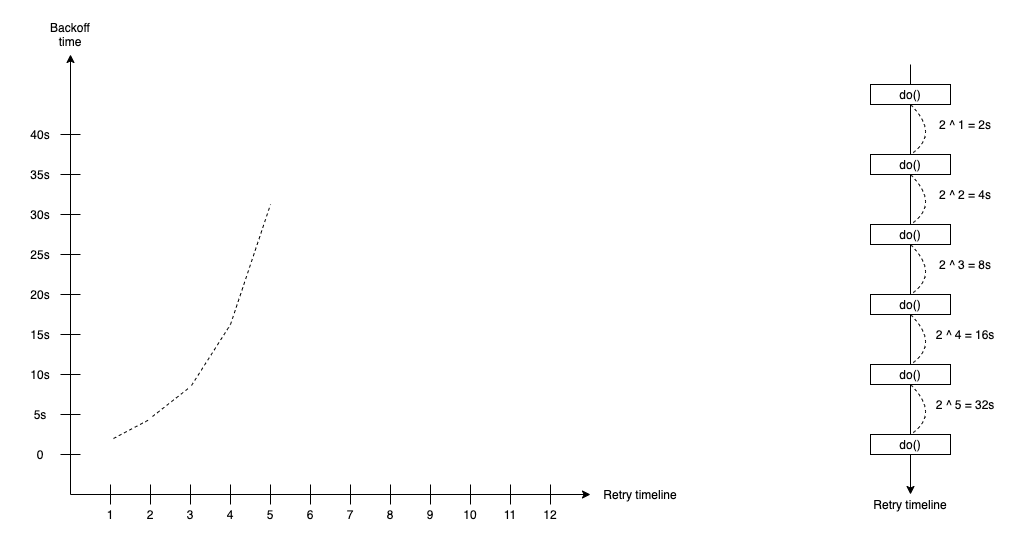
The key parameters you'll typically configure are:
- Initial Delay: The wait time before the very first retry.
- Backoff Factor: The multiplier for the delay (e.g., a factor of 2 doubles the delay each time).
- Max Retries: The total number of attempts before giving up.
- Max Delay: A ceiling on the wait time to prevent excessively long waits.
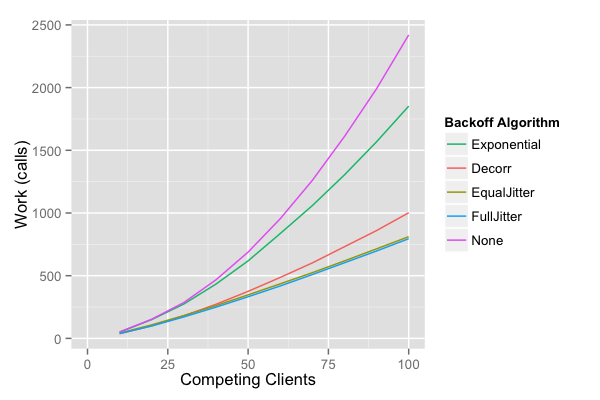
Even with exponential backoff, if many clients start retrying at the same time, their retries can become synchronized, causing periodic spikes in traffic. To solve this, we add jitter, which is a small amount of random time added to each backoff delay. This spreads out the retry attempts from multiple clients, smoothing out the load on the service.
3. Implementing Retries in Agent Development Kits
Now, let's see how Agent Development Kits (ADKs) help us implement these patterns. Instead of writing retry logic from scratch for every tool call, ADKs provide high-level abstractions to handle this automatically.
A. The Middleware Approach: LangChain
LangChain, and by extension LangGraph, often handles cross-cutting concerns like retries using middleware. This is a component that wraps around a tool call, intercepts potential failures, and applies the retry logic before the failure is passed back to the agent.
Production-Ready Agents: Automatic Tool Retries with Exponential Backoff
This short video from LangChain demonstrates their ToolRetry middleware. It's a perfect example of how a framework can abstract away the complexity of retry logic.
Watch the entire video. Pay close attention to the configuration parameters for the middleware, such as maxRetries, backoffFactor, initialDelay, and jitter. Notice how they map directly to the concepts we just discussed.
As you saw, you can configure the middleware to:
- Retry all tools or only a specific list of tools.
- Retry only on specific error types (e.g.,
NetworkErrorbut notInvalidInputError). - Define the exponential backoff and jitter parameters.
- Provide callback functions for logging or handling the final failure after all retries are exhausted.
This middleware approach is powerful because it's declarative and separates the concern of reliability from the core agent logic.
Test your understanding!
You are using a LangChain agent with a tool that queries a stock price API. The API is known to sometimes return a 503 Service Unavailable error during high market volatility. You want to configure a retry mechanism with the following behavior:
- It should attempt the call a total of 4 times (1 initial call + 3 retries).
- The first retry should happen after 200ms.
- The delay should double for each subsequent retry.
- The maximum delay should be capped at 1 second.
What values would you set for maxRetries, initialDelay, backoffFactor, and maxDelay? What would the approximate sequence of delays be?
Show answer
maxRetries: 3 (This is the number of retries after the initial failed attempt).initialDelay: 200 (in milliseconds).backoffFactor: 2.maxDelay: 1000 (in milliseconds).
The sequence of delays between attempts would be:
- Attempt 1: Fails.
- Wait ~200ms.
- Attempt 2 (Retry 1): Fails.
- Wait ~400ms (200 * 2^1).
- Attempt 3 (Retry 2): Fails.
- Wait ~800ms (200 * 2^2).
- Attempt 4 (Retry 3): Fails.
- The mechanism gives up and reports the failure.
The next delay would have been 1600ms, but it would be capped at 1000ms if more retries were allowed.
B. The Manual Loop Approach: Google's ADK
Google's ADK, being more foundational, provides the building blocks to implement this logic yourself within its core run_live() event loop. This gives you more explicit control at the cost of being less declarative than a middleware approach.
The documentation shows a clear pattern for handling retryable errors like RESOURCE_EXHAUSTED (rate limiting).
Part 3: Event handling with run_live()
Let's examine the Google ADK documentation for handling errors. We will focus on the specific example for implementing retries with backoff.
Read the section titled 'Scenario 4: Rate Limit with Retry Logic'. This contains a code snippet demonstrating how to use a retry_count and asyncio.sleep() to create an exponential backoff loop. Then, review the 'Decision Framework' and 'Error Code Reference' tables. These are crucial for deciding which errors are transient and thus safe to retry.
The key takeaway from the Google ADK approach is the importance of inspecting the event.error_code. Your logic must distinguish between:
- Terminal Errors:
SAFETY,MAX_TOKENS,PROHIBITED_CONTENT. Retrying these is pointless; the request will never succeed. You shouldbreakthe loop. - Transient Errors:
RESOURCE_EXHAUSTED,UNAVAILABLE,DEADLINE_EXCEEDED. These are candidates for a retry strategy. You shouldcontinuethe loop after a delay.
Furthermore, many well-designed tools built for ADKs, like the Firecrawl tool for web scraping, come with retry logic built-in and configurable via environment variables (e.g., FIRECRAWL_RETRY_MAX_ATTEMPTS, FIRECRAWL_RETRY_BACKOFF_FACTOR). This shows that handling transient failures is a recognized best practice throughout the agent ecosystem.
Conclusion
You've now learned how to make your agents significantly more robust by implementing one of the most critical patterns for production reliability. By automatically handling transient tool failures, you prevent minor, temporary issues from derailing an entire agent task, leading to better performance, lower costs (fewer failed runs), and a more resilient system.
Key Takeaways:
- Transient failures are temporary and common when dealing with networked services.
- The retry pattern is the standard solution, but simple, rapid retries can harm a system.
- Exponential backoff with jitter is the industry-standard algorithm to give services time to recover and prevent synchronized retries.
- ADKs abstract this complexity:
- LangChain uses a declarative middleware approach.
- Google's ADK encourages an explicit implementation within the event loop, requiring you to inspect error codes.
- It is critical to only retry transient errors. Retrying terminal errors is wasteful and can hide underlying bugs.
In this lesson, we handled failures that can be resolved automatically. But what about failures that can't? What happens when all retries are exhausted, or the agent gets stuck in a way it can't fix on its own? In our next lesson, we will address this by learning how to design and implement a human-in-the-loop fallback mechanism for critical agent errors.