Hello! In our last lesson, you got hands-on experience orchestrating a multi-step workflow using Google ADK's SequentialAgent and LoopAgent. You successfully built a system where specialized agents collaborate to complete a complex task.
This lesson takes a step back from the implementation details to address a more fundamental, strategic question: Why bother with multiple agents at all? We will explore the motivations and trade-offs that lead developers to choose a multi-agent architecture over a simpler, single-agent design. This directly addresses your goal of understanding the "why" behind industry practices.
By the end of this lesson, you will be able to explain when and why to use multiple agents instead of a single agent, a crucial consideration for designing robust and scalable AI systems.
1. The Scaling Problem: Limitations of a Single Agent
A single, all-powerful agent is an appealingly simple concept. You give it a complex prompt, a set of tools, and let it work. This approach is effective for straightforward tasks, but it begins to break down as complexity increases. As a software engineer, you can think of this as the "monolith" problem in an agentic context.
The following video from LangChain offers a concise explanation of the common failure points for single-agent systems.
Conceptual Guide: Multi Agent Architectures
This video, 'Conceptual Guide: Multi Agent Architectures', clearly outlines the practical limitations of single-agent designs.
Watch the segment from 00:00:34 to 00:01:55. Pay close attention to the three main downsides discussed, as they are the primary drivers for adopting a multi-agent approach.
As the video highlights, there are three key challenges that push us towards a multi-agent architecture:
-
Tool Overload: When a single agent is given too many tools, its ability to choose the correct one degrades. The LLM's reasoning gets "confused" by the abundance of choices. The video's anecdotal sweet spot of 5-10 tools is a useful heuristic. Trying to make one agent a master of database queries, web searches, file I/O, and calendar management simultaneously often leads to poor performance.
-
Context Window Complexity: Each tool call, observation, and thought process adds to the agent's "scratchpad" or history. In a long and complex task, this context can grow so large and noisy that it exceeds the LLM's context window or, more subtly, overwhelms its ability to find the relevant "signal" in the "noise."
-
Lack of Specialization: A single, monolithic prompt trying to define multiple expert personas (e.g., "You are a brilliant researcher, an expert coder, and a witty copywriter") is often less effective than using separate agents, each with a highly focused and optimized prompt for a single skill. This aligns with the single-responsibility principle in software design.
2. The "Why": Core Benefits of Multi-Agent Systems
If a single agent is a monolith, a multi-agent system is analogous to a microservices architecture. By breaking down a large problem into smaller, collaborative tasks, you gain significant advantages in modularity, performance, and control.

Let's explore the primary benefits of this approach.
Conceptual Guide: Multi Agent Architectures
We'll return to the same LangChain video to hear about the direct benefits of adopting a multi-agent design.
Now, watch from 00:01:55 to 00:02:33. This short clip summarizes the 'why' behind multi-agent systems.
The video summarizes the benefits as follows:
- Modularity: Each agent is a self-contained component with a specific job. This makes the system easier to design, develop, test, and maintain. If the
researcheragent is underperforming, you can debug or replace it without touching thecoderorwriteragents. - Specialization: You can create "expert" agents fine-tuned for a particular domain. An agent designed solely for financial analysis can have a highly specific system prompt, few but relevant tools, and maybe even use a specialized model, leading to much higher quality results for its task.
- Control & Emergent Behavior: Frameworks like Google's ADK and LangGraph provide explicit control over how agents collaborate. This design allows for complex emergent behavior, where intelligent global outcomes arise from simple, local interactions between agents.
To formalize this, the following reading introduces the core ideas that make multi-agent systems powerful.
A Developer's Guide to Multi-Agent Systems with ADK
The article 'A Developer's Guide to Multi-Agent Systems with ADK' from the Google Cloud Blog provides a great conceptual foundation.
Read the first two sections of the article: 'What Is a Multi-Agent System?' and 'How ADK Supports Multi-Agent Systems'. Focus on the three key ideas: Decentralized Control, Local Views, and Emergent Behavior.
By combining specialized agents with well-defined communication channels and control flows, you can build systems that are more robust, scalable, and capable than any single agent could be.
3. Multi-Agent Systems in Practice: Real-World Use Cases
Theory is valuable, but seeing how these systems are applied in industry makes the concepts concrete. Let's look at some practical examples of problems that are well-suited for a multi-agent approach.
Multi-agent AI system in Google Cloud
This Google Cloud Architecture document, 'Multi-agent AI system in Google Cloud', outlines several excellent use cases that demonstrate the power of agent collaboration.
Read the 'Use cases' section. Pay particular attention to the Financial advisor and Research assistant examples. Notice how each complex task is broken down into a logical sequence of sub-tasks, each handled by a specialized agent.
Let's break down the two examples from the reading:
-
Research Assistant: This is a classic multi-agent pattern. Instead of one agent trying to do everything, the task is divided among:
- A
Planner agentto create the research plan. - A
Researcher agentto gather data. - An
Evaluator agentto critique the research (similar to thecriticin our last lesson). - A
Report composer agentto write the final output.
This structure provides a clear, maintainable workflow and leverages iterative refinement for higher quality.
- A
-
Financial Advisor: This demonstrates a sequential pipeline of specialized experts:
- A
Data retriever agentgets market data. - A
Financial analyzer agentidentifies patterns. - A
Stock recommender agentgenerates personalized advice. - A
Trade executor agentinteracts with the brokerage API.
Attempting this with a single agent would lead to severe tool overload and context complexity.
- A
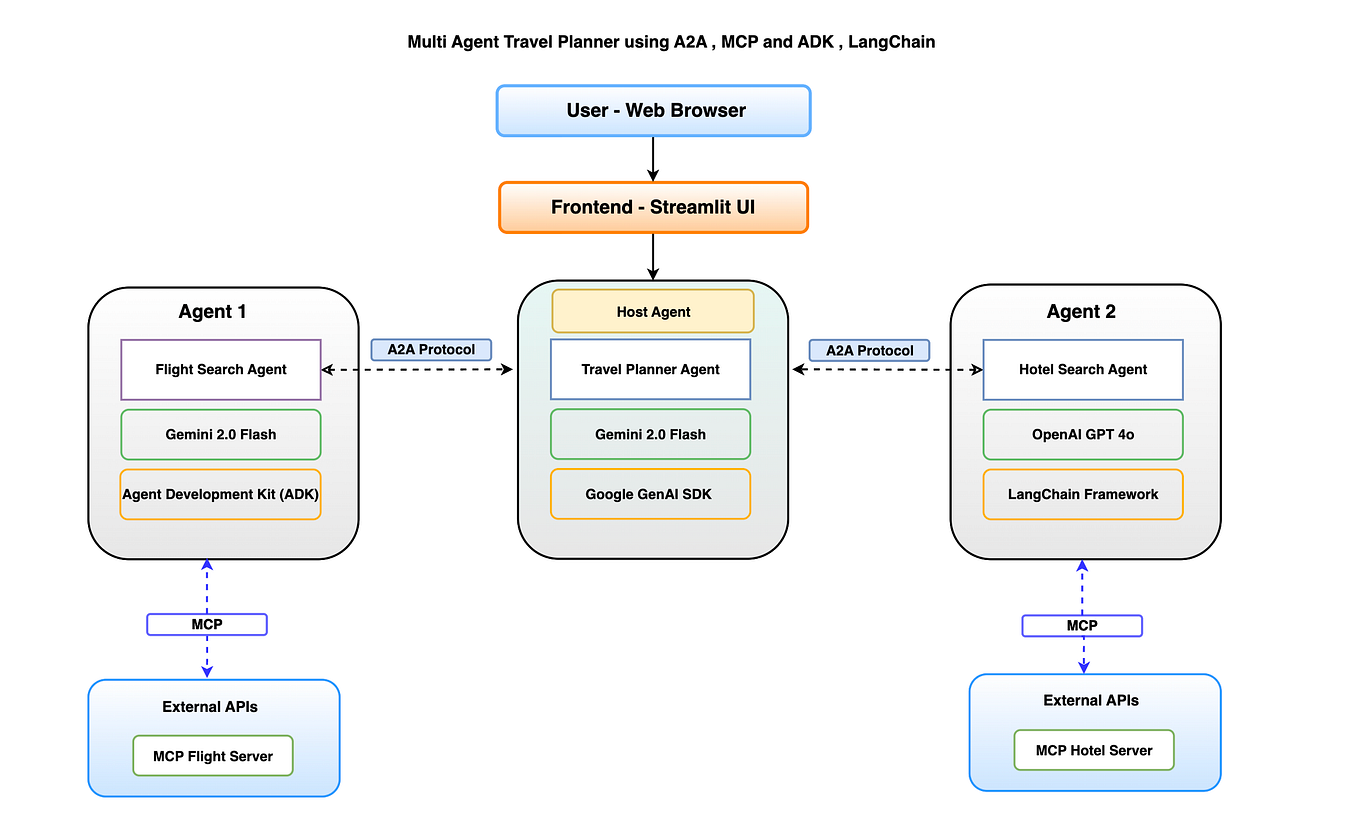
The following diagram of a multi-agent travel planner further illustrates this principle, showing how different agents, potentially built with different frameworks and models, can collaborate.
Test your understanding!
You are tasked with designing an automated system for a software development team. The goal is to take a user story (e.g., "As a user, I want to be able to reset my password") and produce a working code commit.
Would you use a single agent or a multi-agent system? Justify your answer by explaining why and outlining the potential specialized agents you would create.
Show answer
A multi-agent system is far more appropriate for this complex task. A single agent would struggle with the diverse skill sets required (planning, coding, testing, committing) and the iterative nature of software development.
Justification (The "Why"):
- Specialization: Writing code, writing tests, and analyzing requirements are distinct skills. Specialized agents will perform better than one generalist agent.
- Modularity & Maintainability: You can improve the
Code Testeragent's ability to find bugs without altering theCoderagent. - Control Flow: The process is naturally sequential and iterative, lending itself to a workflow orchestrator.
Potential Specialized Agents:
Requirements Analyst: An agent that clarifies the user story, asks clarifying questions if needed, and breaks it down into technical tasks.Coder Agent: Takes a technical task and writes the implementation code.Code Tester Agent: Writes unit tests for the code produced by theCoder Agent. It could also run the tests and report failures.Code Reviewer / Refactor Agent: An agent that reviews the code for quality, style, and bugs. If issues are found, it sends feedback to theCoder Agentto start an iterative refinement loop.Version Control Agent: Once the code is approved, this agent would handle creating a commit with an appropriate message and pushing it to the repository.
This structure mimics a real-world software team, leveraging specialization and collaboration to achieve a complex goal.
Conclusion
Today, we moved from the "how" to the "why" of multi-agent systems. You've learned that while a single agent can be effective, it has clear scaling limits. By embracing a multi-agent architecture, you can build more modular, specialized, and powerful AI systems.
Key Takeaways:
- When to use multiple agents: Choose a multi-agent system when your task involves (1) a large number of tools, (2) a long and complex context, or (3) requires multiple distinct areas of expertise.
- Why use multiple agents: The primary benefits are modularity (easier to build and maintain), specialization (better performance from expert agents), and enhanced control over the workflow.
- Divide and Conquer: The core principle is to break down a complex problem into simpler sub-tasks and assign each to a specialized agent, much like a microservices architecture in traditional software engineering.
In our next lesson, we will build upon this foundation by exploring common multi-agent patterns, such as hierarchical and collaborative broadcast designs. This will give you a vocabulary of architectural solutions for orchestrating your teams of agents.