Hello! Welcome to the next lesson in our journey through the world of Agent Development Kits (ADKs).
In the last lesson, we established a crucial conceptual foundation by identifying the three primary design philosophies for agent orchestration:
- Code-First, which feels like writing a script.
- Graph-Based, which is like drawing a map or flowchart.
- Conversational/Actor-Based, which resembles directing a team.
Today, we'll make this concrete. We'll take these abstract philosophies and map the industry's most popular tools to them. Our goal is to position LangChain/LangGraph, Google ADK, and Autogen within these design philosophies, comparing their core architectures and developer experiences. As a software engineer, this will equip you to see past the feature lists and evaluate these frameworks based on their fundamental architectural trade-offs.
Let's get started.
1. Google ADK: The Code-First, Enterprise-Ready Toolkit
Google's Agent Development Kit (ADK) is a prime example of the code-first philosophy. It's designed to feel intuitive to developers, leveraging familiar programming constructs like classes and functions to build agents. The mental model here is very much "writing a script."
To see this in practice, let's look at how you build an agent with ADK.
Getting started with Agent Development Kit
This video from Google for Developers, 'Getting started with Agent Development Kit', provides a concise look at ADK's structure. As you watch, notice how agent logic is defined using Python classes.
Please watch the following segments: Code Definition (02:33 - 04:00): Pay attention to how the YouTubeShortsAgent is defined as a class, and how it contains sub_agents which are also class instances. This is classic object-oriented programming. Workflow Agents (09:30 - 10:48): Observe how ADK provides pre-built Workflow agents like LoopAgent to orchestrate sub-agents in a deterministic way. This is analogous to using control flow statements in a traditional program.
As the video demonstrates, ADK's approach is rooted in familiar software engineering patterns. You build complex behavior by composing objects. This philosophy is further clarified in the strategic analysis provided by the "Architect's Guide" article we've looked at previously.
The Architect's Guide to Deep Research Agents
Let's revisit the 'The Architect's Guide to Deep Research Agents' to see how it positions ADK strategically. This will connect the code you just saw to the broader design philosophy.
Please read the two short sections: 'Google’s Agent Development Kit (ADK): Building with Enterprise Polish and GCP Integration' The 'Google ADK' bullet point under the heading 'Orchestration & Control: The Spectrum from Script to State Machine'. Focus on how it's described as a 'pragmatic middle ground' that balances predictability and flexibility.
Positioning of Google ADK:
- Philosophy: Code-First ("Writing a script").
- Core Idea: Use Python classes and functions to define and orchestrate agents. Offers both deterministic control (
SequentialAgent,ParallelAgent) and dynamic, LLM-driven routing (LlmAgentdelegating to sub-agents). - Best For: Enterprise teams, especially those in the Google Cloud ecosystem, who value a familiar development paradigm for building reliable and testable agents.
2. LangGraph: The Graph-Based, Control-Oriented Framework
LangGraph perfectly embodies the graph-based philosophy. It was created by the LangChain team specifically to handle the complex, cyclical, and stateful workflows that simple linear chains couldn't manage. The mental model is "drawing a map" or a state machine diagram.
Here, you explicitly define the agent's logic as a graph of nodes (computational steps) and edges (transitions), with a shared state object that persists throughout the run. This provides ultimate control over the execution flow.
Google ADK vs LangGraph: Which One Develops and ...
The ZenML article, 'Google ADK vs LangGraph', offers an excellent technical breakdown of LangGraph's orchestration model. It contrasts it sharply with ADK's approach.
Please read the section 'Feature 1. Orchestration Model', focusing on the 'LangGraph' subsection. Pay close attention to the three core components: State, Nodes, and Edges. This is the fundamental grammar of the graph-based paradigm.
The key takeaway is that LangGraph gives you the power to build loops for self-correction, branches for conditional tool use, and entry points for human-in-the-loop oversight with surgical precision.
Positioning of LangGraph:
- Philosophy: Graph-Based ("Drawing a map").
- Core Idea: Model agent logic as a state machine with nodes, edges, and a persistent state object. This allows for explicit control over complex, non-linear, and cyclical workflows.
- Best For: Developers who need granular control to build highly custom and observable agentic systems. It's ideal for tasks involving iteration, self-correction, and complex decision-making, where platform independence is also a priority.
3. Autogen: The Conversational, Multi-Agent System
Microsoft's Autogen represents the conversational/actor-based philosophy. Instead of a single monolithic agent, you create a system of multiple, specialized agents that collaborate by exchanging messages. The workflow isn't rigidly scripted or mapped; it emerges from the conversation between the agents. The mental model here is "directing a team meeting."
Let's explore this idea through a comparative analysis video.
Which Agentic AI Framework to Pick? LangGraph vs. CrewAI vs. AutoGen
The video 'Which Agentic AI Framework to Pick?' provides a great overview of Autogen's core principles.
Please watch the segment on Autogen (01:33 - 05:43). Focus on the explanation of the 'actor framework,' where each agent has an inbox and communicates via messages. Notice how the developer's role shifts from defining control flow to defining the agents and their conversational rules.
In this paradigm, you define the "players" (e.g., a coder agent and a critic agent) and the rules of engagement (e.g., the conversation terminates when the code executes successfully). The framework then orchestrates the back-and-forth dialogue to achieve the goal.
Positioning of Autogen:
- Philosophy: Conversational / Actor-Based ("Directing a team").
- Core Idea: Orchestrate a collection of specialized agents that solve problems through message-passing and emergent collaboration.
- Best For: Problems that can be naturally decomposed into a team effort, such as complex research, content creation, or software development. It offers a high level of abstraction but can be less predictable and harder to debug than the other approaches.
Visualizing the Ecosystem
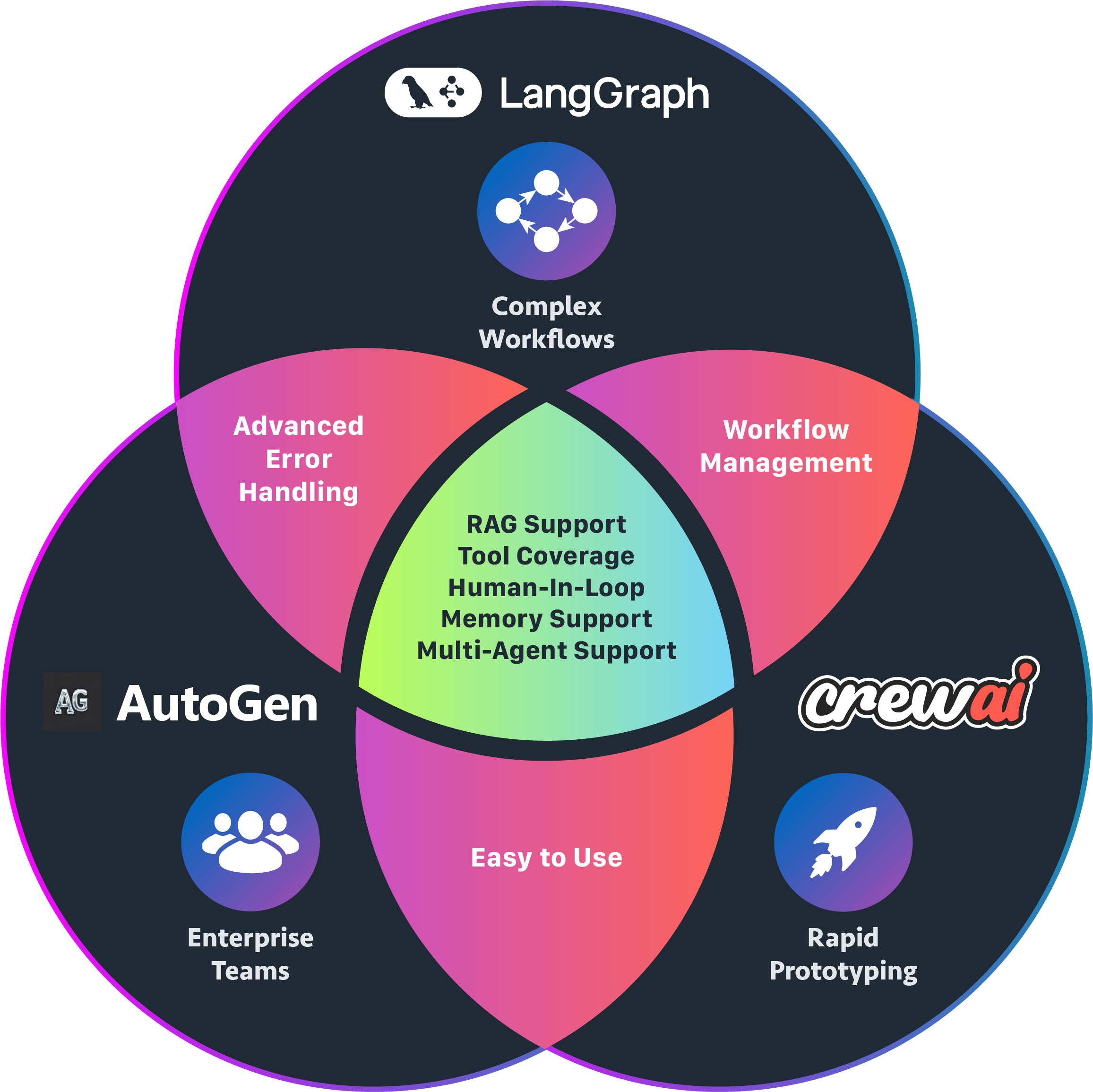
This Venn diagram provides a useful visual summary of how these frameworks (and the related CrewAI) compare in terms of their strengths and shared capabilities.
Test your understanding!
A financial services company wants to build an agent to automate parts of its quarterly earnings report. The process involves:
- An agent to pull financial data from internal databases (a
DataFetcher). - An agent to analyze the data and identify key trends (an
Analyst). - An agent to draft the narrative report based on the analysis (a
Writer). - A final human manager must approve the draft before it's finalized.
Based on the philosophies, which framework—Google ADK, LangGraph, or Autogen—seems like the most natural fit for orchestrating these components, and why?
Show answer
While you could argue for any of the frameworks, LangGraph is arguably the most natural fit here.
Why: The process is a stateful, multi-step workflow with a critical human-in-the-loop requirement.
- A graph-based approach allows you to explicitly model the flow: Node A (
DataFetcher) -> Node B (Analyst) -> Node C (Writer). - Crucially, after Node C, you can create a conditional edge that leads to a "human approval" node. The graph's execution can be paused at this node, awaiting input.
- If approved, the graph proceeds to a "finalize" node. If rejected, it could loop back to the
Writernode with feedback.
This level of explicit control, state management, and built-in support for pausing and resuming is the core strength of the graph-based philosophy embodied by LangGraph. While Autogen could model this as a conversation and ADK could script it, the explicit state transitions make LangGraph an ideal choice for such a structured and auditable process.
Conclusion: Making the Architectural Choice
You have now positioned the three major agent development frameworks within their core design philosophies. Understanding this mapping is the most critical step in choosing the right tool for your project.
Key Takeaways:
- Google ADK is your code-first choice for building enterprise-grade agents with familiar programming patterns, especially within the Google Cloud ecosystem.
- LangGraph is the quintessential graph-based framework, offering maximum control and observability for complex, stateful, and cyclical workflows where you need to define every step of the logic.
- Autogen exemplifies the conversational approach, providing a powerful, high-level abstraction for simulating multi-agent collaboration, where the workflow emerges from dialogue.
The decision between them is a fundamental architectural trade-off: do you need the familiarity of a script, the precise control of a map, or the emergent power of a team meeting?
In our next lesson, we will dive deeper into this decision-making process by identifying industry adoption patterns and analyzing which ADKs are being used in different real-world contexts. This will help you connect these architectural philosophies to practical, business-driven use cases.