Welcome to your next lesson in Swahili. Last time, we equipped you with the ability to ask fundamental questions using nani?, wapi?, and nini?. This was a major step towards turning one-sided introductions into genuine conversations.
Today, we will build on that foundation by adding the essential "social lubricant" of polite expressions. Your goal is to build rapport and trust with your Tanzanian colleagues, and mastering politeness is non-negotiable for that. We will focus on three indispensable words: tafadhali (please), pole (sorry for your misfortune), and samahani (excuse me/I'm sorry for my mistake). Understanding the distinct situations in which to use these words will significantly enhance the grace and effectiveness of your interactions.
1. The Language of Courtesy: An Overview
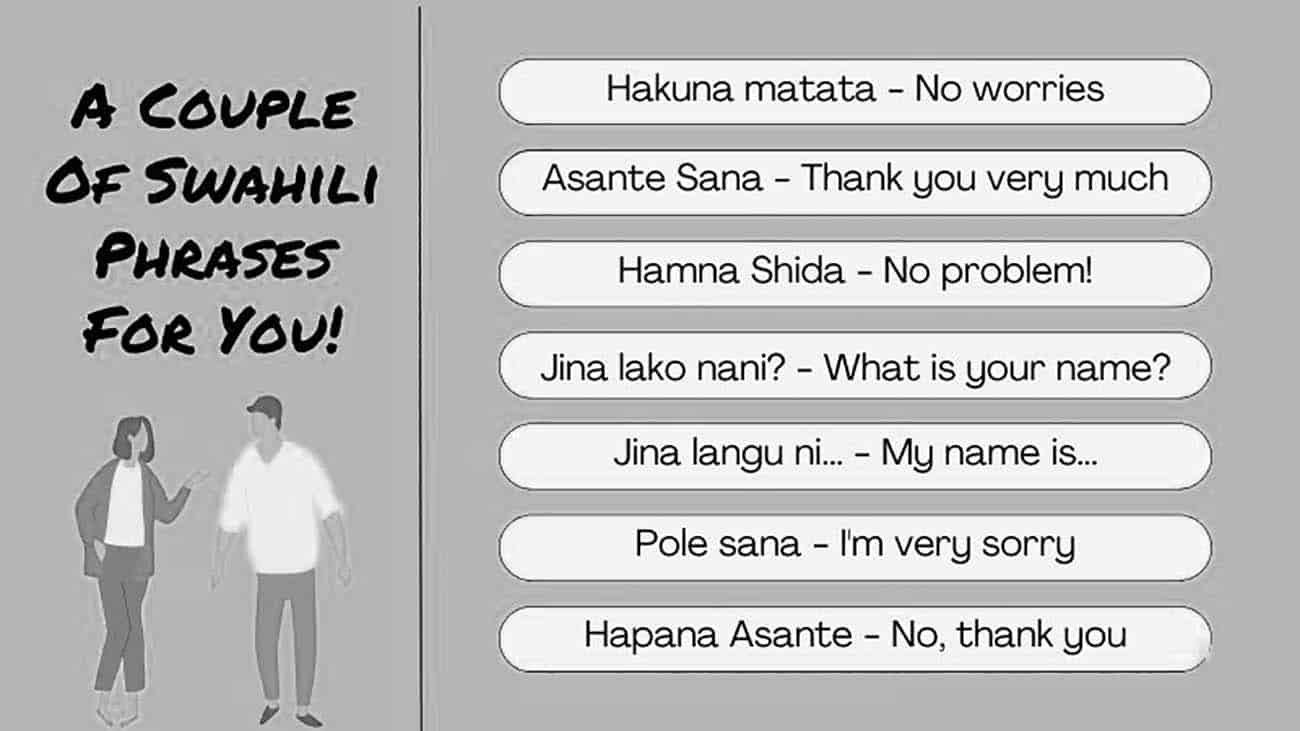
Before diving into the specifics of each word, it's helpful to see them in context. Many of these are expressions you've likely heard, but today we will focus on their precise usage. You already know asante sana (thank you very much) and the image below also includes pole sana (I'm very sorry), which we will explore in detail.
Let's begin with the most straightforward of these courteous words.
2. Making Polite Requests: Tafadhali (Please)
The word tafadhali translates directly to "please." It is used, as in English, to make a request more polite. You can place it at the beginning or end of a sentence. In a professional context, this is a crucial word for daily interactions.
Tafadhali, naomba ankara.(Please, I request the invoice.)Niletee ripoti, tafadhali.(Bring me the report, please.)
To hear the word pronounced correctly and used in various examples, please watch the following segment.
Ten(10) Most Polite Words in Swahili THAT YOU MUST KNOW!
The presenter in "Kiswahili With Abdulkarim" provides a thorough explanation of tafadhali.
Watch the section explaining this word, from the introduction of 'tafadhali' to the example usimpige tafadhali (don't beat him, please). Notice how it can be used to ask for something or to ask someone not to do something.
3. The Critical Distinction: Pole vs. Samahani
This is one of the most common areas of confusion for learners, as both words can be translated as "sorry" in English. However, they are used in completely different contexts. The distinction is fundamental to showing social and emotional awareness.
Poleis used to express sympathy for someone else's misfortune. It's like saying, "I'm sorry that happened to you."Samahaniis used to apologize for your own mistake or to get someone's attention. It's like saying, "Excuse me" or "I'm sorry for what I did."
Let's break this down.
A. Pole: Expressing Sympathy
You say pole when you see someone in a difficult, inconvenient, or sad situation. It is an expression of empathy.
- If a colleague says they have a headache:
Pole. - If you hear a shipment has been delayed:
Pole kwa kuchelewa.(Sorry for the delay.) - If you see someone working hard or late:
Pole na kazi.(A very common and appreciated phrase, literally "Sorry with the work," meaning "I recognize you're working hard.")
The response to pole is typically asante (thank you), as the person is thanking you for your empathy.
How to be polite in Swahili | 10 polite swahili words
This short video from Millie Akuzuha provides a concise explanation of pole.
Watch the very brief segment from the introduction of 'Pole' to hear its pronunciation and a simple use case.
B. Samahani: Apologizing and Interrupting
You use samahani in two main situations:
-
To get attention or interrupt politely: This is the equivalent of "excuse me." It is essential in an office environment.
Samahani, naweza kuuliza swali?(Excuse me, may I ask a question?)Samahani, meneja yupo?(Excuse me, is the manager in?)
-
To apologize for a minor mistake you have made: This is the equivalent of "I'm sorry."
Samahani kwa kuchelewa.(I'm sorry for being late.)Samahani, sikusikia vizuri.(Sorry, I didn't hear you well.)
The following reading provides a clear and concise summary of the difference between pole, samahani, and tafadhali.
Learn Hardcore Swahili: Samahani, sifahamu anwani yako. - Sorry, I do not know your address.
This resource from Elon.io gives a clear, side-by-side definition of the three key polite words for this lesson.
Please read the first question and answer, "What does the word Samahani mean...". This directly contrasts the uses of Samahani, Tafadhali, and Pole.
4. Cultural Insights and Deeper Understanding
Using these words correctly goes beyond grammar; it touches on cultural values of empathy and respect, which is central to your goal of building strong relationships. To deepen your understanding, the following article explores these nuances in detail.
Pole vs. Samahani - Sorry vs. Excuse me in Swahili
This article from Talkpal AI is an excellent guide to the nuances of these important words.
Please read through the article, starting from the introduction. Pay special attention to the sections detailing the usage of Pole and Samahani. Crucially, study the sections on Comparing Pole and Samahani and the vital Cultural Insights, which explain how these words reflect the values of empathy and respect in East African communities.
5. Practical Scenarios
Let's test your understanding. For each scenario below, decide if you would use Pole or Samahani.
| Scenario | Correct Expression |
|---|---|
| 1. You need to walk past a colleague in a narrow hallway. | Samahani |
| 2. A team member tells you their child is sick. | Pole |
| 3. You arrive five minutes late for a meeting. | Samahani |
| 4. You see your accountant working late to finish a report. | Pole na kazi |
| 5. You accidentally bump into someone, causing them to drop a file. | Both could work here. Samahani for bumping them, followed by Pole for their misfortune of dropping the file. This shows great social fluency. |
Conclusion
Mastering the use of tafadhali, pole, and samahani is a significant step toward communicating with sensitivity and respect. These are not just words but tools for navigating the social and professional landscape in Tanzania.
Key Takeaways:
Tafadhaliis "please," used for polite requests.Poleexpresses sympathy for another person's misfortune. It is about them.Samahaniis used to apologize for your own minor mistake or to politely get attention. It is about you and your actions.
Your effort to use these terms correctly will be noticed and appreciated, directly contributing to your goal of building strong, trust-based relationships.
In our next lesson, we will complete our foundational set of conversational tools by learning appropriate leave-taking phrases like kwaheri and tutaonana, ensuring you can begin and end your interactions with grace.