Hello! Welcome to your next lesson in the design of high-field magnets.
In our last session, we derived the magnetic diffusion equation, , and saw how it governs the penetration of a magnetic field into a conductor over a characteristic time . We learned that a conductor can shield its interior from a changing external field, but this shielding is not perfect and decays over time.
Today, we will build directly on that foundation to address the learning outcome: Estimate the skin depth for various conductors and frequencies to understand its impact on current distribution in pulsed operation. We will focus on the behavior of alternating currents (AC), which are the building blocks of any time-varying pulse. You will learn why, at high frequencies, current refuses to flow through the bulk of a conductor and instead "clings" to its surface. This phenomenon, known as the skin effect, is critically important in pulsed magnets. It increases the effective resistance of the coil windings, leading to greater heat generation, and concentrates mechanical forces on the conductor's surface.
1. The Physics of the Skin Effect
The skin effect is another consequence of Faraday's Law of Induction, the same physics that drives eddy currents. When an alternating current flows through a conductor, it generates an alternating magnetic field that permeates the conductor itself.
- This changing magnetic flux induces eddy currents that circulate within the conductor.
- According to Lenz's Law, these eddy currents flow in a direction that opposes the change in the main current's flux.
- In the center of the conductor, the eddy currents flow against the main current, reducing the net current flow there.
- Near the surface of the conductor, the eddy currents loop back around and flow with the main current, reinforcing it.
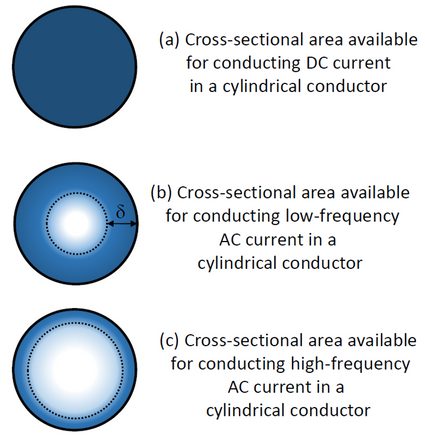
The net result is a redistribution of the total current, with a higher current density near the surface and a lower current density in the core.
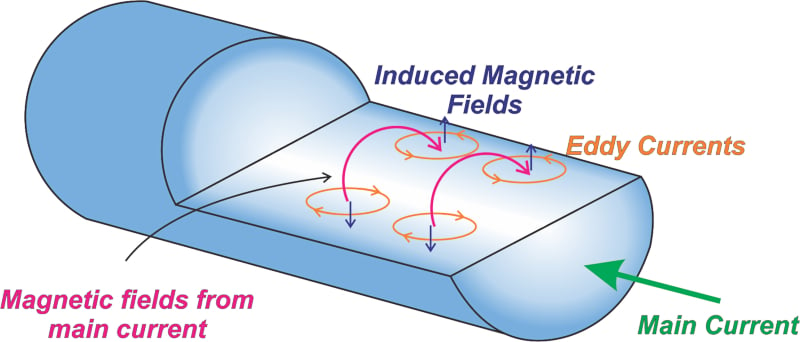
The strength of this effect is frequency-dependent. Higher frequencies mean a faster rate of change of magnetic flux (), which induces stronger eddy currents and pushes the main current more forcefully to the surface.
The following video provides an excellent visualization of this process and introduces the concept of skin depth.
Skin Effect Visualized - Physics Behind Induction Heating
This video from MHD Technology Laboratory uses numerical simulations to visualize how increasing the frequency of an AC current pushes the magnetic field and current towards the conductor's surface.
Please watch from the beginning to 05:31. Pay attention to: The connection between Faraday's law and induced currents (01:20). The animation showing the magnetic field being expelled from the conductor as frequency increases (03:03). The definition of skin depth, \delta, as the distance over which the field decays exponentially (04:16).
2. Deriving the Skin Depth Formula
We can make this concept quantitative by solving the magnetic diffusion equation for a sinusoidal field. Let's consider a simple case: a semi-infinite conductor occupying the space , with a sinusoidal magnetic field propagating into it.
To find the relationship between the wave number and the frequency , we will follow the rigorous derivation provided in David Tong's lecture notes on electromagnetism, which should be familiar from your advanced E&M coursework.
These notes provide a concise and elegant derivation of the skin depth formula directly from Maxwell's equations in the low-frequency limit, which is appropriate for our purposes.
Please read the subsection 'Low Frequencies' on page 208. The derivation starts by considering the effective dielectric constant and ends by defining the skin depth \delta. Follow the steps that lead from the dispersion relation to the final formula for \delta.
As you read, the key steps are:
- Start with the magnetic diffusion equation we saw last lesson, but written in the frequency domain: .
- For a plane wave varying only in , this becomes a simple ordinary differential equation: .
- The solution that decays as is of the form , where .
- Solving for gives .
- The field inside the conductor is therefore , where the real part gives the physical field. The amplitude decays exponentially as .
The skin depth, , is defined as the distance over which the field (and current) amplitude decays to (about 37%) of its surface value. From the derivation, we arrive at the formula:
where:
- is the angular frequency of the current.
- is the magnetic permeability of the conductor (for copper, ).
- is the electrical conductivity (and is the resistivity).
This formula confirms our intuition: higher frequency or higher conductivity leads to a smaller skin depth .
3. Calculating Skin Depth for Pulsed Magnets
A current pulse is not a perfect sine wave, but we can approximate its "effective" frequency to estimate the skin depth. For a sinusoidal pulse of duration (e.g., 10 ms), the fundamental angular frequency is .
Let's calculate the skin depth for a copper conductor, which is a common material for pulsed coils.
- Resistivity of copper at room temp ( K):
- Permeability:
Case 1: 10 ms pulse (typical "short pulse")
- Effective frequency: Hz, so rad/s.
- Skin depth:
Case 2: 100 ms pulse (typical "long pulse")
- Effective frequency: Hz, so rad/s.
- Skin depth:
These numbers are significant. The conductors used in pulsed magnets often have a thickness on the order of several millimeters to a centimeter. For a 10 ms pulse, the skin depth is comparable to the conductor size, meaning the current distribution will be noticeably non-uniform.
The Critical Effect of Temperature
Pulsed magnets are often pre-cooled with liquid nitrogen to 77 K to reduce their initial resistance. The resistivity of high-purity copper drops dramatically at this temperature. For OFHC (Oxygen-Free High-Conductivity) copper, the resistivity at 77 K can be roughly .
Let's re-calculate for the 10 ms pulse at 77 K:
Cooling the coil significantly reduces the skin depth, concentrating the current even more tightly at the surface.
Test your understanding!
A high-strength copper-silver (CuAg) alloy is another common conductor for pulsed magnets. Its resistivity at 77 K is higher than that of pure copper, around . Would using CuAg instead of pure OFHC copper increase or decrease the skin depth during a 10 ms pulse at 77 K? Calculate the value to confirm.
Show answer
Since skin depth , a higher resistivity will lead to a larger skin depth. The skin effect will be less pronounced in CuAg than in pure copper at the same temperature.
Calculation:
This is more than double the skin depth of pure copper at 77 K, meaning the current will be more uniformly distributed in the CuAg conductor. This is one of the trade-offs in material selection.
4. Impact on Magnet Design and a More Rigorous View
The skin effect has three profound consequences for pulsed magnet design:
- Increased Effective Resistance: By forcing the current into a smaller cross-sectional area (), the AC resistance of the conductor becomes much higher than its DC resistance. This leads to significantly more Joule heating () than a simple DC calculation would predict.
- Non-uniform Heating: Since the current density is highest at the surface, heating is also concentrated there. This creates temperature gradients within the conductor, which can lead to thermal stresses.
- Non-uniform Forces: The Lorentz force density () is highest where the current density is highest. This means the mechanical load is not borne uniformly by the conductor but is concentrated on its surfaces, which must be strong enough to withstand it.
Our sinusoidal approximation is a powerful tool for estimation, but a real current pulse is a transient event, not a steady-state sine wave. For a more rigorous analysis, one must solve the time-dependent magnetic diffusion equation for the specific pulse shape.
ANALYTICAL SKIN EFFECT MODELS IN ELECTRICAL ...
The following textbook chapter provides a more advanced look at how fields and currents distribute in a conductor following an impulse excitation, moving beyond the steady-state sinusoidal approximation.
Please read the first two pages of Chapter 3, 'Current displacement in non-ferromagnetic conductors due to impulse excitation' (pages 157-159). Focus on how the problem is set up for a time-varying excitation and notice that the solution for a 'sudden switch-on' (a step function) involves the error function, erf(z), which is characteristic of diffusion problems. This demonstrates the transient nature of the field penetration.
This more advanced treatment confirms that field and current penetration is a diffusive process. A useful rule of thumb for the penetration depth of a field after a time has elapsed is . For a pulse of duration , setting gives a characteristic length scale that is functionally equivalent to the skin depth we derived, reinforcing the validity of our estimation.
Conclusion
Key Takeaways:
- The skin effect is the tendency of AC current to concentrate near the surface of a conductor, caused by opposing eddy currents induced in the conductor's core.
- The skin depth, , is the characteristic distance over which the current density drops to of its surface value. It is given by .
- Skin depth depends inversely on the square root of frequency and conductivity. For pulsed magnets, this means shorter pulses and lower temperatures (higher conductivity) lead to a more pronounced skin effect.
- This effect is not a minor correction; it fundamentally alters the magnet's thermal and mechanical behavior by increasing effective resistance and concentrating heating and forces at the conductor's surface.
Next Lesson Preview:
Now that we have a better understanding of how current distributes itself within a magnet's windings, our next step is to calculate the immense forces this current generates. In the next lesson, we will derive the Maxwell stress tensor, a powerful mathematical tool that allows us to compute electromagnetic forces, such as the immense outward pressure that a high-field magnet exerts on itself.