Hello. In this final module, the task shifts from explaining an AQI number to using it responsibly. This lesson focuses on a practical decision: given a reported air-quality category, what change to an outdoor activity would reduce exposure without treating every outing as equally risky? The examples use U.S. AQI guidance; another reporting system may use different categories or advice.
What an AQI can—and cannot—tell you
An outdoor AQI describes a level of population health concern. It does not measure how much pollution you personally inhale. Two people seeing the same reported value may breathe different amounts of polluted air because one is exercising for an hour and the other is walking briefly. They may also differ in susceptibility.
Start with the pollutant behind the number. An overall AQI can be driven by particle pollution on one day and ozone on another, and their sensitive groups and activity guidance are not identical. The U.S. Environmental Protection Agency (EPA) explains why its categories are useful while cautioning against interpreting them as individual guarantees.
Patient Exposure and the Air Quality Index | US EPA
Read the EPA's explanation of the AQI as a health-communication tool, paying particular attention to its discussion of sensitive groups and exertion.
Under “What is the Air Quality Index (AQI)?”, read from the paragraph beginning “The AQI focuses on health effects” through the discussion of exertion that ends “will reduce the inhaled dose and help protect against the harmful effects of particle pollution.” The relevant passage explains both why categories signal increasing concern and why fitness does not eliminate the value of reducing exertion.
A category boundary is a guide to action, not a line separating harmless from harmful air. The EPA notes that, for particles, health effects do not appear to begin at one universal threshold. Conversely, a higher category does not mean that everyone will develop symptoms. Use the category to choose a precaution, then account for the person and the activity.
Read particle-pollution advice as a graduated response
The EPA’s particle-pollution guide makes the progression visible. Its numbers are U.S. AQI category ranges, not PM2.5 concentrations; do not read “101” as a mass-per-volume measurement. Use the chart for its activity guidance, not as a current table for converting a concentration into an AQI.
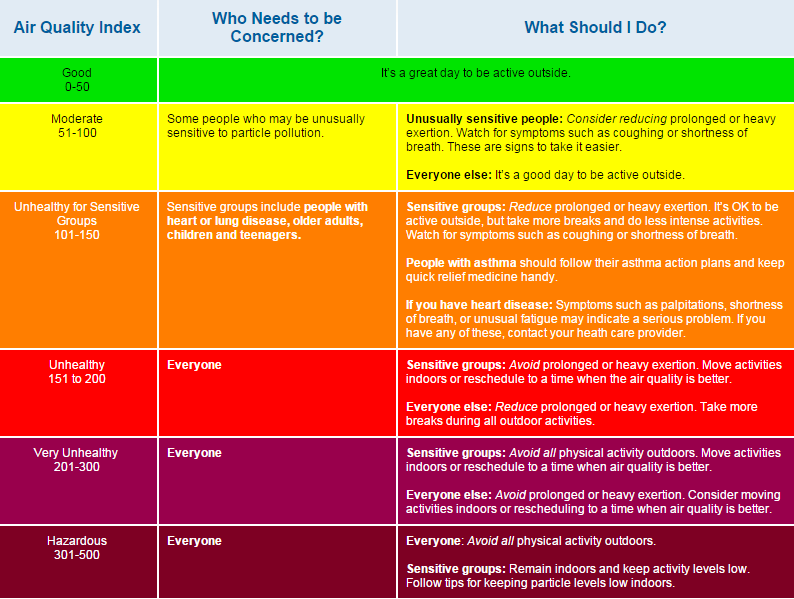
At Good (0–50), the guide places no special restriction on outdoor activity. At Moderate (51–100), most people can remain active, while someone unusually sensitive to particle pollution may consider reducing prolonged or heavy exertion. At Unhealthy for Sensitive Groups (101–150), people with heart or lung disease, older adults, children, and teenagers are advised to reduce prolonged or heavy exertion. “Reduce” leaves room for a shorter, gentler activity; it does not automatically mean staying indoors all day.
At Unhealthy (151–200), those sensitive groups should avoid prolonged or heavy exertion, while everyone else should reduce it. At Very Unhealthy (201–300), sensitive groups should avoid all outdoor physical activity; everyone else should avoid prolonged or heavy exertion and consider moving activity indoors or rescheduling it. At Hazardous (301–500), the guide advises everyone to avoid outdoor physical activity, with sensitive groups remaining indoors and keeping activity levels low.
The verbs matter: consider reducing, reduce, and avoid call for different decisions. So does the phrase “sensitive group”: it describes a greater likelihood of harm, not a prediction that every member will have symptoms.
Duration and effort change the amount inhaled
“Prolonged” and “heavy” refer to different features of an activity. Several hours of intermittent yardwork can be prolonged even if it is not vigorous. A hard run can be heavy exertion even if it is shorter. The AirNow guide supplies these distinctions before its pollutant-specific advice.
A Guide to Air Quality and Your Health - AirNow.gov
Read AirNow’s definitions so that the activity words in the guidance translate into concrete choices.
On p. 4, under “How can I avoid being exposed to unhealthy air?”, locate the two bullets beginning “Prolonged exertion” and “Heavy exertion.” Read both definitions, including the yardwork and jog examples. Stop after the suggestion to substitute a less intense activity.
There is a physical reason to adjust both time and intensity. In a simplified situation where concentration and breathing rate stay constant, the amount of pollution inhaled is approximately
A harder activity usually increases the amount of air breathed per minute; a longer activity adds more minutes. Neither change requires the outdoor AQI number itself to change. This is an approximation of inhaled amount, not a calculation of personal health risk or of the particles retained in the lungs.
Patient Exposure and the Air Quality Index | US EPA
Return to the EPA page for its explanation of how changing an activity can lower particle exposure.
Under “What can I advise my patients to do when the air quality is unhealthy?”, start where the text discusses reducing time spent active outdoors. Read the exposure discussion through the warning about heart disease. Focus on the three adjustable factors: outdoor conditions, breathing rate during activity, and duration.
This gives you several proportionate options: shorten the outing, make it less strenuous, take more breaks, move it to a time or place with cleaner air, or move it indoors if indoor air is cleaner. The right option depends on the category and the person. For someone with heart disease, feeling fine is not proof that elevated particle pollution poses no risk; for someone with asthma, an existing asthma action plan remains important.
Put the guidance to work
Suppose a U.S. report shows a particle AQI of 128. For an adult without a known susceptibility, a brief, easy walk is not the same exposure decision as a vigorous, hour-long workout. The particle guide targets prolonged or heavy exertion for sensitive groups at this category. For a child with asthma scheduled for vigorous outdoor sport, reducing the intensity, shortening the session, or rescheduling it is consistent with that guidance; following the child’s asthma action plan remains important.
Now suppose the particle AQI is 175. A person without a known susceptibility planning heavy outdoor work can reduce the duration and effort, add breaks, or postpone the strenuous portion. Someone with heart or lung disease should avoid the prolonged or heavy exertion rather than merely pressing on with occasional breaks. A necessary short trip and an optional strenuous workout need not receive the same response.
Finally, at a particle AQI of 235, the chart calls for avoiding all outdoor physical activity for sensitive groups. That is substantially different from its advice at 128. For everyone else, prolonged or heavy outdoor exertion should be avoided, with indoor activity or rescheduling considered. These are category-based examples, not guarantees about any individual’s safety.
Before applying any of those examples, check the pollutant. The AirNow guide’s ozone table illustrates why an action should not be copied mechanically from the particle chart.
A Guide to Air Quality and Your Health - AirNow.gov
Compare ozone’s sensitive-group advice with the particle guidance you have just used.
On p. 6, under “How can I protect my health at different AQI values?”, find the table headed “Actions to Protect Your Health From Ozone.” Read the ozone action table from Good through Very Unhealthy. Focus on whom it names at AQI 101–150 and how its exertion advice changes at higher categories. Use its category advice for this comparison, not the brochure’s older concentration-to-AQI footnote.
For ozone at 101–150, the table calls out people with lung disease, children, older adults, and people active outdoors. The particle chart instead emphasizes people with heart or lung disease, children, and older adults. The overlap is substantial, but not complete. If a report gives an overall AQI, identify its driving pollutant before selecting pollutant-specific advice.
Symptoms are another reason to adjust an activity rather than rigidly following a number: unusual coughing, wheezing, chest discomfort, or breathing difficulty warrant taking it easier and reducing exposure. Serious or concerning symptoms warrant medical attention. General AQI guidance does not replace an individual care plan or applicable workplace safety requirements.
Key takeaways
Choose an action using four pieces of information together: the reporting system’s pollutant-specific guidance, the person’s susceptibility, the activity’s intensity, and its duration. An AQI category communicates concern; it neither measures a person’s inhaled dose nor guarantees safety below a cutoff. Often the proportionate response is to change how hard, how long, or when an activity occurs—not to treat all outdoor activity alike.
The next lesson uses the same attention to detail for a different purpose: diagnosing why two air-quality reports can disagree before judging either one unreliable.