In our previous lesson, we examined the brain's fundamental computational substrate: the GABA-glutamate balance. This E/I ratio provides the fast, precise "stop" and "go" signals that underpin all information processing. Today, we shift our focus back to the slower, more global systems that tune and modulate this substrate. We will dissect three critical modulatory systems: the cholinergic, the endogenous opioid, and the endocannabinoid systems.
Your goal is to describe these systems and their roles in pain, stress buffering, and homeostasis, but we will go further. For your work, it is essential to understand their distinct computational styles. Acetylcholine acts as a global state-setter, toggling the brain's operating mode. The opioid and endocannabinoid systems, in contrast, function more like on-demand, localized regulators. Understanding these different architectural approaches to modulation is fundamental to building a robust model of autonomic computation.
The Cholinergic System: The Spotlight of Attention and Plasticity
Acetylcholine (ACh) is a neurotransmitter of many hats. It acts at the neuromuscular junction to command muscle contraction, but its role in the central nervous system is as a powerful modulator of brain state. The core insight, which will serve as the load-bearing concept for this section, is that ACh reconfigures cortical circuits to enhance the processing of external sensory input while suppressing internal, recurrent activity. This makes it the master switch that toggles the brain between an "encoding" state (attending to the world) and a "consolidation" state (processing what's already known).
This function, however, presents apparent paradoxes at the cellular level. To frame the problem, we will start with a paper by Michael Hasselmo, whose computational work has been central to resolving these puzzles.
[PDF] High acetylcholine levels set circuit dynamics for attention and ...
This paper from Progress in Brain Research is an excellent example of using computational modeling to create a unifying framework from seemingly contradictory physiological data, an approach that aligns with your own. We will start with the introduction to understand the problem ACh presents.
Read the Introduction. Focus on the paradoxes highlighted by the authors: ACh simultaneously enhances pyramidal cell firing while suppressing the connections between them. Similarly, it depolarizes interneurons while suppressing the inhibitory signals they send. Note the central proposition: that a unifying theoretical framework is required to make sense of this.
Hasselmo's framework proposes that these disparate effects all serve a single computational goal: to increase the signal-to-noise ratio in favor of incoming, bottom-up information. Let's break down how.
A System in Two Modes: High vs. Low ACh
The cholinergic system, originating primarily from the basal forebrain, provides diffuse, "volume" transmission to the cortex. Its activity level isn't constant; it changes dramatically with behavioral state.
- High ACh State (Active Waking, Attention, Encoding): Levels are highest during active exploration of a novel environment or performance of a task requiring sustained attention.
- Low ACh State (Quiet Waking, Slow-Wave Sleep, Consolidation): Levels drop significantly during rest, consummatory behaviors, and deep sleep.
These two states correspond to two fundamentally different modes of brain function, orchestrated by ACh's specific physiological actions. The paper you just read provides an excellent, detailed account of the mechanisms.
[PDF] High acetylcholine levels set circuit dynamics for attention and ...
This next reading unpacks the core mechanisms of the cholinergic modulation framework. It is dense, but it contains the essential details for a mechanistic understanding.
Please read the following sections from the Hasselmo paper: "Acetylcholine enhances input relative to feedback" (p. 209): This short section presents the core theory. Understand that high ACh promotes feedforward input and suppresses feedback processing. "Acetylcholine enhances spiking response to afferent input" (p. 209): This explains the first half of the paradox. ACh directly depolarizes pyramidal cells and suppresses spike frequency accommodation, making them more responsive to incoming signals. "Cholinergic modulation of inhibitory interneurons..." (p. 211): This section addresses the second paradox. As the computational analysis in Figure 4 shows, the combination of depolarizing interneurons and suppressing their output serves to reduce background noise while enhancing the response to strong, relevant stimuli. "Acetylcholine selectively suppresses excitatory feedback..." (p. 212): This is the crucial counterpart. ACh specifically suppresses recurrent excitatory connections within a cortical area, but not the afferent, feedforward input to that area. This prevents previously stored memories from interfering with the encoding of new information. Behavioral Evidence (Attention & Encoding): Skim the sections titled "Acetylcholine and the enhancement of attention" and "Acetylcholine and the enhancement of encoding". You don't need to absorb every detail, but appreciate the breadth of evidence linking high ACh states to improved performance in attention and memory-encoding tasks. The key takeaway is that these are not separate functions; they are two behavioral consequences of the same underlying shift in circuit dynamics.
Vagal Regulation and Plasticity
The cholinergic system is also the final effector arm for a key part of the autonomic nervous system you are focused on: the vagus nerve. The parasympathetic influence of the vagus, particularly its ability to slow the heart, is mediated by ACh.
Andrew Huberman's podcast provides a clear, mechanistic overview of this pathway. We will use it to connect the abstract concept of cholinergic modulation to the concrete physiology of heart rate variability (HRV) and plasticity.
Control Your Vagus Nerve to Improve Mood, Alertness & Neuroplasticity
In this video, Andrew Huberman discusses the vagus nerve's various functions. We will focus on two specific segments that detail cholinergic mechanisms.
Vagal Control of Heart Rate: Watch the segment from this point, which details the motor pathway for heart rate deceleration. Pay close attention to the circuit: left dorsolateral prefrontal cortex → nucleus ambiguus → sinoatrial node. The key point is that the neurons from nucleus ambiguus release acetylcholine onto the heart's pacemaker to slow it down. This is the direct mechanism by which deliberate exhales increase parasympathetic tone and improve HRV. ACh as a Gate for Plasticity: Now, watch from here. This segment explains the role of ACh released from the nucleus basalis as being "permissive for plasticity." This is the cellular basis for why focused attention (a high-ACh state) is a prerequisite for adult neuroplasticity. When you are alert and focused on a task, ACh release effectively highlights the relevant synapses and makes them more susceptible to modification.
In summary, the cholinergic system is a master regulator. At a high level, it acts as a switch, toggling the brain into a state optimized for learning about the external world. At a low level, it achieves this by enhancing feedforward signals, suppressing recurrent signals, and directly enabling the synaptic changes that constitute memory.
Endogenous Regulators: Opioids and Endocannabinoids
We now turn to two systems that act less like global state-setters and more like on-demand, localized homeostatic agents: the endogenous opioid and endocannabinoid systems. They are the brain's internal toolkit for managing pain, buffering stress, and restoring balance.
The Endogenous Opioid System
This system comprises a family of neuropeptides—most famously endorphins, but also enkephalins and dynorphins—that bind to opioid receptors (mu, delta, kappa).
- Core Function: Analgesia and Reward. The primary and most well-known role of the opioid system is to suppress pain signals. It is the mechanism behind stress-induced analgesia and the "runner's high." This potent analgesic effect is coupled with powerful rewarding properties, which is why exogenous opioids (like morphine or heroin) that hijack this system have such a high potential for addiction.
- Stress Buffering: Beyond pain, the opioid system is a key part of the stress-response termination. Opioids are released during stress and act directly on the HPA axis to inhibit the release of CRH and ACTH, thereby providing a brake on the cortisol response. They blunt both the physical and emotional experience of stress.
The Endocannabinoid System (eCS)
The endocannabinoid system is arguably one of the most elegant regulatory architectures in the brain. Its components are distinct from classical neurotransmitters.
- Key Players: The primary signaling molecules are anandamide (from the Sanskrit word for "bliss") and 2-arachidonoylglycerol (2-AG). These are not stored in vesicles but are lipids synthesized "on demand" from the membrane of the postsynaptic neuron.
- The "Load-Bearing" Concept: Retrograde Signaling. This is the critical architectural feature of the eCS. Unlike nearly all other neurotransmission, it works backward. An active postsynaptic neuron synthesizes and releases endocannabinoids, which diffuse back across the synapse to bind to CB1 receptors located on the presynaptic terminal.
This unique mechanism is beautifully illustrated in the following diagram.
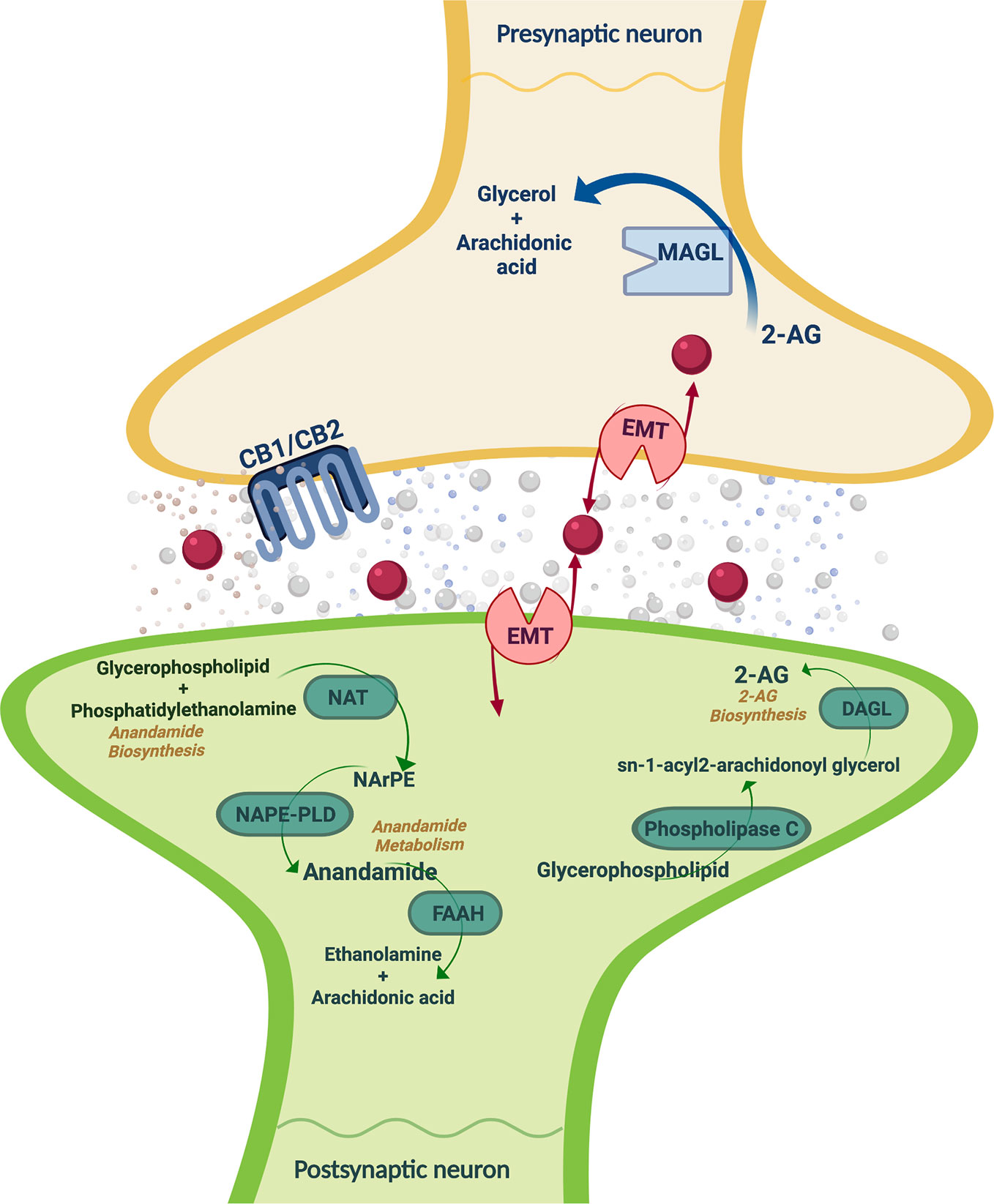
This retrograde signaling makes the eCS a highly localized, precise feedback system. It allows a neuron that is being strongly stimulated to tell its presynaptic partner to "quiet down." This "depolarization-induced suppression of inhibition" (or excitation) is a fundamental mechanism for maintaining synaptic homeostasis.
Functional Roles of the eCS:
- Homeostatic Regulation: The eCS is a master regulator of homeostasis, involved in appetite, sleep, mood, and metabolism. Its primary role is to bring circuits back to their baseline "set point" after a perturbation.
- Stress Recovery: The eCS is crucial for fear extinction and terminating the stress response. While the amygdala drives fear, endocannabinoid signaling within the amygdala helps to dampen that fear response once the threat has passed. It acts as a powerful brake on the HPA axis.
- Pain Modulation: Much like the opioid system, the eCS is deeply involved in analgesia by suppressing nociceptive signaling at multiple levels of the nervous system.
Conclusion
In this lesson, we have explored three distinct but vital modulatory systems that tune the brain's E/I balance to meet different functional demands.
Key Takeaways:
- The cholinergic system, driven by ACh, acts as a global state-setter. High ACh levels create an "encoding mode" by enhancing sensory input and suppressing internal feedback, which is critical for attention and enabling synaptic plasticity for memory. It also mediates the parasympathetic vagal regulation of the heart.
- The endogenous opioid system uses peptides like endorphins to provide powerful pain suppression (analgesia) and stress buffering, acting as a direct brake on the HPA axis.
- The endocannabinoid system (anandamide, 2-AG) is a unique homeostatic regulator that uses retrograde signaling. By acting backward on presynaptic CB1 receptors, it provides a localized, on-demand brake to fine-tune synaptic activity, terminate the stress response, and maintain circuit stability.
In our next lesson, we will continue this theme by exploring how these different neuromodulatory systems—dopamine, serotonin, norepinephrine, acetylcholine, and others—interact as a coupled network. A single-transmitter account of any complex state is insufficient; the brain's true operational logic lies in the dynamic interplay between these systems. We will examine how dopamine and serotonin act in opposition to regulate impulse control and mood, providing a more complete picture of the brain's chemical architecture.