Welcome to your first lesson on sequences and series. Your goal is to build a solid foundation for multivariable calculus, and understanding infinite series is a key part of that journey. Before we can tackle infinite sums (series), we first need to master the behavior of infinite lists of numbers, which are called sequences.
This lesson introduces the fundamental concepts of this topic. We will define what a sequence is, explore how to represent it mathematically, and, most importantly, investigate its long-term behavior. You will learn to describe whether a sequence's terms settle down to a specific value—a property called convergence—or if they do not, which is called divergence. The entire discussion will be framed using the concept of a limit, which should be familiar to you from your previous calculus studies.
What is a Sequence?
At its core, a sequence is simply an ordered list of numbers. Unlike a set, the order of elements in a sequence matters. For example, is a different sequence from . In this course, we'll be focused on infinite sequences.
To get a clear picture of what a sequence is, how it's represented, and its connection to functions, please watch the first part of the following video.
Intro to Sequences | Calculus, Real Analysis
This video from Wrath of Math provides an excellent introduction to the terminology and notation of sequences.
Please watch from the beginning until the end of the notation section. Focus on how a sequence can be thought of as a function whose domain is the positive integers and how we use notation like a_n to describe the general term.
As the video explained, we can define a sequence using an explicit formula, which gives the -th term directly as a function of . This is the most common way we'll encounter sequences.
To solidify these foundational ideas, let's turn to a more formal definition and some classic examples.
5.1 Sequences - Calculus Volume 2
This section from the OpenStax Calculus textbook provides a formal definition of a sequence and introduces two important types: arithmetic and geometric sequences.
Please read the subsection titled Terminology of Sequences. Pay attention to the distinction between an explicit formula and a recurrence relation.
Convergence and Divergence: The Limit of a Sequence
The most important question we can ask about an infinite sequence is: "What happens to the terms as gets very large?" Do they approach a single, finite value? Do they grow without bound? Or do they oscillate? The answer to this question determines whether the sequence converges or diverges.
The image below plots the first few terms of four different sequences. Look at the patterns and think about the long-term behavior of the terms as the index increases.
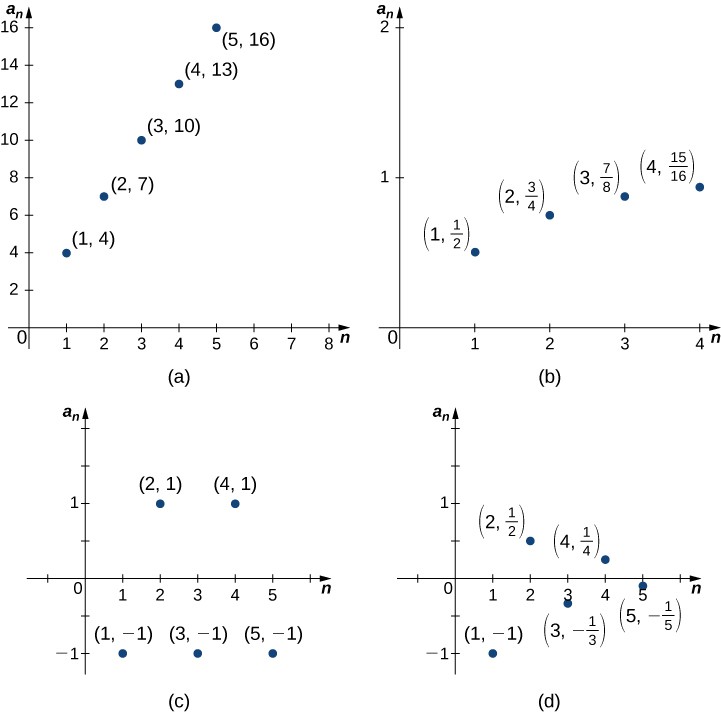
Let's analyze these plots:
- Graph (a): The terms are . The terms are consistently increasing and appear to grow infinitely large. This is an example of a sequence that diverges to infinity.
- Graph (b): The terms are . The terms are increasing, but they seem to be approaching the value 1. This is a convergent sequence, and its limit is 1.
- Graph (c): The terms alternate between -1 and 1. They never settle on a single value. This sequence diverges by oscillation.
- Graph (d): The terms alternate in sign, but their magnitudes get smaller: . The terms are getting closer and closer to 0 from both above and below. This is a convergent sequence with a limit of 0.
This intuitive idea is formalized using the concept of a limit.
The Working Definition of a Limit
We can state the definitions of convergence and divergence informally, in a way that builds directly on your knowledge of limits of functions.
Paul's Online Math Notes provides a very clear and practical "working definition" of sequence limits.
Please read the short subsections Working Definition of Limit and the definition of convergence/divergence. This will give you the essential terminology.
As you've just read, if the limit exists and is a finite number, the sequence converges. Otherwise, it diverges.
The Formal Definition of a Limit
The "working definition" is great for intuition, but for a rigorous mathematical foundation—which you've indicated you appreciate—we need the precise epsilon-N definition of a limit. This definition makes the phrase "arbitrarily close" mathematically exact. It states that for any small positive tolerance , we can find a point in the sequence (an index ) after which all terms are within of the limit .
The following video does an outstanding job of explaining this formal definition, including its graphical interpretation and a full proof for a classic example.
Definition of the Limit of a Sequence | Real Analysis
This video, also by Wrath of Math, is dedicated to unpacking the formal definition of the limit of a sequence.
Please watch the entire video. It covers: The intuitive idea of convergence using the sequence a_n = 1/n. Intro to convergence/divergence An explanation of "arbitrarily close" using a tolerance. The idea of tolerance The formal \epsilon-N definition and its graphical representation. Formal definition and graph A formal proof that the limit of 1/n is 0. Example proof
A Powerful Tool: Connecting Sequence Limits to Function Limits
The formal - definition is the bedrock of sequence convergence, but using it to prove every limit would be cumbersome. Fortunately, because a sequence can be seen as a function restricted to integer inputs, we can use our existing tools for finding limits of functions from single-variable calculus.
This is formalized in a simple but powerful theorem.
5.1 Sequences - Calculus Volume 2
This section presents the theorem that formally links the limit of a function to the limit of a sequence.
Read the section titled Limit of a Sequence Defined by a Function. The key takeaway is Theorem 5.1.
This theorem is incredibly useful. It means that to find the limit of a sequence like , you can simply find the limit of the function as , using familiar techniques—including, as we'll see in the next lesson, L'Hôpital's Rule.
Conclusion
In this lesson, we have laid the groundwork for our entire study of series. We have established a clear understanding of what a sequence is and what it means for a sequence to converge or diverge.
Here are the key takeaways:
- An infinite sequence is an ordered, infinite list of numbers, which can be thought of as a function with the domain of positive integers.
- A sequence converges to a finite limit if its terms get arbitrarily close to as approaches infinity. Otherwise, the sequence diverges.
- The formal definition of a limit, using and , gives us a rigorous way to define convergence.
- We can often evaluate the limit of a sequence by finding the limit of the corresponding continuous function as .
In our next lesson, we will build on this foundation by learning how to apply algebraic limit laws and L'Hôpital's Rule to efficiently calculate the limits of various sequences.