Hello! Welcome to the first lesson in our course on Instagram content strategy. I'm excited to get started and help you build a more systematic and algorithm-aware approach to your work.
Given your experience in content and engagement strategy, you're already skilled at creating content that resonates with an audience. Our goal here is to add a new layer to that expertise: a deep, mechanical understanding of how Instagram's systems decide who sees that content.
In this lesson, you'll learn to map Instagram's ranking signals across the Feed, Stories, Reels, and Explore page to inform your content format decisions. We'll move beyond the myth of a single, mysterious "algorithm" and instead break down the distinct logic that governs each part of the app. By the end, you'll be able to strategically choose the right format for the right job, whether your goal is reaching new audiences or deepening relationships with existing ones.
The Myth of "The Algorithm"
First, let's dispel a common misconception. There isn't one single algorithm controlling everything on Instagram. Instead, think of it as a collection of specialized algorithms, each tailored to how users interact with a specific part of the app. As the Head of Instagram, Adam Mosseri, states, the goal is to make the most of people's time by personalizing their experience.
To understand this official perspective, please start by reading the introduction from Instagram's own blog post on the topic.
This official blog post by Adam Mosseri is our foundational text. It introduces the core concept that different parts of the app use different ranking systems.
Read the first four paragraphs, starting from 'We want to do a better job...' and ending with '...so you can further customize your experience.' Focus on the main idea that Feed, Stories, Explore, and Reels each have their own tailored algorithm.
This idea—that different surfaces have different rules—is the cornerstone of a sophisticated Instagram strategy. Now, let's explore the business logic that drives these systems.
The Strategic "Why": Recommendations and Growth
A key to understanding Instagram today is knowing why you see so much content from accounts you don't follow. This wasn't always the case. In a revealing interview, Adam Mosseri explained the shift. For a long time, the amount of content being shared by regular users to the main Feed was declining. This created a negative feedback loop: less content led to less time spent in the app, which meant less reach for creators, disincentivizing them from posting.
Instagram's solution was recommendations—algorithmically suggesting content from accounts you don't follow but might be interested in. This was a business necessity to keep the Feed vibrant and growing. It also created a huge opportunity for creators to reach new audiences, what Mosseri calls "unconnected reach."
To hear this explained directly, and to understand the business drivers behind the algorithm's evolution, please watch the following segment.
Head of INSTAGRAM reveals secrets to GROWING in 2026
In this clip from an interview with Build Your Tribe, Adam Mosseri explains the strategic shift towards recommended content in the Feed.
Watch the segment from 05:13 to 07:48. Pay close attention to his explanation of the 'negative feedback loop' in the Feed and how recommendations were the 'only viable way' to maintain and grow it. This provides the core 'why' for much of what we see on Instagram today.
This context is crucial. It means that as a strategist, you are now operating in an environment where your content is competing not just for your followers' attention, but for algorithmic placement in front of non-followers as well. Your strategy must account for both.
Deconstructing the Algorithm, Surface by Surface
Now, let's dive into the specifics of each surface. For each one, we will examine its purpose, the primary signals the algorithm uses to rank content, and the strategic takeaway for you as a content strategist.
1. The Instagram Feed
The Feed is a user's home base, mixing content from accounts they follow with algorithmically recommended posts.
-
Primary Goal: Relevance and relationship. It's designed to show users what they care about most, from friends, family, and creators they've chosen to follow.
-
Key Ranking Signals: In his blog post, Mosseri outlines the signals in rough order of importance:
- Your activity: Posts you've liked, commented on, shared, and especially saved.
- Information about the post: How popular it is (engagement velocity, which we'll cover in the next lesson), and basic data like when it was posted.
- Information about the poster: How often people have interacted with them in the past few weeks.
- Your history of interacting with someone: Whether you comment on each other's posts, for example.
The algorithm then predicts the likelihood of you taking five key actions: spending a few seconds on a post, commenting, liking, sharing, and tapping on the profile photo.
-
Strategic Takeaway: The Feed is your primary channel for nurturing your existing audience. The emphasis on saves and shares means that high-utility content (e.g., educational carousels, detailed guides, checklists) and deeply resonant content (e.g., relatable stories, strong points of view) perform best. Your goal here is to create content so valuable that your audience wants to save it for later or share it with others, signaling its quality to the algorithm.
2. Instagram Stories
Stories are designed for casual, everyday moments and maintaining connections.
-
Primary Goal: Closeness and immediacy. Stories prioritize content from the accounts a user interacts with most intimately.
-
Key Ranking Signals: The algorithm for Stories is heavily weighted towards relationship strength:
- Viewing history: How often you view an account’s stories.
- Engagement history: How often you engage with that account's stories through replies, DMs, or emoji reactions.
- Closeness: The algorithm's assessment of your overall relationship (are you likely friends or family?).
-
Strategic Takeaway: Stories are your tool for community building and relationship reinforcement. They are less about broad reach and more about strengthening the bond with your core followers. Use interactive features like polls, quizzes, and question stickers to generate engagement signals. Replying to DMs from Stories is a powerful way to fortify this "closeness" signal, which in turn can boost the visibility of your Feed posts and Reels to that same user.
3. Instagram Reels
Reels are Instagram's engine for entertainment and discovery, with the majority of content shown coming from accounts users don't follow.
- Primary Goal: Entertainment and reach. The algorithm is designed to find and broadly distribute the most entertaining short-form videos.
- Key Ranking Signals:
- Your activity: Which Reels you’ve recently liked, saved, commented on, and reshared.
- Watch Time: How long you watch a Reel, and whether you watch it all the way through (completion rate). Replays are a very strong signal.
- Shares: How likely you are to reshare a Reel. As Mosseri emphasizes, shares are a powerful indicator of value.
- Interaction with the poster: If you've interacted with the creator before, you're more likely to see their new Reels.
- Information about the Reel: The audio track used (is it trending?), visual analysis of the video, and its overall popularity.
The following flowchart provides a great mental model for how a Reel gains momentum.
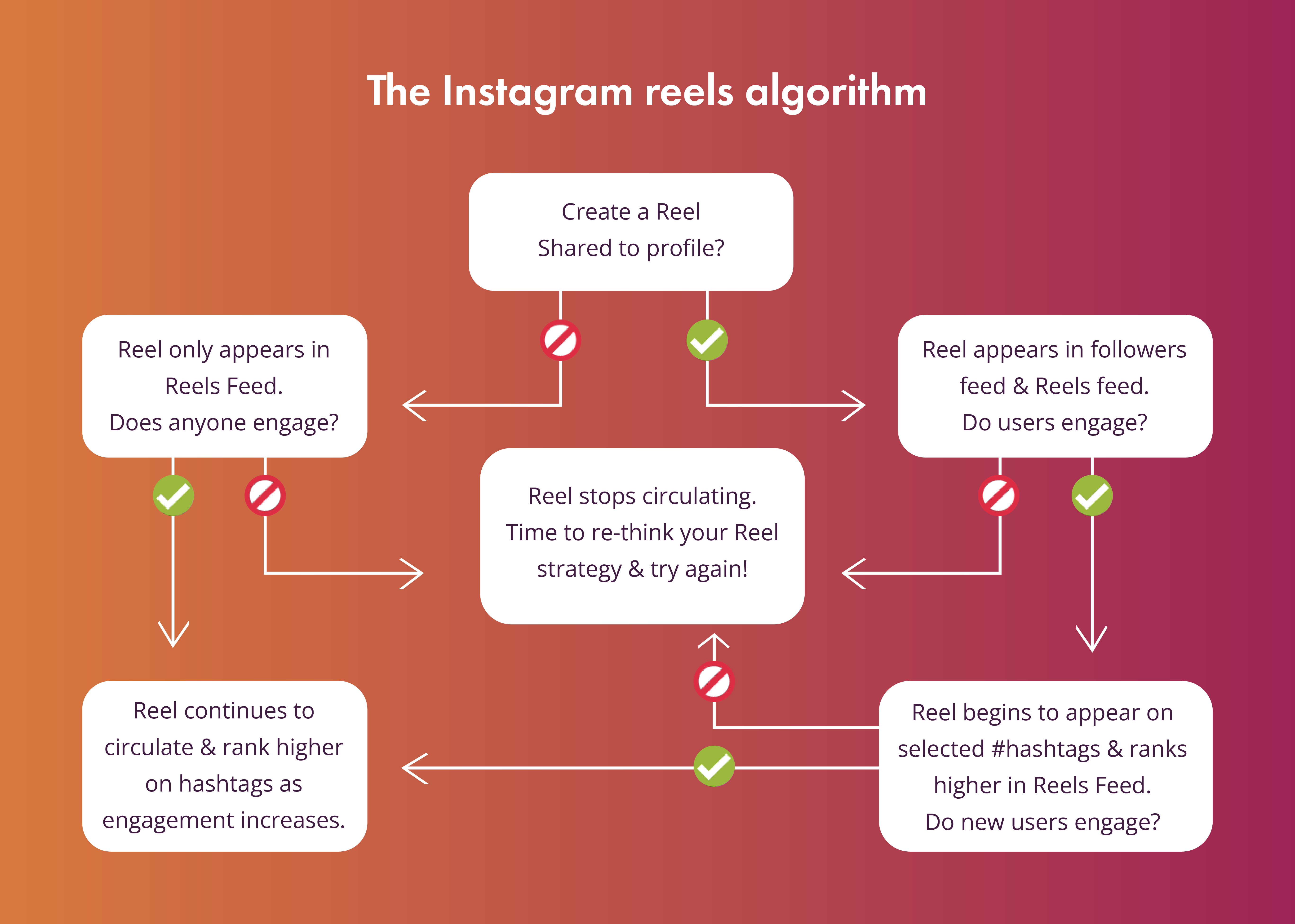
- Strategic Takeaway: Reels are your primary tool for top-of-funnel audience growth. Success here is dictated by your ability to hold attention. Your content must have a strong hook in the first 1-2 seconds and deliver a payoff that encourages viewers to watch to the end, replay it, or share it. While using trending audio can help with initial discovery, the core drivers are watch time and shares.
To get the full picture, please read the official breakdowns for Feed, Stories, and Reels from the Instagram blog.
This will solidify your understanding of the signals for Feed, Stories, and Reels with the official descriptions.
Please read the sections titled 'How we rank Feed,' 'How we rank Stories,' and 'How we rank Reels.' Compare the signals listed for each and note the different verbs used (e.g., Feed is about 'interest', Stories about 'closeness', and Reels about 'entertainment').
4. The Explore Page
Explore is purely for discovery, surfacing content from accounts you don't follow based on your interests.
- Primary Goal: Broad discovery. To help users find new creators and content aligned with their demonstrated interests.
- Key Ranking Signals:
- Information about the post: Post popularity is much more important here than in the Feed. The algorithm looks for posts getting lots of engagement (likes, shares, saves) very quickly.
- Your activity in Explore: What you've liked, saved, or commented on within the Explore tab itself.
- Your history with the poster: If you've interacted with them before, even without following, it's a positive signal.
- Information about the poster: Signals that they create compelling content for a wide array of people.
Here’s a simplified look at the technical process Instagram uses to filter content for the Explore page.

- Strategic Takeaway: You don't create content for Explore. Rather, Explore is the destination for your best-performing content. A high-performing Reel or a Feed post that gets significant saves and shares can be picked up by the algorithm and shown on Explore. The key is to focus on creating excellent, engaging content for the Feed and Reels; success there is the ticket to getting featured on Explore.
Putting It All Together: A Strategic Framework
Now that we've broken down each surface, let's synthesize this into a practical framework. As a content strategist, you can use this understanding to make deliberate format choices based on your goals.
| Surface | Primary Goal | Key Algorithmic Driver | Strategic Application for Your Content |
|---|---|---|---|
| Reels | Reach & Discovery | Watch Time, Completion Rate, Shares | Create entertaining or high-utility short videos with a strong hook to attract new followers. Top-of-funnel content. |
| Feed Posts | Nurture & Value | Saves, Shares, Comments | Publish high-value carousels, guides, and thought leadership to educate and build trust with your existing audience. Mid-funnel content. |
| Stories | Relationship & Community | DMs, Poll Votes, Reactions | Use interactive, behind-the-scenes, and timely content to build a loyal community and strengthen relationship signals. Bottom-of-funnel/retention content. |
| Explore | Amplification | Post Popularity (Velocity) | This is an outcome, not a target. Your best-performing Reels and Feed posts will land here, amplifying your reach. |
Conclusion
In this lesson, we've dismantled the idea of a single Instagram algorithm and replaced it with a more accurate, strategic model.
Key Takeaways:
- Instagram uses a variety of distinct algorithms for Feed, Stories, Reels, and Explore, each optimized for a different user experience.
- The algorithm's behavior is driven by business needs, primarily the need to keep users engaged and provide opportunities for creators to grow.
- Reels are for Reach: Optimize for attention—strong hooks, high watch time, and shareability.
- Feed Posts are for Nurturing: Optimize for value—create content worth saving and sharing with peers.
- Stories are for Relationships: Optimize for interaction—use stickers and encourage DMs to build community.
By aligning your content format with your strategic goal and the corresponding algorithmic drivers, you move from simply posting content to architecting a system for growth and engagement.
Preview of the next lesson:
We mentioned that post popularity and engagement velocity are critical signals. But what does that mean in practice? In our next lesson, we will identify the engagement velocity metrics that trigger expanded algorithmic distribution. We'll look at the crucial first hour after you post and how to maximize your content's initial momentum.