Hello! Welcome back.
In our last lesson, we established hemoglobin A1c (HbA1c) as a cornerstone for diagnosing and monitoring diabetes, reflecting a patient's average glucose over several months. We celebrated its strengths, but as with any tool in medicine, it's crucial to know its limitations.
Today's lesson addresses your learning outcome: to recognize situations where HbA1c may be inaccurate (e.g., hemoglobinopathies, hemolysis). Misinterpreting an HbA1c value can lead to significant errors in management—either failing to treat hyperglycemia or, conversely, causing dangerous hypoglycemia by overtreating. Understanding these pitfalls is a key step toward mastering lab interpretation.
1. The Core Assumptions of an Accurate HbA1c
The validity of the HbA1c test rests on a few key biological assumptions:
- A normal red blood cell (RBC) lifespan: The calculation of a 3-month average assumes RBCs live for approximately 120 days.
- Normal hemoglobin: The test assumes a standard hemoglobin structure (HbA) and a normal rate of glycation.
- A reliable assay: The laboratory method must be able to accurately measure the glycated portion of hemoglobin without interference.
When any of these assumptions are violated, the HbA1c result can become misleading. We'll explore the most common clinical scenarios where this occurs.
2. Conditions Causing a Falsely Elevated HbA1c
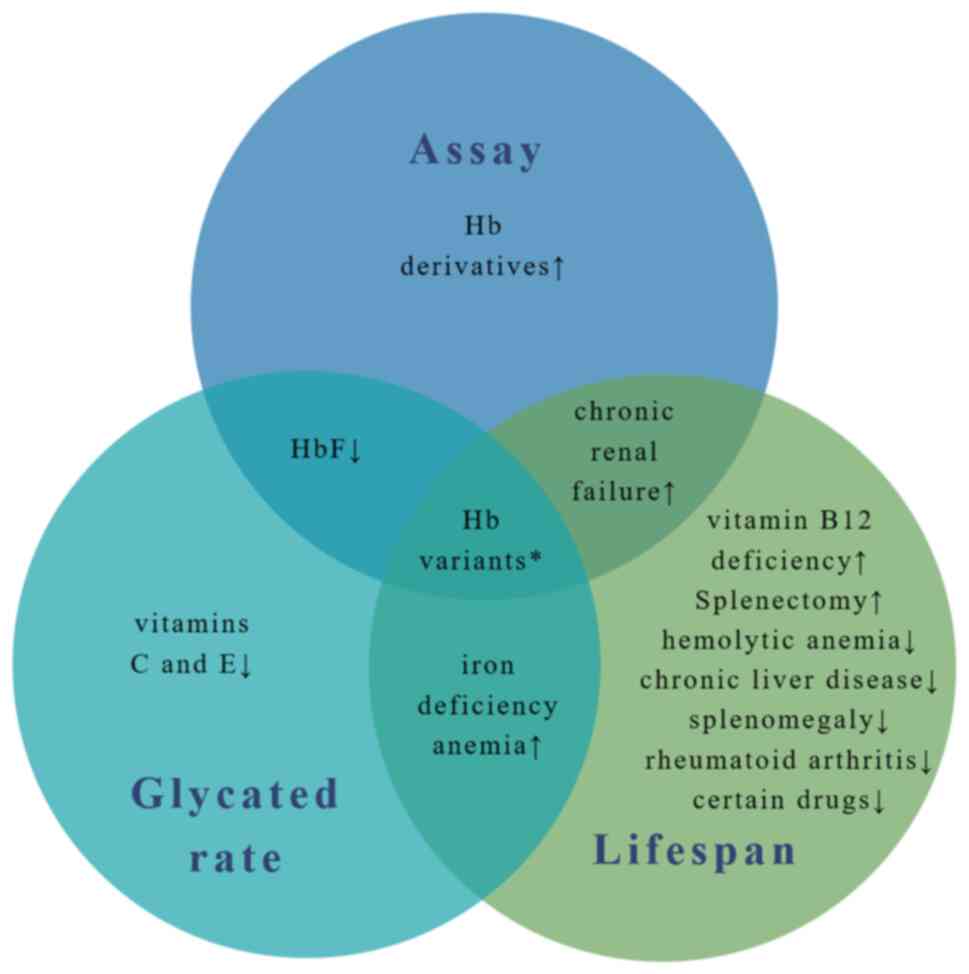
Any condition that prolongs the average lifespan of red blood cells will give them more time to accumulate glucose, leading to a falsely high HbA1c that overestimates the patient's actual average blood sugar.
The most common causes include:
- Iron Deficiency Anemia: When iron is scarce, the bone marrow slows down the production of new RBCs. This results in a higher proportion of older cells, which have been exposed to blood glucose for a longer period.
- Vitamin B12 or Folate Deficiency Anemia: Similar to iron deficiency, these nutritional deficiencies impair RBC production, increasing the average age of the RBC population.
- Asplenia: The spleen is responsible for removing old or damaged RBCs from circulation. In patients without a spleen (due to surgical removal or a condition like sickle cell disease causing functional asplenia), RBCs live longer.
To get a quick overview of these concepts, let's start with a video.
7 Overlooked Reasons Why Your A1C May Be Inaccurate
The video '7 Overlooked Reasons Why Your A1C May Be Inaccurate' from the HealthRX channel provides a clear explanation of factors that can falsely raise HbA1c.
Please watch from 01:22 to 03:45. The speaker discusses how deficiencies in iron, B12, or folate, as well as spleen disorders, lead to an overestimation of HbA1c.
3. Conditions Causing a Falsely Lowered HbA1c
Conversely, any condition that shortens the average lifespan of red blood cells will lead to a falsely low HbA1c. The RBC population will be dominated by "younger" cells that haven't had enough time to become significantly glycated, underestimating the patient's true average blood sugar.
Common causes include:
- Hemolysis: Conditions that cause rapid destruction of RBCs (hemolytic anemias, including some autoimmune diseases or drug-induced hemolysis) will dramatically lower the HbA1c.
- Acute or Chronic Blood Loss: Losing blood removes older, more glycated RBCs. The bone marrow compensates by producing a wave of new, unglycated cells, diluting the average.
- Recent Blood Transfusion: If a patient receives a transfusion from a non-diabetic donor, their blood is filled with RBCs with normal levels of glycation, which will artificially lower the patient's overall HbA1c.
- End-Stage Renal Disease (ESRD): Patients with ESRD often have anemia of chronic disease, which shortens RBC survival. The use of erythropoietin to treat this anemia further drives the production of new cells. Both factors tend to falsely lower the HbA1c.
- Pregnancy: Increased RBC turnover during pregnancy can lead to a falsely low HbA1c. This is one reason why HbA1c is not used for diagnosing gestational diabetes.
The following infographic provides an excellent visual summary of the factors that can alter HbA1c results, organizing them by their mechanism of action.
Test your understanding!
A 55-year-old male with type 2 diabetes has consistently had HbA1c values around 8.5%. His home glucose readings have also been consistently high. He is started on iron supplementation for newly diagnosed iron deficiency anemia. Three months later, his repeat HbA1c is 7.2%. He reports no significant change in his diet, exercise, or home glucose readings.
What is the most likely explanation for the drop in his HbA1c? Is his diabetes truly better controlled?
Show answer
The most likely explanation is that his initial HbA1c of 8.5% was falsely elevated due to his iron deficiency anemia (prolonged RBC lifespan). Treating the anemia stimulated the production of new, less-glycated red blood cells, causing the HbA1c to drop to a more accurate, but still elevated, level of 7.2%.
His diabetes is likely not significantly better controlled. The change in HbA1c is an artifact of treating his anemia. This highlights the danger of relying solely on the HbA1c in such situations; his persistently high home glucose readings are the more reliable indicator of his glycemic status.
4. The Special Case: Hemoglobinopathies
Hemoglobin variants, or hemoglobinopathies, are a critical and common cause of HbA1c inaccuracy. They can interfere in two main ways:
- Physiological Interference: Some variants, like in sickle cell disease (HbSS), cause hemolysis and shorten RBC lifespan, leading to a falsely low HbA1c.
- Analytical Interference: The variant hemoglobin molecule itself might not be recognized or may be misidentified by the specific laboratory assay being used. This can lead to either a falsely high or falsely low result, depending entirely on the lab's method.
Common hemoglobinopathies like sickle cell trait (HbAS), HbC trait, and HbE trait are prevalent in certain ethnic populations (e.g., African, Mediterranean, Southeast Asian descent).
The key clinical takeaway is that the effect of a hemoglobinopathy is assay-dependent. You don't need to memorize which assays are affected by which variants. You need to know that if you have a patient from a high-risk ethnicity, or if the HbA1c is discordant with their fingerstick values, a hemoglobinopathy should be on your differential.
For a deep and authoritative dive into all these interfering factors, the following paper is an excellent resource.
Pitfalls in Hemoglobin A1c Measurement: When Results may ...
The review article 'Pitfalls in Hemoglobin A1c Measurement: When Results may be Misleading' provides a comprehensive clinical summary of this topic. We'll focus on the tables and sections that directly address falsely high, low, and hemoglobinopathy-related inaccuracies.
Please read the sections titled 'FALSELY ELEVATED A1C', 'FALSELY LOWERED A1C', and 'HEMOGLOBIN VARIANTS'. Pay special attention to Table 2, which provides a superb summary of conditions that cause false elevations and reductions. You don't need to memorize Table 3 on hemoglobin variants, but appreciate the complexity and understand that the effect is method-dependent.
5. Clinical Application: What to Do When You Suspect an Inaccurate HbA1c
Recognizing the potential for an inaccurate HbA1c is the first step. The next is knowing how to act on that suspicion.
Clinical Red Flags:
- Discordance: The most significant red flag is a major disagreement between the HbA1c result and the patient's self-monitored blood glucose (SMBG) or continuous glucose monitoring (CGM) data.
- Underlying Condition: The patient has a known condition that affects RBCs (e.g., CKD, anemia, sickle cell trait).
- Unexplained Value: An HbA1c result is unexpectedly high or low given the clinical picture, or an A1c result is >15%.
Your Action Plan:
- Review the CBC: Look for anemia (low Hgb/Hct), abnormal red cell indices (e.g., low MCV in iron deficiency, high MCV in B12 deficiency), or signs of hemolysis.
- Rely on Direct Glucose Measurement: Trust the patient's SMBG log or CGM data over a suspicious HbA1c. This provides a direct look at their glucose levels.
- Consider Alternative Glycemic Markers: When HbA1c is unreliable, other tests can provide a picture of medium-term control.
- Fructosamine: Measures glycated proteins (mostly albumin) and reflects average glucose over the prior 2-3 weeks. It is useful but can be falsely low in patients with low protein/albumin (e.g., liver or kidney disease).
- Glycated Albumin: Similar to fructosamine, but may be more reliable in certain populations, like patients on dialysis.
Why Your A1c May Be INCORRECT! Your Doc May Not Even Know!
Let's watch a final clip that brings this together, discussing when to question the A1c and what alternatives are available.
Watch from 02:44 to 05:47. The speaker discusses checking the CBC for clues, the issue of hemoglobin variants, and mentions fructosamine and GlycoMark as alternative tests.
Conclusion
You have now moved beyond simply using the HbA1c test to critically evaluating its validity in a given patient. This is a hallmark of sophisticated clinical reasoning.
Key Takeaways:
- HbA1c accuracy depends on normal RBC lifespan and hemoglobin structure.
- Conditions that prolong RBC life (e.g., iron/B12 deficiency, asplenia) can cause a falsely high HbA1c.
- Conditions that shorten RBC life (e.g., hemolysis, blood loss, ESRD) can cause a falsely low HbA1c.
- Hemoglobinopathies can interfere with HbA1c results in an assay-dependent manner and are a crucial consideration.
- Always investigate discordance between HbA1c and home glucose readings.
- When HbA1c is unreliable, rely on direct glucose monitoring (SMBG/CGM) and consider alternative markers like fructosamine.
Preview of the Next Lesson:
We've focused on the long-term picture of glycemic control. However, severe hyperglycemia can lead to acute, life-threatening emergencies. In our next lesson, we will shift gears to learn how to differentiate Diabetic Ketoacidosis (DKA) from Hyperosmolar Hyperglycemic State (HHS) using laboratory values, focusing on the critical "snapshot" provided by the BMP and ABG.