Hello! Welcome to our new module, "Glucose Metabolism and Diabetes Monitoring." This is a cornerstone of internal medicine, and mastering the interpretation of these tests will serve you daily in almost any specialty you pursue.
In our last module, we focused on the importance of clinical context when interpreting cardiac and inflammatory markers. We'll continue that theme here. While glucose values may seem straightforward, knowing which test to order, how to prepare a patient for it, and how to interpret the results within specific diagnostic criteria is a critical clinical skill.
Today, your learning outcome is to interpret fasting glucose, random glucose, and oral glucose tolerance test (OGTT) results for diabetes screening and diagnosis. We will cover the foundational tests used to identify patients with, or at risk for, diabetes mellitus.
1. The "Why": When to Test for Disordered Glucose Metabolism
Before we dive into the numbers, let's establish when to order these tests. The decision to screen for diabetes is based on two primary scenarios: the presence of symptoms or the presence of risk factors in an asymptomatic patient.
Symptomatic Patients:
You should have a low threshold to check a glucose level in any patient presenting with the classic "polys" of hyperglycemia:
- Polyuria: Excessive urination
- Polydipsia: Excessive thirst
- Polyphagia: Excessive hunger
- Unexplained weight loss
- Blurred vision
Asymptomatic Screening:
Given the high prevalence of type 2 diabetes, screening asymptomatic individuals with risk factors is a public health priority. The American Diabetes Association (ADA) provides clear guidelines on who to screen.
ADA standards of medical care in diabetes (2024)
The ADA Standards of Medical Care is the definitive guide for diabetes in the United States. This summary document concisely lists the criteria for diagnosing prediabetes and diabetes, as well as the risk factors that should prompt screening.
Please read the section titled 'Prediabetes', paying close attention to the list of risk factors that begins with 'Testing should be performed in asymptomatic individuals who are overweight or obese...'. This will anchor your understanding of who needs screening.
Key risk factors for screening asymptomatic adults include:
- Overweight or obesity (BMI ≥ 25 kg/m², or ≥ 23 kg/m² in Asian Americans) plus at least one other risk factor (e.g., first-degree relative with diabetes, physical inactivity, history of cardiovascular disease).
- All adults beginning at age 35, regardless of risk factors.
2. The Diagnostic Toolkit: FPG, Random Glucose, and OGTT
There are three main blood tests we use for diagnosis that we will cover today. (We'll address HbA1c in the next lesson). Let's break down each one.
To get a clear overview of these tests, including patient preparation and the interpretation of results, please watch the following video.
Fasting Blood Glucose | Random Blood Glucose | OGTT | HbA1C | Laboratory Tests | Dr Asif Lectures
Dr. Asif Qureshi provides an excellent and practical overview of the different glucose tests. This video will cover the indications, patient preparation, and the diagnostic cutoffs for each test.
Please watch from 07:09 to 11:05 to understand the crucial patient preparation steps for fasting glucose and the OGTT. Then, watch the core interpretation section from 16:23 to 22:26. Focus on the specific numerical cutoffs for 'normal,' 'pre-diabetic,' and 'diabetic' ranges, and the distinction between 'impaired fasting glucose' and 'impaired glucose tolerance.' Note that the video primarily uses mmol/L; we will consolidate these with the standard US units (mg/dL) afterward.
Now, let's synthesize that information with the official ADA guidelines and present it in a unified way, using both mg/dL and mmol/L units, which you will encounter in different settings.
3. A Systematic Approach to Interpretation
Here is a summary of the diagnostic criteria. This table is your go-to reference for diagnosis.
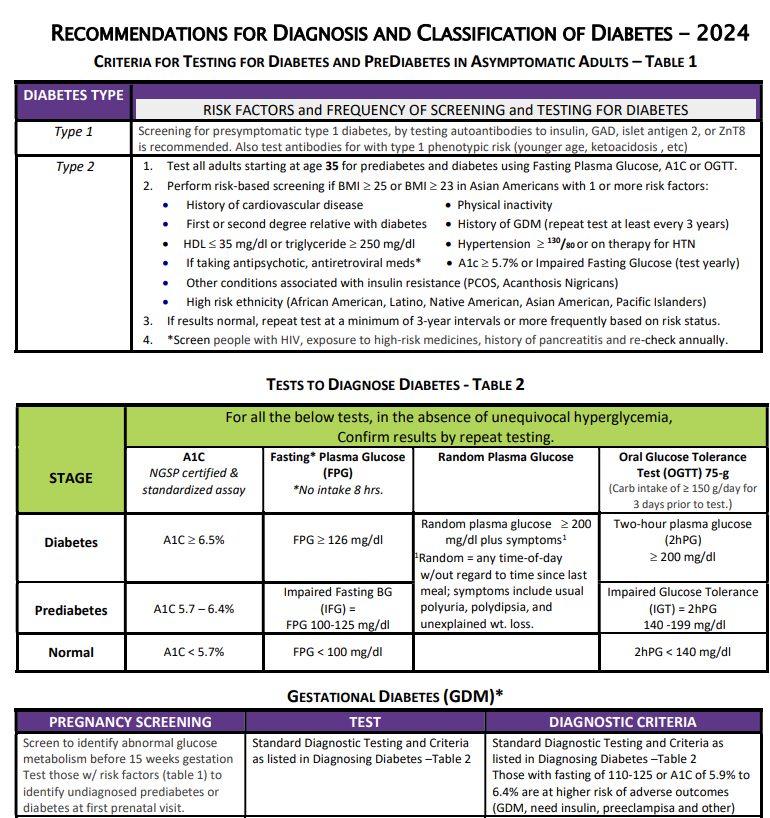
Let's walk through each test based on this framework.
A. Fasting Plasma Glucose (FPG)
This measures glucose after a period of no caloric intake (usually at least 8 hours). It primarily reflects hepatic glucose production.
- Normal: < 100 mg/dL (< 5.6 mmol/L)
- Prediabetes (Impaired Fasting Glucose - IFG): 100 to 125 mg/dL (5.6 to 6.9 mmol/L)
- Diabetes: ≥ 126 mg/dL (≥ 7.0 mmol/L)
B. Random Plasma Glucose
This can be drawn at any time, without regard to the last meal. Its utility is highest in patients who are already showing symptoms.
- Diabetes: ≥ 200 mg/dL (≥ 11.1 mmol/L) PLUS classic symptoms of hyperglycemia (polyuria, polydipsia, unexplained weight loss).
- Note: A random glucose below 200 mg/dL without symptoms is not sufficient to rule out diabetes and may require further testing if suspicion is high.
C. 2-Hour Oral Glucose Tolerance Test (OGTT)
The OGTT assesses the body's ability to handle a glucose load. It involves giving a 75-gram glucose drink after a fasting blood draw, with a second blood draw 2 hours later.
- When to order? The OGTT is most useful when FPG results are equivocal (i.e., in the prediabetes/IFG range) to further clarify risk. It is also the gold standard for diagnosing gestational diabetes.
Oral glucose tolerance testing
This article from the Royal Australian College of General Practitioners focuses specifically on the OGTT, providing clear guidance on when it should be ordered and how to perform it correctly.
Read the sections 'When should an OGTT be ordered?' and 'What do I tell my patient?'. This will solidify your understanding of the test's specific indications and the critical importance of proper patient preparation for an accurate result.
Here is how you interpret the 2-hour plasma glucose value from the OGTT:
- Normal: < 140 mg/dL (< 7.8 mmol/L)
- Prediabetes (Impaired Glucose Tolerance - IGT): 140 to 199 mg/dL (7.8 to 11.0 mmol/L)
- Diabetes: ≥ 200 mg/dL (≥ 11.1 mmol/L)
4. Putting It All Together: Diagnosis and Clinical Nuances
Confirmation is Key
A crucial point for clinical practice: In an asymptomatic patient, a diagnosis of diabetes must be confirmed. This is done by repeating the test on a separate day. The confirmation can be the same test or a different one (e.g., a high FPG followed by a confirmatory HbA1c). If two different tests are drawn from the same blood sample and both are in the diabetic range, the diagnosis is also confirmed.
However, if a patient presents with classic hyperglycemic symptoms and a random glucose ≥ 200 mg/dL, you do not need a second test to confirm the diagnosis; you can begin treatment.
IFG vs. IGT: What's the Difference?
- Impaired Fasting Glucose (IFG) suggests a primary problem with excess hepatic glucose production overnight (a liver-centric issue).
- Impaired Glucose Tolerance (IGT) suggests the body cannot adequately handle a glucose load, pointing to issues with peripheral insulin resistance and/or inadequate insulin secretion after a meal (a muscle/pancreas-centric issue).
A patient can have IFG, IGT, or both. Both are considered "prediabetes" and are significant risk factors for future development of diabetes and cardiovascular disease.
Test your understanding!
A 55-year-old asymptomatic man with a BMI of 29 kg/m² and hypertension undergoes screening labs. His fasting plasma glucose is 118 mg/dL. What term best describes this finding, and what is an appropriate next step?
Show answer
The finding is best described as Impaired Fasting Glucose (IFG), which is a form of prediabetes. An appropriate next step would be to counsel the patient on lifestyle modifications (diet, exercise, weight loss). You could also consider ordering an OGTT to see if he also has Impaired Glucose Tolerance (IGT), which would further refine his risk profile. A confirmatory test (like a repeat FPG or an HbA1c) is also reasonable.
Case Application
Let's apply this knowledge to a brief case.
Oral glucose tolerance testing
Let's return to the RACGP article on the OGTT and look at their case study.
Read the 'Case study – Peter' and its interpretation. See how they combine the risk factors and the specific lab values to arrive at a diagnosis.
In Peter's case, his fasting glucose of 6.6 mmol/L (~119 mg/dL) establishes Impaired Fasting Glucose (IFG). The 2-hour OGTT result of 7.6 mmol/L (~137 mg/dL) is below the threshold for IGT. Therefore, his diagnosis is prediabetes, specifically isolated IFG. This places him at high risk for developing type 2 diabetes.
Conclusion
Today you have learned the foundational methods for screening for and diagnosing diabetes using plasma glucose measurements. You are now equipped to interpret the key tests that form the first step in managing this widespread disease.
Key Takeaways:
- Diabetes diagnosis relies on specific numerical thresholds for Fasting Plasma Glucose (FPG), Random Plasma Glucose (in symptomatic patients), and the 2-hour value in an Oral Glucose Tolerance Test (OGTT).
- Prediabetes is a critical intermediate stage, identified by Impaired Fasting Glucose (IFG) (FPG 100-125 mg/dL) or Impaired Glucose Tolerance (IGT) (2-hr OGTT 140-199 mg/dL).
- Correct patient preparation (e.g., fasting duration) is essential for accurate test results.
- In asymptomatic patients, a single abnormal test result must be confirmed with a second test before a final diagnosis is made.
Preview of the Next Lesson:
While plasma glucose gives us a snapshot in time, our next test gives us a view of the past few months. In the next lesson, we will explore hemoglobin A1c (HbA1c), learning how to use it for both diagnosis and for monitoring long-term glycemic control. We will also discuss important clinical scenarios where HbA1c results can be inaccurate.