Hello! Welcome to the next lesson in our module on coagulation studies.
In our last session, we explored how intrinsic conditions like vitamin K deficiency and liver disease disrupt the coagulation cascade, primarily by affecting the production of clotting factors. We learned to differentiate them using Factor V levels and the response to a vitamin K challenge.
Today, we'll shift our focus to iatrogenic causes of abnormal coagulation tests. Your learning goal is to differentiate the laboratory findings associated with warfarin versus unfractionated heparin therapy. These are two of the most common anticoagulants you will manage, and understanding their distinct effects on lab tests is a fundamental clinical skill. This lesson builds directly on our discussion of vitamin K, as warfarin's mechanism is intimately tied to it.
1. Warfarin (Coumadin): The Vitamin K Antagonist
Warfarin is an oral anticoagulant that works by interfering with the vitamin K cycle. As we discussed in the last lesson, vitamin K is essential for activating clotting factors II, VII, IX, and X. Warfarin specifically inhibits an enzyme called vitamin K epoxide reductase, preventing the recycling of vitamin K and thereby reducing the amount of active, functional clotting factors.
How do heparin and Coumadin affect the coagulation cascade?
To understand how warfarin impacts lab tests, we first need to be crystal clear on its mechanism. This brief article from Pathology Student provides an excellent explanation of how warfarin works and contrasts it with heparin.
Please read the sections 'How Coumadin works' and 'How Coumadin and heparin affect coagulation lab tests'. Pay close attention to the explanation of why the PT/INR is the best test for monitoring warfarin, focusing on the role of Factor VII's half-life.
The Laboratory Signature of Warfarin
As you just read, the key to warfarin's lab signature is Factor VII.
- Factor VII has the shortest half-life of all the clotting factors (about 6 hours).
- Because Factor VII is part of the extrinsic pathway, its depletion is detected by the Prothrombin Time (PT).
When a patient starts warfarin, the Factor VII level drops first, leading to a prolongation of the PT long before the other vitamin K-dependent factors (II, IX, X) are significantly depleted. This makes the PT a sensitive and early indicator of warfarin's effect.
To standardize results between different labs and reagents, the PT is reported as the International Normalized Ratio (INR) when used for monitoring warfarin.
Coagulation screen interpretation | blood test analysis MADE EASY!
This clip from 'Medicine Made Simple' provides a great visual summary of the PT, its connection to the extrinsic pathway, and how the INR is used to monitor warfarin.
Watch from 2:12 to 4:05. The video uses the mnemonic 'Play Tennis outside' to help you remember that PT measures the extrinsic pathway. Note how it explicitly links warfarin to an increased PT/INR.
The classic lab pattern for a patient on a therapeutic dose of warfarin is an isolated prolonged PT/INR, with a normal aPTT.
However, it's important to know that at very high doses (i.e., over-anticoagulation), the levels of factors II, IX, and X will also drop significantly, which can lead to a prolongation of the aPTT as well.
2. Unfractionated Heparin (UFH): The Antithrombin Activator
Unfractionated heparin works through a completely different mechanism. It's an intravenous or subcutaneous anticoagulant that functions by binding to and super-charging a natural anticoagulant in our blood called antithrombin III (ATIII).
The activated ATIII complex is a powerful inhibitor of several clotting factors, most notably Thrombin (Factor IIa) and Factor Xa. Since these factors are key components of the intrinsic and common pathways, heparin's effect is primarily reflected in the activated Partial Thromboplastin Time (aPTT).
Coagulation screen interpretation | blood test analysis MADE EASY!
Let's return to the 'Medicine Made Simple' video to see the explanation for the aPTT and its relationship with heparin.
Watch from 3:46 to 5:00. This section uses the mnemonic 'Play Table Tennis inside' to link aPTT to the intrinsic pathway and clearly states that heparin prolongs the aPTT.
The Laboratory Signature of Heparin
Because heparin's main effect is on the intrinsic and common pathways, it is monitored using the aPTT. The therapeutic goal is typically an aPTT that is 1.5 to 2.5 times the laboratory's control value.
The classic lab pattern for a patient on a therapeutic dose of unfractionated heparin is an isolated prolonged aPTT, with a normal PT/INR.
Similar to the warfarin nuance, it's possible for very high doses of heparin to prolong the PT/INR, but the aPTT is the far more sensitive measure of its effect. An interesting clinical pearl is that the blue-top tubes used to collect blood for PT/INR testing often contain heparin-neutralizing substances to prevent contamination from heparin lines from giving a falsely elevated result.
Test your understanding!
A 65-year-old woman is being treated for a pulmonary embolism. Her coagulation studies show:
- PT/INR: 1.1 (Normal < 1.2)
- aPTT: 75 seconds (Normal 25-35s)
Which anticoagulant is she most likely receiving?
Show answer
She is most likely receiving an infusion of unfractionated heparin. The isolated, significant prolongation of the aPTT with a normal INR is the characteristic laboratory signature of heparin therapy.
Putting It All Together: A Critical Nuance
While we learn these classic "isolated" patterns, it's crucial to understand a finer point that will elevate your clinical reasoning. Both drugs can affect both tests. The key is which test is the most sensitive and therefore used for monitoring.
Coagulation Tests - PT, aPTT, TT, Fibrinogen, Mixing Studies
This clip from Medicosis Perfectionalis makes this important point very clearly and will help you avoid a common oversimplification.
Watch from 11:19 to 12:05. The main takeaway is that both drugs can prolong both tests, but we choose the most sensitive and practical test for monitoring.
This brings us to a clear, practical summary for clinical use.
Interpreting Coagulation Studies
The 'Interpreting Coagulation Studies' guide provides a fantastic, clinically-focused summary that directly addresses our learning outcome.
First, read the two paragraphs under the heading 'Aetiology of Coagulopathy' that begin with 'Isolated INR prolongation...' and 'Isolated APTT prolongation...'. Then, review the bulleted lists under 'Causes of Abnormal Coagulation Profile'. Finally, read the section 'Anticoagulants' to see how this knowledge is applied to monitoring.
Summary Comparison
This table provides a high-yield summary of the key differences you need to know for your clinical rotations.
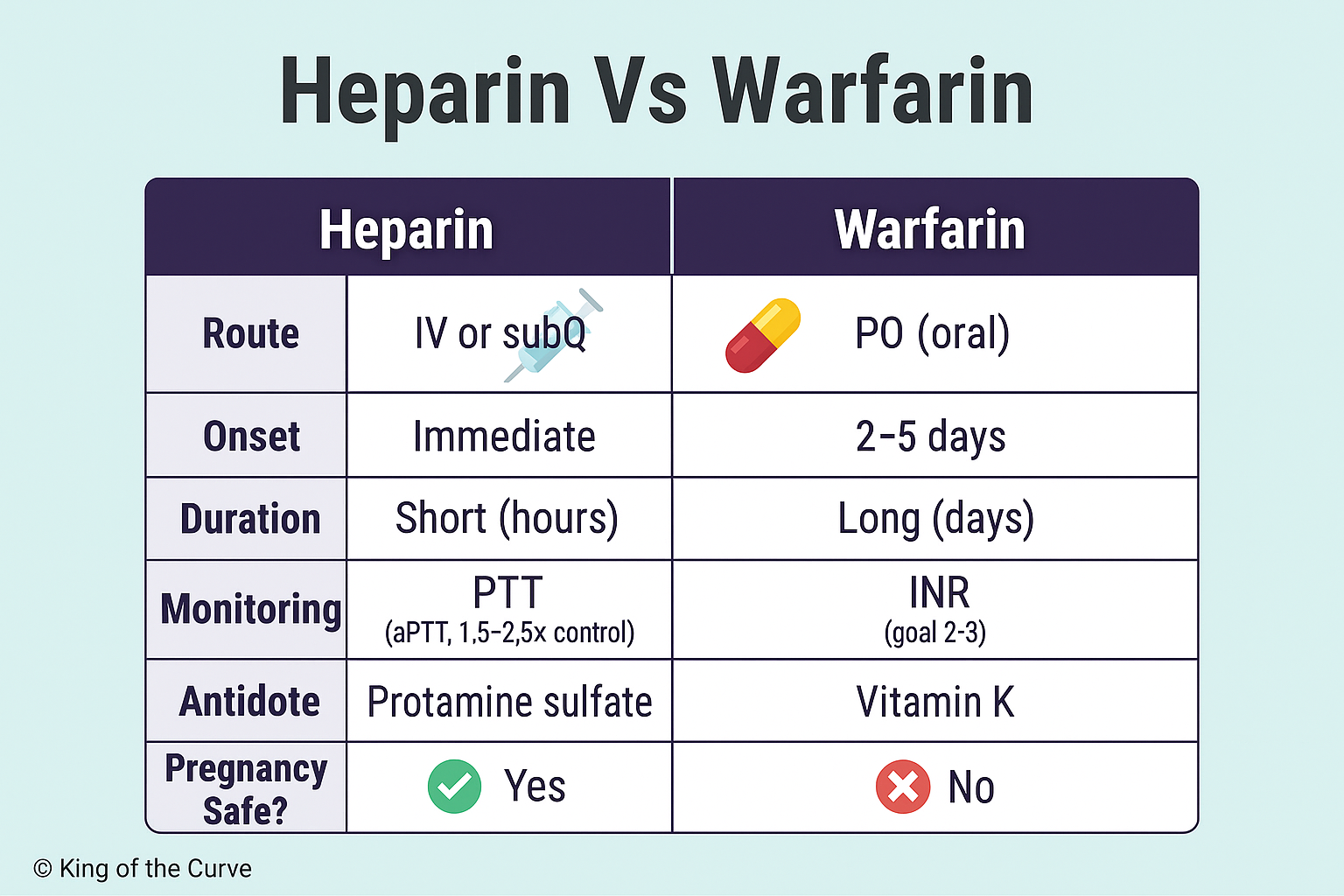
| Feature | Warfarin (Coumadin) | Unfractionated Heparin (UFH) |
|---|---|---|
| Mechanism | Inhibits activation of Vitamin K-dependent factors (II, VII, IX, X) | Potentiates antithrombin III, which inactivates Thrombin (IIa) and Factor Xa |
| Primary Pathway Affected | Extrinsic (due to Factor VII) | Intrinsic |
| Primary Lab Test Affected | PT/INR | aPTT |
| Monitoring Test | INR | aPTT |
| Classic Lab Pattern | ↑ INR, Normal aPTT | ↑ aPTT, Normal INR |
Test your understanding!
A patient has been on warfarin for atrial fibrillation for several years. They come to the clinic for a routine check. Their INR is 2.7 (therapeutic goal 2.0-3.0). You also check an aPTT, which is 32 seconds (normal).
Does this pattern make sense? Why or why not?
Show answer
Yes, this pattern is exactly what you would expect for a patient on a stable, therapeutic dose of warfarin. The INR is prolonged into the therapeutic range, reflecting inhibition of the extrinsic pathway. The aPTT is normal because the inhibition of factors in the intrinsic pathway (like Factor IX) is not profound enough at this dose to prolong the aPTT outside its normal range.
Conclusion
Congratulations! You have now mastered the laboratory signatures of two essential anticoagulant therapies. By understanding why they affect different tests, you can confidently interpret coagulation panels in patients receiving these medications.
Key Takeaways:
- Warfarin inhibits vitamin K-dependent factors. Due to the short half-life of Factor VII, its effect is seen first in the PT/INR. It is therefore monitored with the INR.
- Unfractionated Heparin potentiates antithrombin III. This has a more profound effect on the intrinsic and common pathways, so its effect is seen in the aPTT. It is therefore monitored with the aPTT.
- The classic pattern for warfarin is an isolated prolonged INR. The classic pattern for UFH is an isolated prolonged aPTT.
In our next lesson, we will explore the D-dimer test. We'll discuss what it measures and how to use it correctly in the clinical workup for venous thromboembolism—the very condition that warfarin and heparin are often used to treat.