Hello! Welcome to the final module of your course, "Research Methodology for Scheduling." This module is designed to equip you with the skills needed to transition from learning about scheduling to contributing to the field—a perfect setup for your thesis work.
In our last lesson, you learned how to dissect seminal papers to understand their core contributions. Today, we take the crucial next step. We will build directly on that skill to address the learning outcome: Identify open problems and research gaps in the flexible job shop literature.
Identifying a research gap is the cornerstone of any thesis. It's the process of finding an unanswered question, an unsolved problem, or an underexplored area within the existing body of knowledge. Your ability to clearly articulate a research gap is what justifies your entire research project and defines its potential contribution.
In this lesson, you will learn a systematic process for finding and evaluating these gaps, moving from a general strategy to a specific analysis of the FJSP literature.
1. A Systematic Approach to Finding Research Gaps
Before diving into the specifics of FJSP, let's establish a general framework for identifying research gaps. A common and effective method involves systematically reviewing recent, high-impact literature and looking for explicit or implicit suggestions for future work.
The following video provides an excellent, practical tutorial on this process. While the examples are from a different field, the strategies are universal.
How I Find Research Gaps In Under 5 Minutes (Step-by-Step Tutorial & Strategies)
This video from Prof. David Stuckler's channel outlines a step-by-step strategy for finding research gaps using academic search engines and analyzing papers.
Please watch the segment from 00:43 to 06:08. Pay close attention to: The technique of using search filters (e.g., recent years) to find relevant papers. The 'laser beam' approach: going directly to the 'Limitations' or 'Future Research' sections of a paper. The three types of gaps mentioned: population, methodological, and conceptual.
The video provides a great starting point. Now, let's translate those general categories into the specific context of scheduling research, particularly for your focus on FJSP:
- Population Gap → Problem Variant Gap: This involves applying a known method to a new, more complex, or more realistic version of the problem.
- Example: "The NEH heuristic is effective for the permutation flow shop, but how does it perform on a flexible job shop with transport constraints?"
- Methodological Gap → Algorithmic or Model Gap: This is about proposing a new or improved solution method.
- Example: "Existing studies use either a metaheuristic or an exact method. What if a hybrid metaheuristic/CP approach could combine the speed of the former with the optimality-proving power of the latter?"
- Conceptual Gap → Paradigm or Objective Gap: This involves shifting the fundamental assumptions or goals of the problem.
- Example: "Nearly all research on FJSP aims to minimize makespan. What if the objective was to minimize energy consumption or maximize worker satisfaction?"
Armed with this framework, your most valuable resources are recent survey and review papers. Their entire purpose is to map the existing landscape and point to the frontiers where new research is needed.
2. Research Gaps in the "Digital Era" of Scheduling (Industry 4.0)
The context of Industry 4.0—with its focus on data, connectivity, and automation—has created a wealth of new challenges and opportunities in scheduling. Let's analyze a very recent review paper that surveys this landscape.
Industrial Scheduling in the Digital Era: Challenges, State ...
The paper 'Industrial Scheduling in the Digital Era' by F. Le-Fort et al. provides a fantastic summary of recent trends and explicitly lists future research directions. It's a goldmine for identifying high-impact gaps.
Please read Section 5, 'Conclusions and Research Directions.' As you read, try to identify the challenges the authors highlight. Pay special attention to the bulleted list at the end, which explicitly outlines 'research priorities.'
This paper frames its discussion around three core challenges: scalability, robustness, and integration. The "Future Research Directions" section directly translates these challenges into open problems. Let's explore a few and frame them as potential thesis questions.
Gaps related to Scalability and Performance:
The paper notes the rise of deep learning (DL) and deep reinforcement learning (DRL), but highlights significant obstacles.
- Gap: Interpretability and Assurance. Black-box AI models are not trusted in critical operations.
- Potential Thesis Question: How can a hybrid genetic algorithm for the FJSP be enhanced with explainable AI (XAI) techniques to provide human-understandable justifications for its scheduling decisions?
- Gap: Data Quality and Benchmarks. The field lacks standardized, realistic datasets for training and comparing new algorithms.
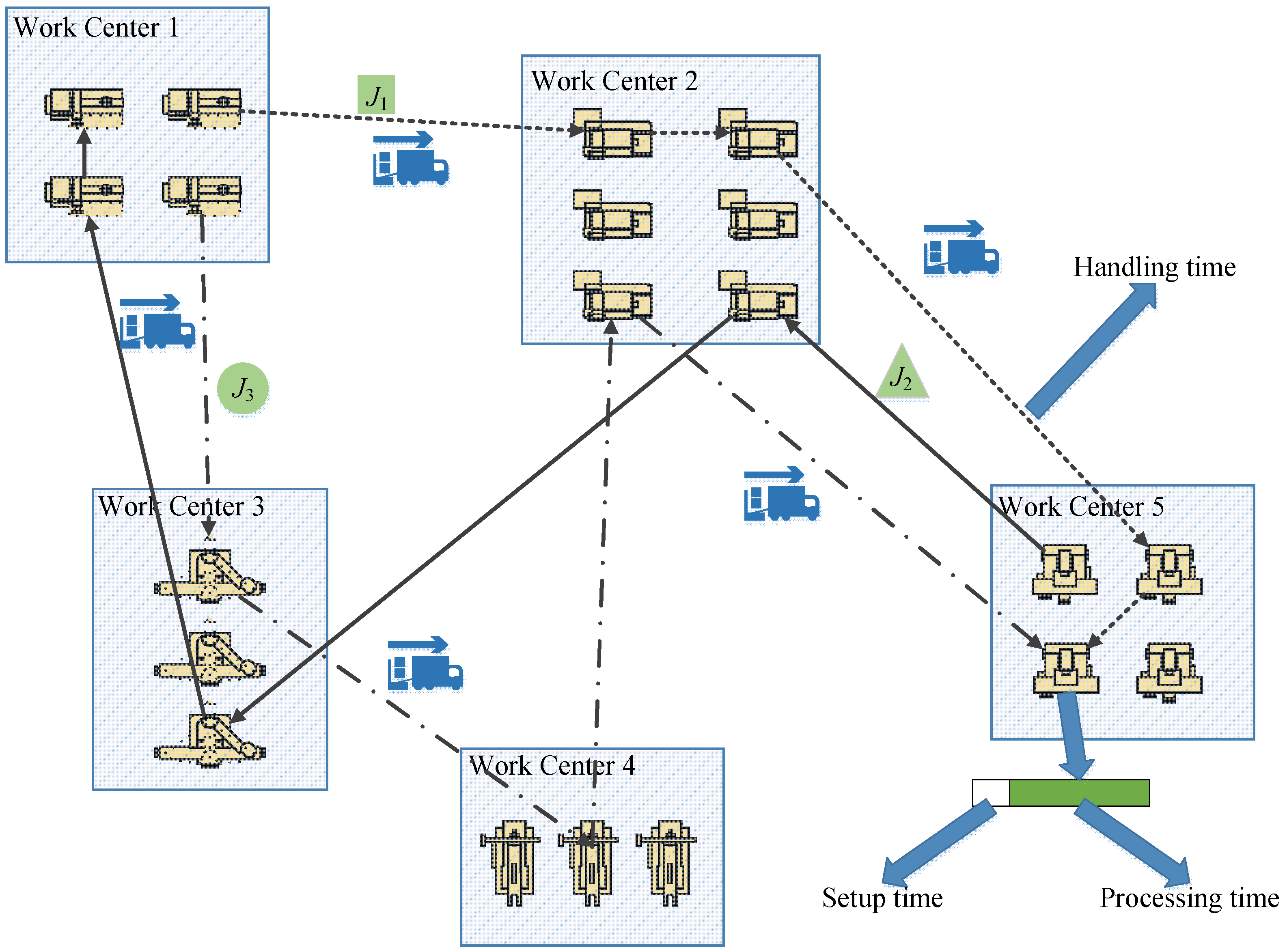
- Potential Thesis Question: What is the impact of integrating realistic, sequence-dependent setup times and transport delays into FJSP benchmark instances, and how do state-of-the-art hybrid algorithms perform on them?
Gaps related to Robustness and Adaptability:
Static, optimal schedules are brittle. The real world is dynamic.
- Gap: Robustness and Safety. Policies must remain stable when faced with real-world disruptions.
- Potential Thesis Question: How can a constraint programming model for the FJSP be formulated within a proactive-reactive framework to maintain high performance under stochastic machine breakdowns?
- Gap: Human-in-the-loop. Purely automated systems ignore the valuable tacit knowledge of human planners.
- Potential Thesis Question: Can a hybrid large neighborhood search (LNS) framework be designed for the FJSP that allows a human scheduler to guide the search by interactively approving or rejecting proposed "destroy" operators?
These are just a few examples. The paper you read points to many more, including federated learning for cross-factory scheduling and integrating AI with digital twins.
3. Research Gaps in the "Human-Centric Era" of Scheduling (Industry 5.0)
While Industry 4.0 focuses on technology, the emerging Industry 5.0 paradigm brings a renewed focus on sustainability, human well-being, and resilience. This shift opens up an entirely new frontier of research gaps, moving beyond purely economic objectives like makespan.
Flexible job shop scheduling problem under Industry 5.0
The paper 'Flexible job shop scheduling problem under Industry 5.0' by Destouet et al. directly addresses this paradigm shift. It is an excellent source for identifying novel research directions that are highly relevant today.
Please read the following sections: Section 2.2 ('Scheduling challenges in the I5.0 era'): Skim this to understand the new challenges: sustainability, human-centricity, and resilience. Section 5 ('Future research'): Read this section carefully. The authors propose a mathematical model for a 'Sustainable FJSSP' (SFJSSP) and discuss future extensions. Section 6 ('Conclusion'): This section provides a clear, explicit summary of the research gaps identified in their survey.
This paper is incredibly direct in its conclusion. It explicitly states:
"This survey proved a lack of studies integrating both factors linked to I5.0, namely human and environmental consideration, and a lack of dynamic FJSSP studies. These gaps provide a direction for future work to keep up with the manufacturing trend towards Industry 5.0."
This is a clear signpost for your research. Let's break down the gaps it reveals:
-
Gap: Integrated Multi-Objective Models. The vast majority of FJSP research focuses on a single objective (e.g., ). A significant gap exists in solving problems that simultaneously consider the three pillars of sustainability:
- Economic: (e.g., minimizing makespan, tardiness)
- Environmental: (e.g., minimizing total energy consumption, carbon emissions)
- Social: (e.g., maximizing worker well-being by balancing workloads, minimizing ergonomic risks)
- Potential Thesis Question: How can a multi-objective metaheuristic be designed for the FJSP to find the Pareto-optimal front for the conflicting objectives of makespan, total energy consumption, and maximum ergonomic load on workers?
-
Gap: Dynamic and Sustainable Scheduling. The paper highlights that while dynamic scheduling is already an advanced topic, combining it with sustainability objectives is almost entirely unexplored.
- Potential Thesis Question: How can a deep reinforcement learning agent be trained to make real-time dispatching decisions in a dynamic FJSP, where the reward function is a weighted sum of on-time delivery, energy usage, and schedule stability?
The authors even provide a starting point by outlining a mathematical formulation for the static, sustainable FJSP (SFJSSP) and suggesting the use of advanced methods like DRL or fuzzy logic for dynamic and multi-objective extensions. This is a very promising area for a thesis that aims to be both novel and relevant.
Test your understanding!
Based on your reading, you've noticed that while many papers address the FJSP with sequence-dependent setup times (FJSP-SDST) and others address the FJSP with transport constraints (FJSP-T), very few studies tackle a problem with both constraints simultaneously.
How would you formulate this observation as a research gap, and what might be a corresponding research question for a thesis?
Show answer
-
Research Gap: There is a gap in the literature concerning the integrated Flexible Job Shop Scheduling Problem that simultaneously considers sequence-dependent setup times and transport times handled by a limited fleet of vehicles. Existing solution methods for simpler variants of the problem may not be effective for this more complex and realistic industrial scenario.
-
Potential Research Question: How can a hybrid algorithm, combining a Genetic Algorithm for high-level sequencing and Constraint Programming for detailed machine assignment and transport scheduling, be designed to effectively and efficiently solve the FJSP with both sequence-dependent setup times and transport constraints?
4. Selecting Your Research Gap
You have now seen how to identify a long list of potential research gaps. The final step is to choose one for your thesis. When evaluating a gap, consider these factors:
- Significance & Novelty: Does the gap address a meaningful, unsolved problem? Is the area relatively unexplored? (The Industry 5.0 topics are particularly strong here).
- Feasibility: Can you realistically address this gap within the timeframe and resources of your thesis? Be honest about the complexity.
- Your Interest: Research is a marathon. Choose a problem that you find genuinely fascinating, as your passion will sustain you through challenges.
- Alignment with Expertise: Does the problem align with your strengths (e.g., mathematical modeling, algorithm design) and the expertise of your thesis supervisor? This is a critical point to discuss with your advisor.
Conclusion
In this lesson, you have learned a systematic methodology for identifying research gaps in the FJSP literature. You have moved beyond simply understanding what has been done to actively seeking out what remains to be done—the very essence of research.
Key Takeaways:
- Finding research gaps is a systematic process of analyzing literature for limitations and future work sections.
- Gaps can be categorized as new problem variants, new solution methods, or new paradigms/objectives.
- The FJSP literature has significant gaps related to Industry 4.0 challenges, such as algorithm interpretability, creating realistic benchmarks, and developing robust, human-in-the-loop systems.
- An even more recent and less explored frontier lies in Industry 5.0 themes, particularly creating multi-objective models that integrate sustainability (energy) and human-centricity (worker well-being) into dynamic FJSP environments.
Preview of the Next Lesson:
Once you have identified a research gap and formulated a research question, the next step is to design an experiment to prove that your proposed solution is effective. In the next lesson, "Select appropriate benchmark instances and performance metrics for evaluating scheduling algorithms," you will learn how to choose the right test cases and measures to rigorously validate your research contribution.