Hallo! Welcome back to your second lesson.
In our first lesson, you did the important work of identifying your personal triggers for nervousness—the specific thoughts and situations that cause those "mental blocks." You now have a clearer understanding of what makes you anxious when you speak German.
Today, we move from the "what" to the "how." Our goal is to apply breathing and mindfulness techniques to calm your nerves before you speak. These are not just psychological tricks; they are simple, physical actions you can take to manage your body's stress response. By calming your body, you free up your mind to focus and access the German you already know.
1. Why Does Breathing Work? The Science of Calm
When you feel nervous—perhaps thinking about one of the triggers you identified last week—your body enters a "fight-or-flight" mode. Your heart beats faster, your muscles tense up, and your breathing becomes shallow and quick, often high in your chest. This physical state makes it very difficult to think clearly and recall words.
The good news is that you can consciously reverse this process. By controlling your breath, you activate a different part of your nervous system—the parasympathetic nervous system, which is responsible for "rest and digest." Slow, deep, and controlled breathing sends a powerful signal to your brain that there is no immediate danger, allowing your body and mind to relax.
The key is to move from shallow chest breathing (which signals panic) to deep diaphragmatic breathing, or "belly breathing" (which signals safety).
2. Foundational Technique: Diaphragmatic (Belly) Breathing
Before we learn specific exercises, we need to master the basic movement of calm breathing. This involves using your diaphragm, the large muscle at the base of your lungs.
To understand and practice this, we'll watch a short, practical video. The speaker, Dominic Colenso, is a public speaking coach, and he clearly demonstrates the difference between panic-inducing chest breathing and calming belly breathing.
BREATHING EXERCISES FOR CONFIDENT PUBLIC SPEAKING
In this clip from 'BREATHING EXERCISES FOR CONFIDENT PUBLIC SPEAKING', you will first learn why low, diaphragmatic breathing is so important and then be guided through a simple exercise to feel it in your own body.
Please watch from 00:56 to 02:39. Follow the instructions in the video: place a hand on your chest and then on your belly to feel the difference. The goal is to get used to the sensation of your belly expanding as you breathe in.
Practice this for a minute or two. This type of breathing is the foundation for all the other techniques we will discuss.
3. Structured Techniques to Calm Your Nerves
Once you are comfortable with belly breathing, you can use structured patterns to quickly reduce feelings of anxiety. These are excellent to practice for a minute or two right before you plan to speak German.
Technique 1: The 4-4-4-4 Exercise (Box Breathing)
This technique is simple, powerful, and easy to remember under pressure. It's often recommended for managing anxiety in stressful situations, such as exams—or speaking a foreign language!
Let's look at a German resource from the University of Vienna that suggests this exact technique for students dealing with a "blackout."
Blackout: Tipps zum Umgang mit Denkblockaden in Prüfungen
This article, 'Blackout: Tipps zum Umgang mit Denkblockaden', offers practical advice for students. We will focus on their 'Bonus tip' which contains a powerful one-minute breathing exercise.
Please find the section titled 'Unser Bonustipp: Eine gut investierte Minute'. Read the first bullet point, 'Die 4-4-4-4-Übung für bewusste Atmung'. This describes the exercise: inhale for 4 seconds, hold for 4, exhale for 4, hold for 4. Try doing this 3-4 times.
Technique 2: Breathing with a Longer Exhale
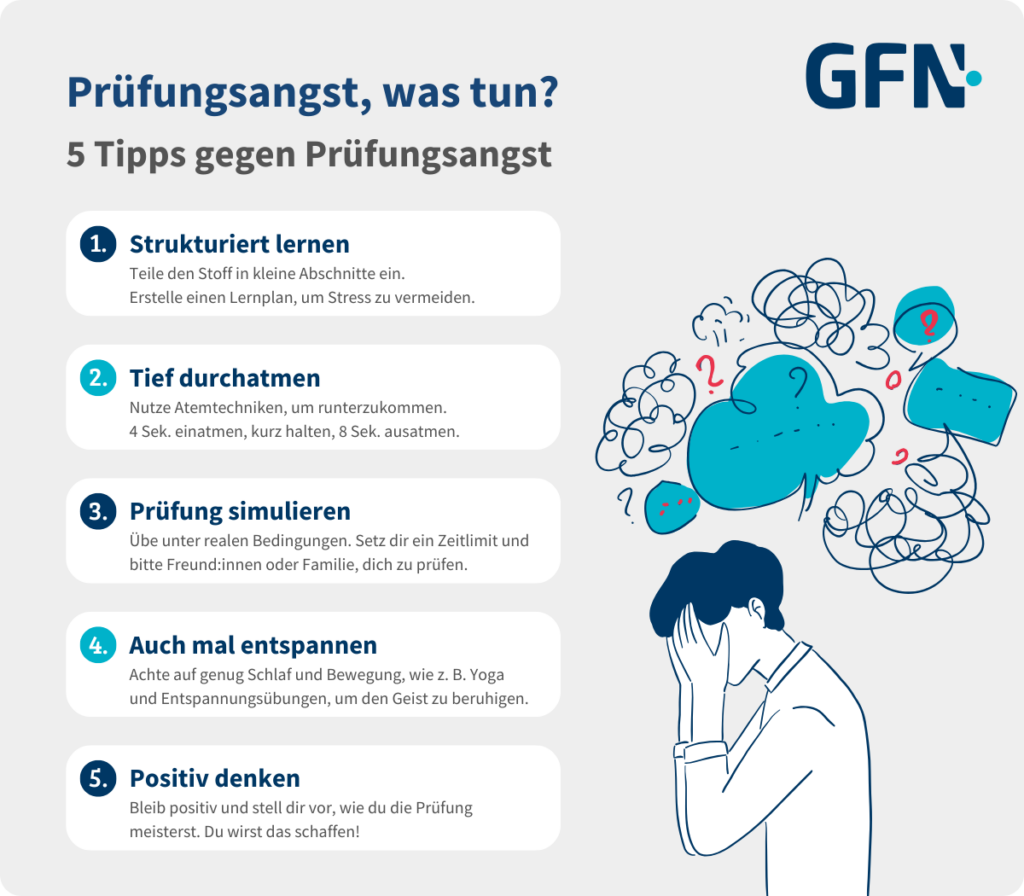
Another very effective variation is to make your exhale longer than your inhale. This is especially good at slowing your heart rate. Here is a simple illustration of this principle from a German source on managing anxiety.
4. An Introduction to Mindfulness
Breathing techniques are excellent for calming your physical state. Mindfulness helps you manage the anxious thoughts that trigger the physical state in the first place.
What is mindfulness? In simple terms, it is the practice of paying attention to the present moment, on purpose, without judgment.
It's not about stopping your thoughts or having an empty mind. It's about noticing your thoughts ("I'm going to forget the word!") and feelings (a knot of anxiety in your stomach) without getting carried away by them. You simply acknowledge them—"Ah, there's that worried thought again"—and gently bring your attention back to the present moment, often using your breath as an anchor.
This video from the channel Therapy in a Nutshell gives a great introduction to what mindfulness is and why it's so helpful for anxiety.
Mindfulness for Anxiety 💓 A Beginner's Guide 21/30
In 'Mindfulness for Anxiety', the speaker explains what mindfulness is, how it differs from meditation, and its key characteristics. This will give you a solid understanding of the concept.
Please watch from 04:49 to 07:31 to understand the definition of mindfulness and acceptance. Then, skip ahead and watch from 09:59 to 13:05 to learn about the characteristics of mindfulness, such as having a 'beginner's mind' and a non-judgmental approach.
5. Simple Mindfulness Practices for Speaking Anxiety
Now, let's put that theory into practice with two simple exercises you can do anywhere.
Practice 1: Mindful Breathing
This is the most fundamental mindfulness exercise. You use the physical sensation of your breath as an anchor to keep you in the present moment.
Let's try a short, guided practice from the same video.
Mindfulness for Anxiety 💓 A Beginner's Guide 21/30
This section of the 'Mindfulness for Anxiety' video will guide you through a short, practical mindful breathing activity. The goal is not to change your breathing, but simply to notice it.
Please watch from 13:05 to 15:42 and follow along with the guided exercise. When your mind wanders (which it will!), just gently bring your attention back to the sensation of your breath.
Practice 2: Grounding with a Body Scan
When you feel your thoughts spiraling, another powerful mindfulness technique is to bring your attention to the physical sensations in your body. This is called "grounding." The same German article from the University of Vienna we looked at earlier has a perfect, simple description of this.
In the resource LINK ("Blackout: Tipps..."), go back to the section "Unser Bonustipp." Read the second bullet point: "Den eigenen Körper bewusst spüren" (Consciously feel your own body).
It suggests:
- Sit up straight.
- Notice where your body touches the chair.
- Notice where your feet touch the floor.
- Notice where your hands rest on the table.
Try this right now. Really feel the solid ground beneath your feet and the support of the chair. This simple act can pull you out of your anxious thoughts and bring you back to the reality of the present moment.
Test your understanding!
Imagine you are about to start a 2-minute solo speaking practice. You notice one of your triggers kicking in—perhaps a thought like, "My German is going to sound terrible." You feel your heart start to beat faster.
Which of the techniques we learned today would be most helpful to use right now, in the 60 seconds before you press "record"? Describe the steps you would take.
Show answer
There's no single right answer, but a great combination would be:
- Grounding: First, take 10 seconds to consciously feel your feet on the floor and your body in your chair. This immediately brings you into the present moment.
- Structured Breathing: Then, practice the 4-4-4-4 exercise for 3-4 cycles. This will physically calm your nervous system and slow your heart rate.
- Mindful Intention: While you do this, you can mindfully acknowledge the thought ("My German will sound terrible") without believing it. You can simply notice it and let it go as you focus on your breath.
This entire routine takes less than a minute and prepares you to speak from a much calmer state.
Conclusion
Fantastic work today. You've just learned practical, science-backed tools to manage the physical and mental symptoms of nervousness.
Key Takeaways:
- Nervousness creates a physical "fight-or-flight" response. Controlled, deep breathing reverses this and activates your body's "rest and digest" system.
- The foundation of calm breathing is diaphragmatic breathing (belly breathing).
- You can use simple, structured patterns like 4-4-4-4 Box Breathing or 4-8 Breathing for 1-2 minutes before you speak to quickly calm your nerves.
- Mindfulness is the practice of observing your thoughts and feelings without judgment, which helps you break free from cycles of anxious thinking.
- Grounding yourself by feeling your feet on the floor is a very fast and effective way to return to the present moment.
Preview of the next lesson:
We have now worked on the physical response to anxiety. But what about the anxious thoughts themselves? Our next lesson, "Use positive self-talk strategies to reduce the fear of making mistakes," will focus on changing the inner monologue that fuels your anxiety in the first place. You'll learn how to challenge perfectionism and build a more supportive inner voice.