Hello. This first module separates two questions that are often collapsed into “Does the bill have enough votes?” Can the Senate bring debate toward an end so it can vote? And if a final vote occurs, does the bill pass? Today you will use vote counts to answer each question for an ordinary bill. The next lesson will examine where delays can arise before that final vote.
One bill, two decisions
A bill does not become law merely because the Senate votes for it: the House and Senate must agree on identical text, followed by the presidential stage. For this lesson, focus on the Senate portion of that larger path.
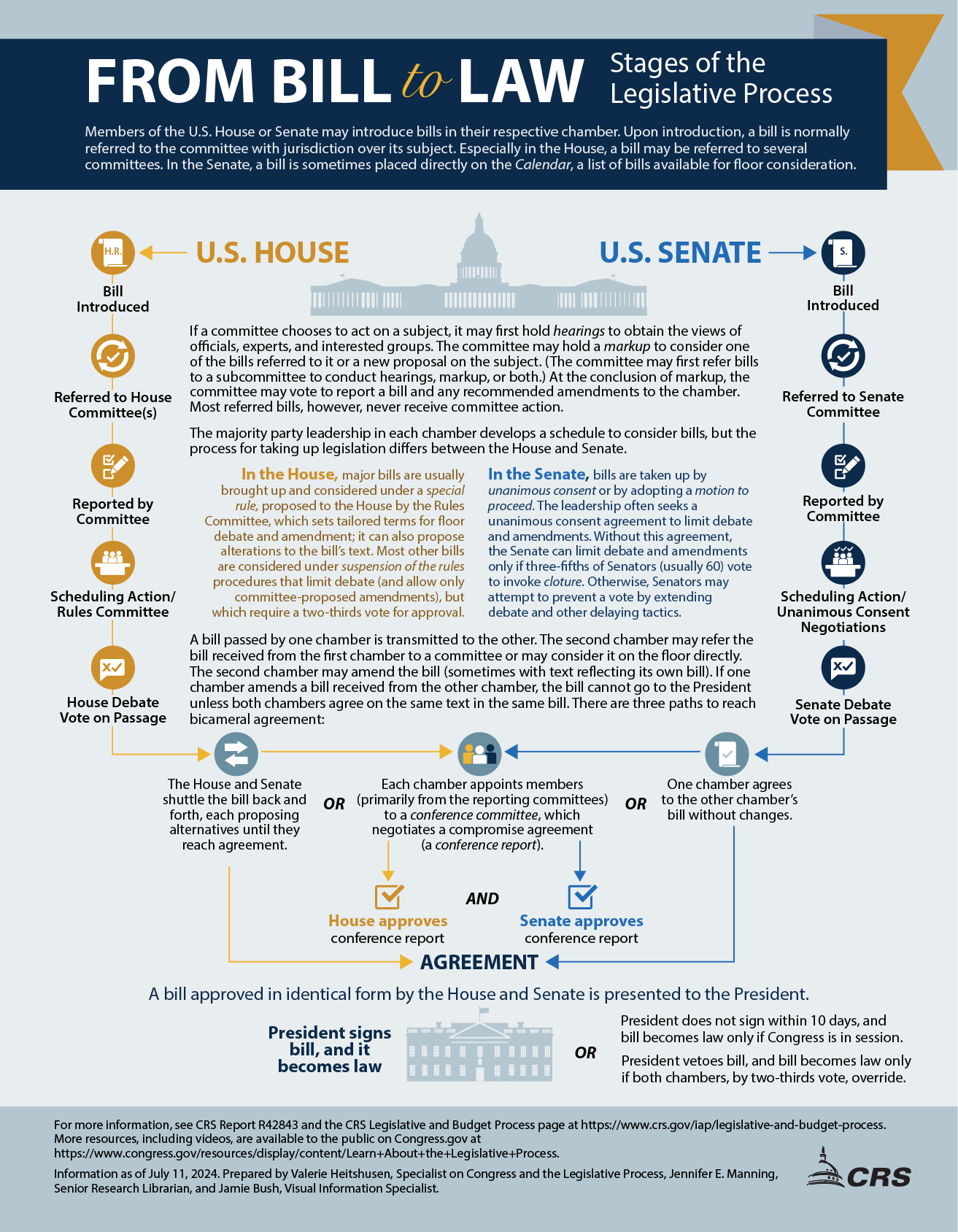
On the Senate floor, an ordinary bill can face prolonged debate. Cloture is a vote to limit that debate under Senate rules. Final passage is the later vote on whether the Senate adopts the bill. Invoking cloture does not itself pass the bill, and failing to invoke cloture does not itself vote the bill down.
Watch the following explanation for the basic distinction. It uses “51 votes” as shorthand for a majority; afterward, we will make that shorthand precise.
Senate filibusters and cloture
Watch “Senate filibusters and cloture” from Khan Academy to see why support for a bill and the ability to bring debate to a close are separate questions.
Start with committee to floor for the brief setup. Then watch debate and cloture, focusing on why the speaker associates 60 votes with ending debate but a majority with passing an ordinary bill. Stop before the discussion turns to nominations.
The video’s useful insight is that a bill might have enough supporters to win a final vote yet encounter an obstacle before that vote. Its shorthand needs one qualification: 60 is ordinarily the cloture threshold, not the legal threshold for final passage of an ordinary bill. A final passage vote can occur without a cloture vote if debate is not being prolonged.
What each threshold counts
The Senate’s own voting guide states the two rules side by side. Read its opening paragraph before working through the counts below.
Read “About Voting” from the U.S. Senate for its distinction between a majority vote on a measure and a cloture vote on legislation.
In the first paragraph of the main text, read the opening explanation. Focus on the sentences beginning “In most cases a simple majority” and “Under Senate debate rules.” Note the vice president’s role in a tie and the phrase “duly chosen and sworn.” The intervening examples of constitutional two-thirds votes are exceptions, not the rule for an ordinary bill.
For cloture on an ordinary bill, the usual requirement is three-fifths of senators duly chosen and sworn. If all 100 Senate seats are filled, that means 60 senators voting yes. The denominator is not just the number who turn up to vote: with all 100 senators sworn, one senator’s absence does not lower the requirement from 60 to 59.
For final passage of an ordinary bill, the usual requirement is a simple majority of senators voting, provided the Senate has a quorum. If all 100 senators vote, 51 yes votes defeat 49 no votes. If one is absent and the other 99 vote, 50 yes votes defeat 49 no votes. Thus “51 votes to pass” describes a common full-attendance result, not an unchanging threshold.
The vice president provides another important distinction. The vice president may cast a tie-breaking vote on final passage: if senators divide 50–50, a vice president voting yes can secure passage. But the vice president is not one of the senators whose votes make up the three-fifths required for legislative cloture. A 50–50 Senate cloture tally is nowhere near 60, with or without a vice-presidential tie-breaker.
| Question about an ordinary bill | Usual test | With 100 senators sworn |
|---|---|---|
| Did cloture succeed? | Yes votes from three-fifths of senators duly chosen and sworn | At least 60 senators vote yes |
| Did the bill pass, if a final vote occurred? | More yes than no votes among senators voting; a tied Senate vote can be broken by the vice president | Usually 51–49, or 50–50 with a vice-presidential yes vote |
The word “if” in the second row matters. A tally can show that a bill would pass if voted on without telling you whether its supporters can overcome opposition to reaching that vote.
Reading vote counts without mixing the questions
Suppose all 100 senators are sworn and all 100 vote 59 yes, 41 no. On cloture, the answer is no: 59 falls short of 60. On final passage, the answer is yes, if this is a final passage vote: 59 is a majority. The apparent contradiction disappears once you name the question being voted on.
Now change the tally to 60 yes, 40 no. Cloture succeeds if that is the cloture vote. But the bill has not thereby passed; the Senate has voted to limit debate. A later final passage vote decides the bill. Senators need not vote the same way twice. For example, 60 senators might agree to bring debate toward an end, while only 53 of them—or fewer—support the bill itself.
Consider a 50–50 split. If this is a final passage vote, the vice president can break the tie: a yes vote passes the bill; a no vote defeats it. If this is a cloture vote on an ordinary bill with 100 senators sworn, cloture fails. Thinking “the vice president makes 51” does not solve the cloture problem, because the requirement is 60 votes from senators.
Attendance tests whether you are using the correct denominator. With 50 yes, 49 no, and one absent, all 100 senators are still sworn. Cloture fails because it has only 50 yes votes, not 60. If the tally is instead on final passage, the bill passes 50–49, assuming the necessary quorum is present.
Vacancies differ from absences. If there are two vacant seats, only 98 senators are duly chosen and sworn; three-fifths of 98 requires 59 yes votes, rounding up to a whole senator. That is why 60 is called the usual cloture number rather than a number that applies regardless of Senate membership. In everyday examples with all seats filled, though, use 60.
A reliable way to interpret any report about Senate votes is to identify the question on the floor before interpreting the tally. “The bill got 59 votes” is incomplete: 59 votes would clear an ordinary final passage vote against 41 no votes but would fail a standard cloture vote with 100 senators sworn. Likewise, “cloture passed” tells you that a procedural hurdle was cleared, not that the bill passed.
Takeaway
For an ordinary bill, keep two decisions separate: cloture usually needs three-fifths of sworn senators (60 when all 100 seats are filled); final passage usually needs a simple majority of those voting, with the vice president able to break a tie. Neither vote substitutes for the other. Next, you will locate the points in the Senate’s consideration of a bill where debate and procedural choices can delay reaching a final vote.