In our last lesson, we explored how viruses act as nature's original genetic engineers, using sophisticated strategies to inject their own code into host cells. We saw that the lysogenic cycle, in particular, provides a natural template for permanently integrating new DNA into a genome. This gives us a potential delivery system, but how do we control what gets changed?
This lesson introduces the other half of the puzzle: a precision editing tool. We will explore CRISPR-Cas9, a revolutionary technology that functions as a molecular "search and replace" for DNA. Your background in computer science and mathematics will be helpful here, as we can think of CRISPR as a programmable system with a specific addressing mechanism and an execution function. By the end of this lesson, you will understand the conceptual mechanics of how CRISPR finds a target gene, makes a change, and how scientists have refined this tool for incredible precision.
From Bacterial Defense to a Revolutionary Tool
The story of CRISPR doesn't start in a high-tech gene-editing lab, but with a puzzle in microbiology. Scientists noticed strange, repeating DNA sequences in bacteria. For a long time, their purpose was a mystery.
To understand what they discovered, let's turn to a short, engaging animated overview from TED-Ed.
How CRISPR lets you edit DNA - Andrea M. Henle
This video, "How CRISPR lets you edit DNA," provides an excellent conceptual introduction to where CRISPR comes from and how scientists have adapted it.
Please watch the first part of the video, focusing on two key segments: First, watch the section explaining CRISPR's natural function as a bacterial immune system. Pay attention to how bacteria capture viral DNA to create a "memory" of the invader. Next, watch how scientists hijacked this system. This part explains how the natural defense mechanism was repurposed into a programmable editing tool.
As the video explains, CRISPR (Clustered Regularly Interspaced Short Palindromic Repeats) is fundamentally an adaptive immune system for bacteria. Let's formalize the key components:
- Genetic Memory: When a virus infects a bacterium, the bacterium's defense proteins (Cas proteins) cut out a piece of the viral DNA and store it in its own genome within the CRISPR region. These stored fragments act as a "most-wanted gallery" of past invaders.
- The Search Party: The bacterium transcribes these stored viral DNA fragments into short RNA molecules. This RNA molecule is known as the guide RNA (gRNA).
- The Executioner: The guide RNA attaches to a protein called Cas9, which is a nuclease—an enzyme that cuts DNA.
- Seek and Destroy: The gRNA-Cas9 complex then patrols the cell. If it encounters DNA that matches the sequence in the guide RNA (i.e., if the same virus invades again), the gRNA binds to it, and the Cas9 protein cuts the viral DNA, neutralizing the threat.
The elegance of this system lies in its programmability. The Cas9 protein is a general-purpose cutting tool; it's the guide RNA that gives it a specific target.
Engineering CRISPR: The "Search and Replace" Function
The brilliant insight by scientists was realizing that this system could be reprogrammed. You don't have to use a guide RNA that targets a virus; you can synthesize a guide RNA that targets any gene in any organism.
This transforms the CRISPR-Cas9 system from a bacterial defense mechanism into a universal gene editor. Here is the conceptual workflow:
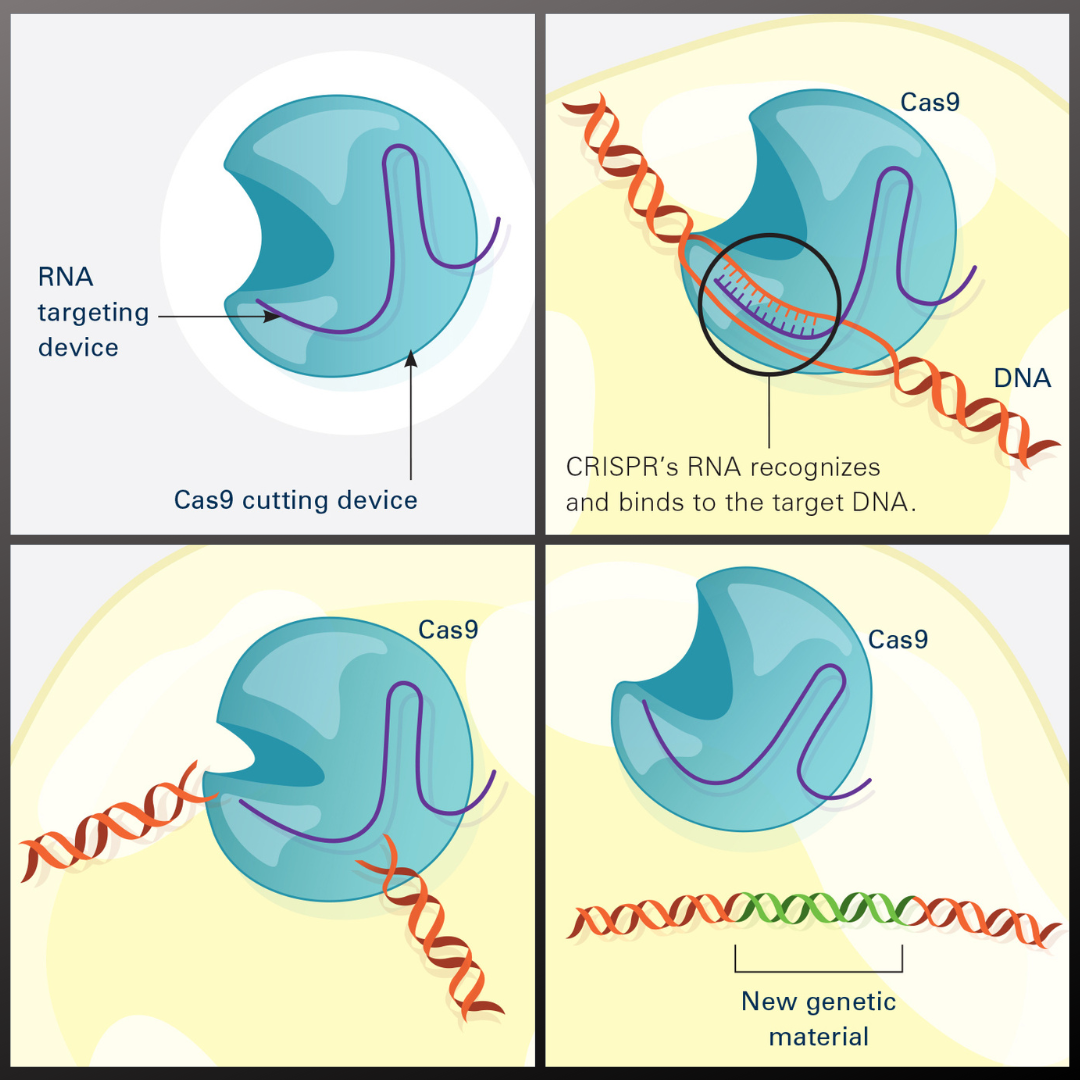
The process is analogous to a 'find and replace' command in a text editor:
- The "Find" command: You provide a specific string of text to search for. In CRISPR, this is the sequence you encode into the guide RNA.
- The "Execute" command: The Cas9 protein travels to the location specified by the guide RNA and makes a precise double-strand break (DSB) in the DNA.
But what happens after the cut? This is where the cell's own systems take over and where the "replace" part of the operation occurs.
To see this in more detail, we'll watch a segment from a video by the McGovern Institute at MIT.
Genome Editing with CRISPR-Cas9
This animation, "Genome Editing with CRISPR-Cas9," clearly illustrates what happens at the molecular level after Cas9 makes its cut.
Watch from the point where the complex enters the nucleus. The video details two possible outcomes after the DNA is cut: The cell's default, error-prone repair process. A more precise repair process that can be guided by a template.
The video introduces the two main DNA repair pathways that cells use to fix a double-strand break. The outcome of the edit depends on which pathway is used.
-
Non-Homologous End Joining (NHEJ): This is the cell's quick-and-dirty emergency repair system. It stitches the two broken ends of the DNA back together. However, this process is error-prone and often results in small random insertions or deletions of base pairs (called indels). These indels can scramble the gene's code, effectively disabling or "knocking out" the gene. In a programming analogy, this is like deleting a critical character or line, causing a syntax error that breaks the function.
-
Homology-Directed Repair (HDR): This is a more precise repair pathway. If the cell can find a template sequence that matches the area around the break, it will use that template to repair the gap flawlessly. Scientists can exploit this by supplying an artificial DNA template along with the CRISPR-Cas9 components. This template contains the desired new sequence. The cell's HDR machinery then uses this template to "fix" the break, effectively replacing the original sequence with the new one. This is a true "search and replace."
The programmability of CRISPR is what makes it so powerful compared to older gene-editing methods, which required redesigning an entire protein for each new target—a complex and unpredictable process. With CRISPR, you just need to synthesize a new RNA sequence, which is trivial from a molecular biology standpoint.
Advancing Precision: Base and Prime Editing
While powerful, the reliance of CRISPR-Cas9 on double-strand breaks and cellular repair is not ideal. DSBs can stress the cell, and the outcomes of NHEJ are unpredictable. This has driven the development of even more precise tools.
The following article from Drug Discovery News provides an excellent summary of the current landscape.
What are gene editing therapies? CRISPR, base editing, and prime ...
This article explains the evolution from standard CRISPR-Cas9 to the next generation of editors that offer higher precision.
Please read the following three sections: Start with CRISPR-Cas9 to review the core mechanism and its limitations. Next, read Base editing, which explains how to make single-letter changes without cutting the DNA. Finally, read the section on Prime editing, which describes the most versatile "search-and-replace" tool to date.
Let's summarize these advanced systems:
-
Base Editing: Think of this as chemical surgery on DNA, not mechanical cutting. It uses a modified, "blunted" Cas9 that can't cut both strands but still finds the target address. Fused to this Cas9 is a different enzyme (a deaminase) that chemically converts one DNA base into another (e.g., changing a C to a T) without breaking the DNA backbone. It's incredibly precise for fixing single-letter mutations, a common cause of genetic diseases.
-
Prime Editing: This is perhaps the closest biological analog to a true software patch. It uses a Cas9 that only "nicks" one strand of the DNA. Fused to it is a reverse transcriptase enzyme—the same type used by retroviruses, which we discussed in the last lesson. The guide RNA (called a pegRNA) not only contains the target address but also the template for the new sequence. The prime editor nicks the DNA, and the reverse transcriptase directly synthesizes the new DNA sequence into the target site. This allows for all types of small edits—substitutions, insertions, and deletions—with high precision and without a double-strand break.
These advancements represent a rapid evolution from a "molecular sledgehammer" to "molecular scalpels," pushing the technology closer to the level of control required for safe and effective therapeutic use.
Conclusion
In this lesson, we have demystified the function of CRISPR-Cas9, a technology that has transformed bioscience. We've seen how a natural bacterial defense system was ingeniously repurposed into a programmable tool for editing the source code of life.
Key Takeaways:
- CRISPR-Cas9 is a two-part system: a guide RNA that specifies the target DNA address, and a Cas9 enzyme that cuts the DNA at that address.
- The system's power lies in its programmability; changing the target is as simple as designing a new guide RNA.
- After the DNA is cut, the cell's repair mechanisms take over. NHEJ can be used to disable a gene, while HDR, when supplied with a template, can be used to correct or replace a gene sequence.
- Newer technologies like Base Editing and Prime Editing offer even greater precision by avoiding destructive double-strand breaks, allowing for direct chemical modification or rewriting of the DNA sequence.
You now understand the core mechanics of both a delivery system (viral vectors) and a powerful editing tool (CRISPR). In our next lesson, we will begin to synthesize these ideas. We will compare different methods for delivering these genetic editors into organisms and introduce the concept of a gene drive—a mechanism that uses CRISPR to force a genetic change to spread through an entire population, bringing us one step closer to the scenarios imagined in Children of Time.