Introduction
Welcome to a new module! In our last lesson, we concluded our deep dive into adapting models internally by evaluating the performance delta between a base model and its fine-tuned version. You learned that while fine-tuning is powerful for teaching a model how to behave, it's often inefficient and costly for teaching it new facts, especially when that information is vast or changes frequently.
This limitation brings us to a fundamental challenge in applied AI: how do we ground a model in truth, keep its knowledge current, and make it an expert in a specific domain without constant, expensive retraining?
This lesson introduces the dominant architectural pattern for solving this problem: Retrieval-Augmented Generation (RAG). Our goal is to explain the RAG architecture and how it mitigates core LLM limitations like knowledge cutoffs and hallucinations. Understanding RAG is not just another tool in your toolkit; it's a paradigm shift that turns general-purpose LLMs into specialized, trustworthy, and production-ready applications.
The Core Problem: Parametric Memory is Not Enough
To understand why RAG is so essential, we first need to appreciate the inherent limitations of a standalone LLM. An LLM stores its knowledge within its parameters—a concept known as parametric memory. This knowledge is compressed from its vast training data. However, as the article "Beyond the Prompt" astutely points out, this compression is lossy and leads to several critical failures.
Beyond the Prompt: The Definitive Engineering Guide to Retrieval-Augmented Generation (RAG)
Let's start by reading the introduction from 'Beyond the Prompt: The Definitive Engineering Guide to Retrieval-Augmented Generation (RAG)'. This article frames the problem in terms that will resonate with your engineering background.
Read the sections 'Introduction: The Problem with Parametric Memory' and the first few paragraphs of 'Background: Foundations of RAG'. Focus on understanding why parametric memory fails (private, forgotten, or stale data) and how RAG offers an 'open-book test' alternative to fine-tuning.
As you just read, the core issues with relying solely on an LLM's parametric memory are:
- Hallucinations: When a model doesn't know an answer, it often "pattern-matches" its way to a plausible but incorrect response. It's a confident liar.
- Knowledge Cutoff: The model's knowledge is frozen at the time of its last training run. It has no awareness of events, data, or information created since then.
- Lack of Access to Private Data: The model knows nothing about your company's internal wiki, your project's codebase, or any other proprietary information it wasn't trained on.
Let's watch a short video that uses a couple of simple examples to make these abstract problems very concrete.
Retrieval-augmented generation (RAG), Clearly Explained (Why it Matters)
The video 'Retrieval-augmented generation (RAG), Clearly Explained' by Builders Central starts by perfectly illustrating the frustration of hallucinations and knowledge cutoffs.
Watch the first 1 minute and 19 seconds of the video. The speaker clearly articulates why asking an LLM about future events or private code fails, setting the stage for a solution.
The RAG Solution: An Open-Book Exam
So, how do we fix this? The article you read contrasted two approaches: fine-tuning (teaching the model) and RAG (giving the model an open book for the test).
While fine-tuning is great for adapting a model's style or behavior, it's less effective for injecting factual knowledge. RAG takes a different, more scalable approach. Instead of trying to cram all possible knowledge into the model's parameters, we connect the model to an external, searchable knowledge base at inference time.

This approach offers several powerful advantages over relying on fine-tuning for knowledge injection.
A Practitioners Guide to Retrieval Augmented Generation (RAG)
Let's read 'A Practitioners Guide to Retrieval Augmented Generation (RAG)' to understand the key benefits.
Read the section 'The Benefits of RAG'. Pay close attention to the four main advantages listed: reducing hallucinations, access to up-to-date information, data security, and ease of implementation.
In essence, RAG makes the LLM:
- More Truthful: By grounding its answers in retrieved documents, we reduce hallucinations and can provide citations for verification.
- More Current: We can continuously update the external knowledge base with new information without ever retraining the LLM.
- More Secure: Proprietary data is used at inference time but is never baked into the model's weights, mitigating data leakage risks.
- More Cost-Effective: Updating a vector index is far cheaper and faster than running a full fine-tuning job on a massive model.
The RAG Architecture: A Two-Phase System
Now, let's dissect the architecture that makes this possible. A RAG system consists of two main pipelines: an offline indexing pipeline and an online retrieval-and-generation pipeline.
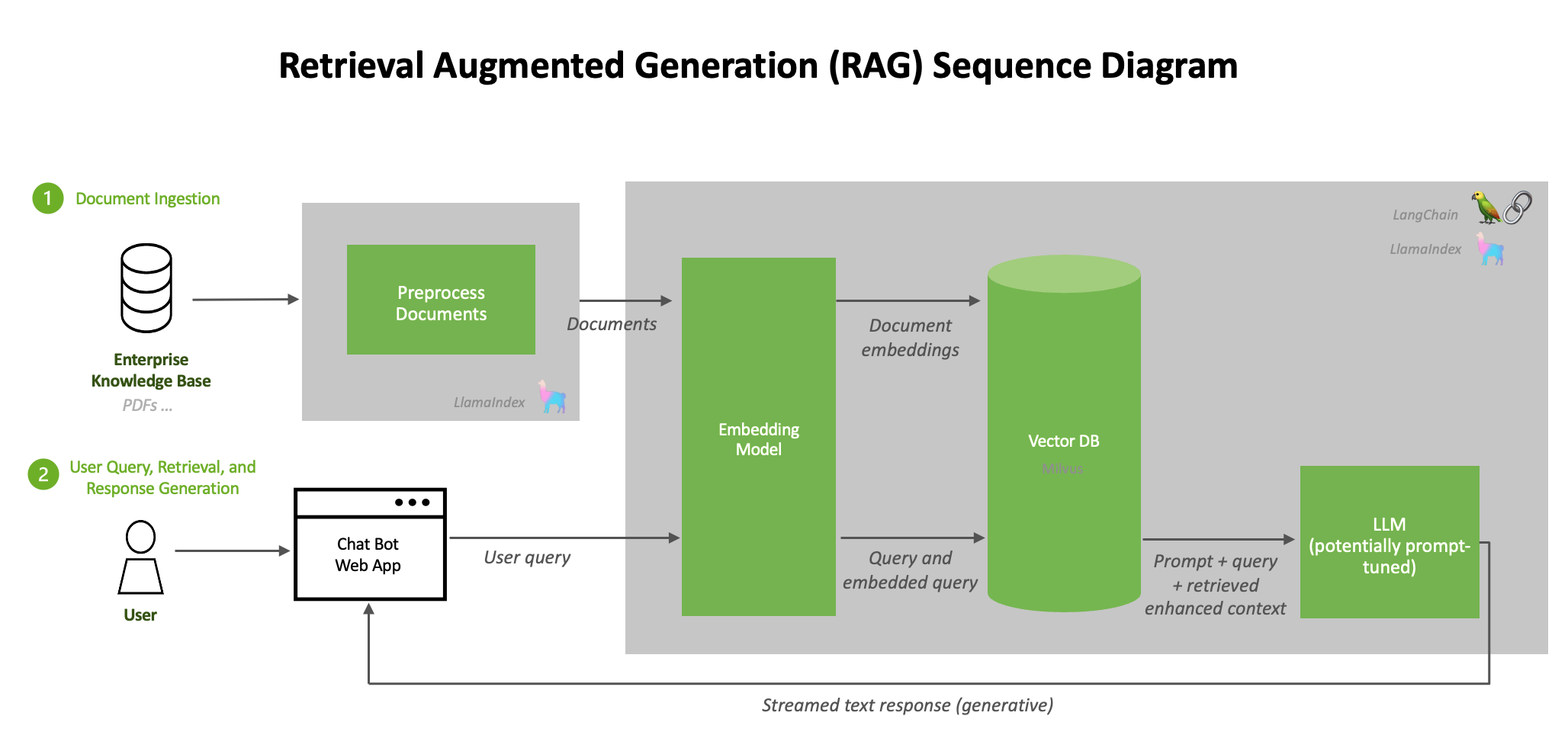
The video from Builders Central that we started earlier provides an excellent, detailed walkthrough of this process using a "high-tech library" analogy.
Retrieval-augmented generation (RAG), Clearly Explained (Why it Matters)
We'll now watch the core architectural explanation from 'Retrieval-augmented generation (RAG), Clearly Explained'. The library analogy is a very effective way to map each technical step to an intuitive concept.
Watch from 04:14 to 08:34. As you watch, mentally map each step of the library analogy to its technical counterpart: Data Intake (Books arrive): Sourcing your documents (PDFs, Markdown, etc.). Chunking (Breaking books into index cards): Splitting large documents into smaller pieces. Embedding (Giving each card GPS coordinates): Using an embedding model to convert text chunks into vectors. Vector Storage (High-tech shelves): Storing these vectors in a specialized vector database. Retrieval (Librarian finds the cards): Embedding the user query and finding the most similar document vectors. Synthesis (Librarian writes the answer): Passing the query and retrieved context to the LLM to generate a final answer.
To solidify this, let's review the flow with a slightly different explanation from IBM Technology.
What is Retrieval-Augmented Generation (RAG)?
This short clip from IBM Technology, 'What is Retrieval-Augmented Generation (RAG)?', provides a concise summary of the retrieval and generation flow, reinforcing what you just learned.
Watch from 02:50 to 04:30. Notice how the prompt sent to the LLM is augmented with the 'retrieved content' alongside the original user question. This is the 'A' in RAG—the augmentation.
How RAG Solves the Core LLM Problems
Let's explicitly connect this architecture back to the problems we identified at the start.
-
Mitigating Hallucinations: The final prompt explicitly instructs the LLM to base its answer on the provided context. By "grounding" the model with factual source material, its tendency to invent information is drastically reduced. We can even add an instruction like, "If the answer is not in the provided context, say 'I don't know.'" This transforms the LLM from a creative storyteller into a fact-based synthesizer.
-
Overcoming Knowledge Cutoffs: The LLM itself remains frozen in time, but the knowledge base it queries is alive. If a new discovery is made or your company policy changes, you simply add the new documents to your vector database. The next time a user asks a relevant question, the RAG system will retrieve the fresh information and provide an up-to-date answer. The model's knowledge is effectively as current as its data source.
-
Enabling Domain Expertise: The knowledge base can be populated with any corpus of data—internal technical documentation, legal contracts, medical research papers, etc. The RAG system allows the general-purpose LLM to act as an expert on that specific domain without having been trained on it, democratizing access to specialized information.
Test your understanding!
A user asks a chatbot powered by a base LLM trained in 2023: "What were the key architectural innovations in the Llama 3 model released in April 2024?"
- What is the likely response of the base LLM without RAG?
- Now, imagine this chatbot is enhanced with a RAG system whose knowledge base includes the Llama 3 research paper. Briefly outline the six steps the RAG system would take to generate a correct answer.
Show answer
-
Base LLM Response: The base LLM would likely hallucinate or state that it doesn't have information past its 2023 knowledge cutoff. It might say something like, "As of my last update, Llama 3 has not been released, so I cannot provide details on its architecture."
-
RAG System Steps:
- Ingestion/Indexing (Done beforehand): The Llama 3 research paper was ingested, chunked, embedded, and stored in the vector database.
- Embed User Query: The user's question, "What were the key architectural innovations in the Llama 3 model...", is converted into a vector embedding.
- Retrieve: The system performs a similarity search in the vector database using the query vector. It finds chunks from the research paper that discuss Llama 3's architecture (e.g., its use of GQA, larger vocabulary, etc.).
- Augment Prompt: A new prompt is constructed, combining the original query with the retrieved text chunks. For example:
Context: [Text from Llama 3 paper about GQA and vocabulary]. Question: What were the key architectural innovations in the Llama 3 model? Based only on the context provided, answer the question. - Generate: This augmented prompt is sent to the LLM.
- Synthesize Answer: The LLM reads the context and the question and generates a factually grounded answer, such as: "The key architectural innovations in Llama 3 included the use of Grouped-Query Attention (GQA) to improve inference efficiency and an expanded tokenizer with a 128K token vocabulary..."
Conclusion
In this lesson, you've grasped the fundamental "why" and "how" of Retrieval-Augmented Generation. You've moved beyond seeing LLMs as static, all-knowing oracles and now understand them as powerful reasoning engines that can be connected to dynamic, external knowledge.
Key Takeaways:
- Problem: Standard LLMs suffer from hallucinations, stale knowledge (knowledge cutoff), and a lack of access to private data due to their reliance on static, parametric memory.
- Solution: RAG provides an "open-book" approach, connecting the LLM to an external knowledge base at inference time.
- Architecture: RAG involves two key phases: an offline indexing phase (chunk, embed, store) and an online inference phase (embed query, retrieve, augment, generate).
- Benefits: This architecture makes LLM applications more truthful, current, domain-specific, and cost-effective to maintain compared to knowledge injection via fine-tuning.
What's Next?
We've covered the high-level RAG architecture. Now it's time to start getting our hands dirty. As the saying goes, "the devil is in the details," and the first critical detail in any RAG pipeline is how you prepare your data.
In the next lesson, we will dive into the first step of the indexing pipeline: document chunking. You will learn various strategies for splitting documents and explore the crucial trade-offs between chunk size, overlap, and their impact on retrieval quality.