Introduction
Welcome back. In our last lesson, we conducted a detailed comparative analysis of specific state-of-the-art LLM architectures, examining the design choices behind models like Llama, Mistral, and DeepSeek. We looked at them as snapshots of the current landscape.
This lesson serves as the grand finale for our exploration of LLM architectures. We will zoom out from individual models to trace the overarching story of their development. Your learning outcome is to trace the architectural evolution from the original Transformer to modern LLMs, identifying key trends and innovations.
Instead of just knowing what changed, you'll understand why. Each major innovation was a direct response to a specific engineering problem—computational cost, memory bottlenecks, training instability, or limited context. Understanding this evolutionary path is crucial for an elite engineer, as it provides the context to anticipate future trends and make informed architectural decisions in your own work.
The Starting Point: The 2017 "Vanilla" Transformer
To appreciate the journey, we must first remember our origin point: the 2017 "Attention Is All You Need" Transformer. Its architecture, while revolutionary, had characteristics that modern designs have systematically improved upon.
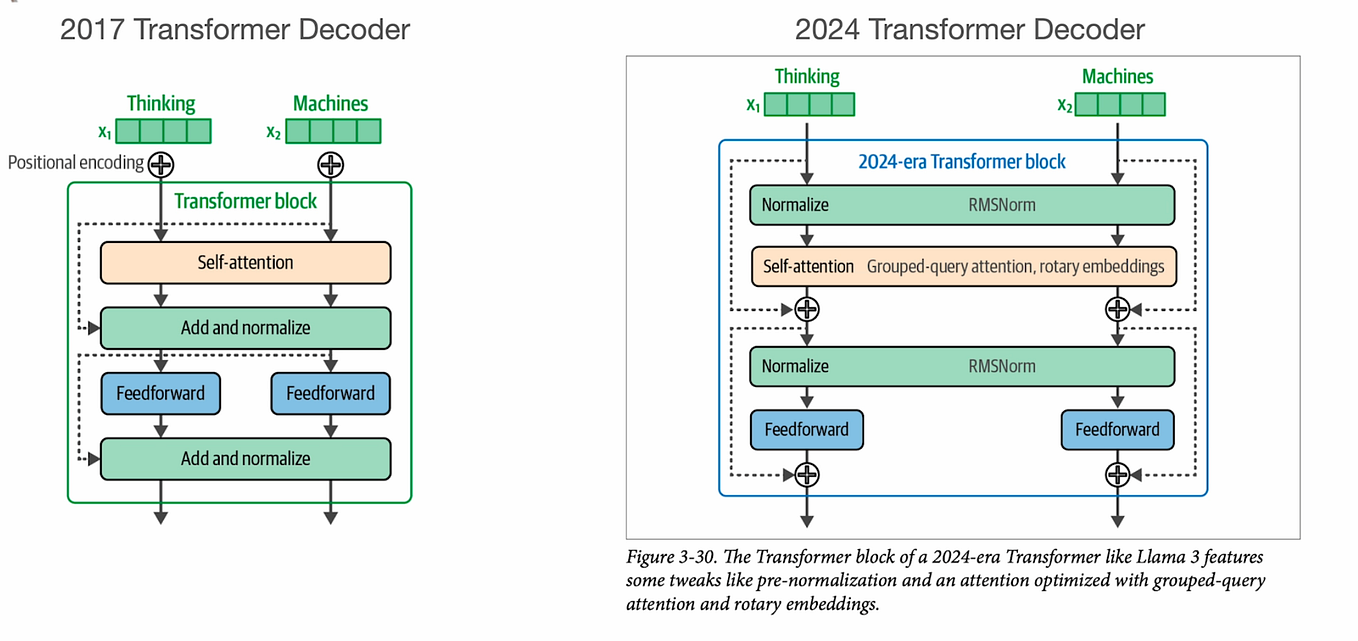
Key features of the original Transformer included:
- Encoder-Decoder Structure: Designed for machine translation.
- Post-LayerNorm: Normalization applied after sub-layer operations.
- Absolute Positional Encodings: Sinusoidal functions to denote token position.
- Multi-Head Attention (MHA): The core mechanism, with full quadratic complexity.
- ReLU/GELU Activation: The standard activation function in the feed-forward network.
Every one of these features has been a target for innovation. Let's trace the major trends that have shaped the evolution from this baseline to the models of today.
Key Evolutionary Trends in LLM Architecture
The evolution of LLMs is not random; it's a story of targeted problem-solving. A fantastic overview of these advancements is provided in the article "Advancements in Modern LLM Architectures" and the detailed video "LLaMA explained". We will use them to frame our discussion.
Advancements in Modern LLM Architectures
The article 'Advancements in Modern LLM Architectures' provides an excellent summary of the key innovations that define modern LLMs. We'll use it as a guide to structure the main evolutionary trends.
Please read the 'Key Takeaways' section. This will give you a high-level map of the major evolutionary pressures: efficiency, context length, inference speed, and the challenge to the Transformer itself. We will dive into each of these points in our lesson.
Trend 1: Architectural Simplification (Decoder-Only)
The original Transformer was an encoder-decoder model, ideal for sequence-to-sequence tasks like translation. However, for open-ended text generation, a simpler architecture proved more effective.
- Evolution: Encoder-only (e.g., BERT for analysis) and Encoder-Decoder models (e.g., T5 for transfer learning) gave way to the now-dominant Decoder-Only architecture for generative tasks (GPT series, Llama, Mistral).
- Why? The autoregressive nature of the decoder is perfectly suited for next-token prediction. This simplification streamlined both training and inference for large-scale language modeling.
Trend 2: Solving The Core Bottlenecks: Stability, Position, and Activation
Several core components of the original Transformer were quickly identified as areas for improvement. The Llama family of models is a perfect case study of how these new standards were integrated.
To see these pieces in detail, this video provides a clear, technical breakdown of the components that define a "modern" LLM.
LLaMA explained: KV-Cache, Rotary Positional Embedding, RMS Norm, Grouped Query Attention, SwiGLU
The video 'LLaMA explained' meticulously breaks down the key innovations that separate models like Llama from the original Transformer. Watching these segments will clarify the 'end state' of this evolutionary path.
Please watch the following segments, focusing on the problem each innovation solves: RMS Normalization (00:20:28 - 00:24:31): Understand why RMSNorm replaced LayerNorm for efficiency. Rotary Positional Embeddings (00:24:31 - 00:37:16): Grasp how RoPE provides better relative position information and length extrapolation compared to absolute encodings. SwiGLU Activation (01:04:05 - 01:09:46): See why this replaced ReLU/GELU to become the new standard in feed-forward layers.
- Normalization: Shift from Post-Norm to Pre-Norm for improved gradient flow and training stability. Then, a shift from LayerNorm to RMSNorm to reduce parameters and computational cost.
- Positional Encoding: Moved from fixed Absolute Encodings to Rotary Positional Embeddings (RoPE). RoPE injects relative position information directly into the attention mechanism, offering superior performance on long sequences. This was further enhanced by methods like YaRN for extreme context window extension.
- Activation Function: Transitioned from ReLU/GELU to gated functions like SwiGLU, which consistently showed better performance in practice, likely due to enhanced expressive power.
Trend 3: Taming Attention's Appetite for Compute and Memory
The O(n^2) complexity of self-attention remains the biggest challenge. The evolution here has been multi-pronged, addressing different facets of the problem.
-
Algorithmic Efficiency (FlashAttention): This is not an architectural change but a groundbreaking implementation that fuses attention operations into a single GPU kernel. By minimizing slow read/writes to GPU HBM, FlashAttention made it feasible to train on much longer sequences without changing the attention mathematics. It's now a universal standard.
-
Inference Efficiency (GQA & MQA): As we've covered, the KV cache is a major memory bottleneck during inference. The evolution from Multi-Head Attention (MHA) to Multi-Query Attention (MQA) and the more balanced Grouped-Query Attention (GQA) was driven entirely by the need to reduce this cache size, leading to faster token generation and the ability to handle longer contexts.
-
Scaling to Massive Parameter Counts (MoE): To build models with trillions of parameters without incurring impossible inference costs, the industry turned to Mixture-of-Experts (MoE). This "sparse activation" approach allows models to store vast amounts of knowledge, but only use a small, relevant fraction of it for any given token. It represents a major architectural fork from the "dense" model path.
-
Challenging the Paradigm (Linear Attention & State-Space Models): A more radical line of evolution seeks to replace quadratic attention altogether. Architectures like Mamba (SSM) and linear attention variants (e.g., Gated DeltaNet in Qwen3-Next) offer linear-time scaling, promising revolutionary efficiency for extremely long sequences. While still maturing, they represent the frontier of sequence modeling.
For a great overview of these attention-related optimizations and the emerging alternatives, review the following resource.
LLM Building Blocks & Transformer Alternatives
Dr. Sebastian Raschka provides a clear, high-level summary of the key optimizations used in modern models to tackle the attention bottleneck and scale efficiently.
Please watch these segments to connect the different optimization strategies: Grouped Query Attention (00:02:08 - 00:05:29): Reinforces the 'why' behind reducing the KV cache. Sliding Window Attention (00:09:38 - 00:13:45): An alternative approach to managing long contexts by limiting the attention scope. Mixture of Experts (00:13:45 - 00:16:37): Understand how MoE enables scaling via sparsity. Transformer Alternatives (00:16:37 - 00:26:09): A tour of the research frontier, including Mamba and other non-Transformer architectures.
Synthesis: The Story of LLM Evolution
The journey from the 2017 Transformer to a modern LLM is a clear narrative of addressing bottlenecks.

We can summarize the key evolutionary steps in a "Problem -> Solution" framework:
| Problem in Original Transformer | Key Innovation / Evolutionary Trend |
|---|---|
| Training Instability | Pre-Normalization: Moving LayerNorm/RMSNorm before the sub-layer improves gradient flow. |
| Poor Length Generalization | Rotary Positional Embeddings (RoPE): Encodes relative position, enabling better performance on sequences longer than seen in training. |
| High Inference Memory (KV Cache) | Grouped-Query Attention (GQA): Reduces the size of the KV cache by sharing key/value heads, speeding up autoregressive generation. |
| Scaling Parameter Count is Costly | Mixture-of-Experts (MoE): Enables massive parameter counts by only activating a small subset of "expert" weights per token, decoupling knowledge capacity from inference cost. |
| Slow Memory I/O in Attention | FlashAttention: An algorithmic optimization (not architectural) that fuses attention calculations into a single kernel, drastically reducing memory transfers and speeding up computation. |
| Sub-optimal FFN Performance | SwiGLU Activation: Replaced ReLU/GELU, consistently yielding better results and becoming the new standard in the feed-forward block. |
Fundamental O(n^2) Complexity |
Alternative Architectures (Mamba, etc.): Emerging research on State-Space Models and linear attention variants that scale linearly (O(n)) with sequence length, representing a potential paradigm shift. |
Test your understanding!
A new research paper claims to have developed a "next-generation" 1-trillion-parameter LLM. Based on the evolutionary trends we've discussed, which of the following architectural features would you be most surprised to see in its design, and why?
A) The use of Post-Layer Normalization.
B) A dense (non-MoE) architecture.
C) The use of Multi-Head Attention instead of GQA/MQA.
D) The use of SwiGLU in its feed-forward networks.
Show answer
The most surprising feature would be B) A dense (non-MoE) architecture.
Reasoning: The primary driver for the MoE trend is to enable scaling to massive parameter counts (like 1 trillion) while keeping inference computationally feasible. A 1-trillion-parameter dense model would be extraordinarily expensive to run for inference, as every single parameter would be used for every token. This runs counter to the major evolutionary trend of optimizing for efficient scaling. While Post-Norm (A) and MHA (C) are older techniques, they are not as fundamentally prohibitive at that scale as being a fully dense model would be. SwiGLU (D) is the current standard and would be expected.
Conclusion
You have now traced the complete architectural arc from the original Transformer to the sophisticated LLMs of today. This was not a random walk, but a series of brilliant engineering solutions to concrete problems.
Key Takeaways:
- Evolution is Problem-Driven: Advancements like RoPE, GQA, MoE, and RMSNorm were not arbitrary; they were created to solve specific issues related to performance, efficiency, and scale.
- Efficiency is the Mainspring of Innovation: Many key changes—FlashAttention, GQA, RMSNorm—are about doing the same thing, but faster and with less memory. This is what has unlocked the ability to train ever-larger models on ever-longer contexts.
- A New Standard Has Emerged: The "Llama-style" architecture (Pre-RMSNorm, RoPE, SwiGLU, GQA) represents the modern, efficient baseline for dense models.
- The Frontier is Diverse: The largest models are converging on sparse MoE architectures, while radical new designs like State-Space Models (Mamba) are challenging the very foundations of the Transformer paradigm.
What's Next?
With this lesson, you have completed your deep dive into the architecture of LLMs. You understand the components, how they fit together, and the evolutionary story behind their design.
Our next module, "Training and Scaling Large Language Models," shifts from the blueprint to the construction site. Now that we know what these models are, we will explore how they are built. Our first lesson will start at the very beginning of the pipeline: tokenization. You will learn about methods like Byte-Pair Encoding (BPE), understand how text is converted into a format a model can process, and see how this seemingly simple step has profound implications for a model's vocabulary, performance, and multilingual capabilities.