Introduction
Welcome back! In our last lesson, we explored Mixture-of-Experts (MoE), an architectural innovation for scaling a model's knowledge capacity while keeping computation manageable. We saw how replacing the dense Feed-Forward Network (FFN) with a sparse set of experts allows models to grow to trillions of parameters.
Today, we shift our focus from the FFN layer to another fundamental component of the Transformer: positional encoding. You'll recall from our earlier modules that because the self-attention mechanism is permutation-invariant, we must explicitly inject information about a token's position in the sequence. The original Transformer did this by adding fixed sinusoidal embeddings. While functional, this approach has limitations.
This lesson addresses the learning outcome: Explain Rotary Positional Embeddings (RoPE) and their advantages over absolute or learned positional encodings. RoPE is the modern, elegant solution to this problem, used in virtually all state-of-the-art models like Llama 3, Mistral, and many others. We'll discover how it uses a clever geometric insight—rotation—to encode position in a way that is both more powerful and more flexible than its predecessors.
The Problem: The Rigidity of Absolute Positions
Before diving into RoPE, let's solidify our understanding of why older methods like absolute positional embeddings are problematic. In these methods, a unique vector is created for each position (e.g., position 0, position 1, etc.) and added to the token's content embedding.
Consider the word "transformer" in these two sentences:
- "A transformer is an electrical device." (Position 2)
- "The architecture of the model is a transformer." (Position 7)
With absolute positional embeddings, the final input vector for "transformer" would be completely different in each case (embedding_transformer + pos_2 vs. embedding_transformer + pos_7). This forces the model to re-learn the meaning of the word "transformer" and its potential interactions at every single position in the sequence. This is highly inefficient and doesn't capture the intuitive idea that language is built on relative relationships.
The following video explains this "old way" and its fundamental flaws, setting the stage for a better solution.
Give me 30 min, I will make RoPE click forever
This video, 'Give me 30 min, I will make RoPE click forever' by Zachary Huang, starts by perfectly articulating the problem with absolute positional embeddings. Understanding this problem is key to appreciating RoPE's design.
Watch from 01:24 to 04:04. Pay close attention to the example of the 'red car'. It clearly illustrates how absolute embeddings create different input vectors for the same word, forcing the model to be inefficient.
The ideal system, as the video concludes, is one where the attention score between two tokens depends only on their content and their relative distance (e.g., "3 tokens apart"), not their absolute positions.
The Core Idea of RoPE: Position as Rotation
RoPE achieves this ideal system with a simple yet profound insight: what if we encode position not by adding a vector, but by rotating the query and key vectors?
This is what the video calls the "geometric split":
- The length (norm) of a vector represents its semantic meaning (the "what").
- The direction (angle) of a vector represents its position (the "where").
By using rotation, we can change a vector's direction to encode its position without altering its length. This preserves the original semantic meaning of the token's embedding, which was a major issue with the additive approach.
This is the billion-dollar idea. Before we get into the math, let's watch the video segment that introduces this concept.
Give me 30 min, I will make RoPE click forever
This next segment explains the core 'geometric split' idea and answers some key practical questions about where and how RoPE is applied in a Transformer.
Watch from 04:32 to 06:30. Focus on three key takeaways: RoPE is applied only to the Query (Q) and Key (K) vectors. RoPE is a fixed, deterministic mathematical function—it is not learned. The concept of separating meaning (length) and position (direction).
From 2D Rotation to High-Dimensional Embeddings
The math for rotating a 2D vector is straightforward high-school trigonometry using a 2x2 rotation matrix. A key property, as you might recall, is that rotation is an isometry—it preserves distances and, crucially for us, the vector's length (norm).
The real challenge is: how do we rotate a high-dimensional vector, like the 4096-dimensional embeddings common in LLMs? A direct 4096x4096 rotation matrix would be computationally nightmarish.
RoPE's solution is elegant:
- Pairwise Split: The high-dimensional vector is treated as a sequence of 2D vectors. For a
d-dimensional vector, we getd/2pairs. - Different Frequencies: Each pair is rotated, but at a different "speed" or frequency. This is analogous to a clock, where the second, minute, and hour hands all rotate but at different rates. The combination of their positions gives a unique signature for any moment in time. Similarly, rotating each vector pair at a unique speed gives every position a unique rotational signature.
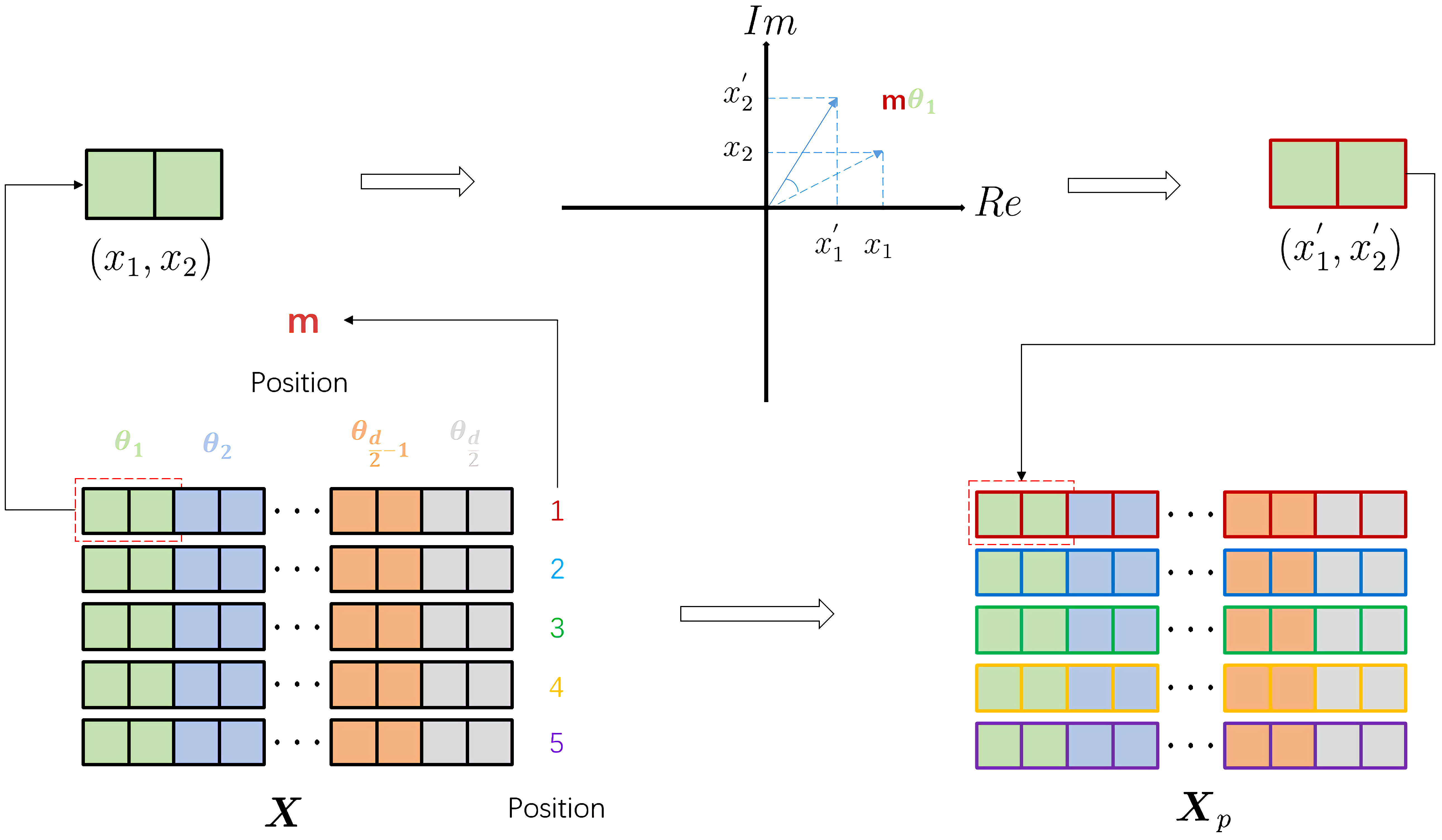
The formula for the rotation frequency for the -th pair is designed such that early pairs ("high frequency") spin fast, while later pairs ("low frequency") spin very slowly.
where d is the total dimension of the embedding.
Let's see this in action.
Give me 30 min, I will make RoPE click forever
The following clip explains the pairwise split strategy, the clock analogy for different frequencies, and walks through a concrete 4D example.
Watch from 10:32 to 16:16. This is a dense but critical section. First, internalize the pairwise split and the 'symphony of clocks' analogy. Then, follow the 4D vector example to see how the different frequencies (theta_0 vs. theta_1) result in different amounts of rotation for each pair.
Test your understanding!
In the RoPE frequency formula , what happens to the rotation speed as the dimension index i increases (i.e., for pairs further down the vector)? Why is this mix of high and low frequencies useful?
Show answer
As i increases, the exponent becomes more negative, making smaller. This means the rotation speed decreases.
This mix is useful because:
- High-frequency pairs (small
i, fast rotation) are very sensitive to small changes in relative position, helping the model capture fine-grained local order. - Low-frequency pairs (large
i, slow rotation) change very little over short distances, allowing the model to maintain semantic attention over long-range dependencies without being overly distracted by the exact distance.
The Mathematical Guarantee: Why It Works
We now have the intuition and the mechanics. But the final, crucial step is to prove that this complex procedure actually achieves our goal: making the attention score dependent only on relative position.
The attention score is driven by the dot product between a query vector at position and a key vector at position . After applying RoPE, this becomes:
Where and are the rotation matrices for positions and , respectively. Using properties of matrix transposes and rotation matrices, this simplifies beautifully:
The final expression depends only on the original vectors and , and a new rotation matrix that depends solely on the relative position . The absolute positions and have vanished. This is the mathematical proof of RoPE's elegance.
The video provides a rigorous and clear walkthrough of this proof.
Give me 30 min, I will make RoPE click forever
This final clip from the video provides the mathematical proof. Seeing this derived step-by-step solidifies the entire concept.
Watch from 16:16 to 20:49. Follow the derivation on screen. The key is to understand how the properties of rotation matrices (transpose is inverse, multiplication adds angles) lead to the absolute positions m and n canceling out, leaving only the relative distance n-m.
Advantages of RoPE Over Other Methods
We can now summarize the distinct advantages of RoPE, which explain its widespread adoption:
- Inherent Relative Positional Information: As proven above, the attention mechanism naturally becomes a function of relative positions. This is a fundamental inductive bias that aligns perfectly with how language works.
- Excellent Extrapolation to Long Sequences: Because RoPE is a continuous mathematical function (rotation), it can gracefully handle sequences longer than any seen during training. In contrast, learned absolute positional embeddings are defined only for a fixed context length and fail to generalize beyond it.
- No Trainable Parameters: RoPE is a deterministic transformation. It doesn't add any parameters to the model, making it more efficient and reducing the risk of overfitting on positional data.
- Decaying Attention with Distance: The specific formulation of the rotation frequencies causes the inner product (attention score) to naturally decay as the relative distance between tokens increases. This provides another useful inductive bias: closer words are generally more relevant to each other.
To solidify these points, you can review the "Advantages of RoPE" section in the following article.
Understanding Rotary Positional Embeddings (RoPE) | Spacebar
This article from 'Spacebar' provides a concise summary of RoPE's benefits.
Briefly read section 5, 'Advantages of RoPE'. This will serve as a good textual summary of the benefits we've discussed.
Conclusion
Today, we've dissected Rotary Positional Embeddings, a cornerstone of modern LLM architecture. You've moved beyond the simple additive embeddings of the original Transformer to a far more elegant and powerful geometric approach.
Key Takeaways:
- The Problem: Absolute positional embeddings are rigid and inefficient, forcing the model to re-learn word meanings at every position.
- The Core Idea: RoPE encodes position by rotating query and key vectors, separating a token's semantic meaning (vector length) from its position (vector angle).
- The Mechanism: High-dimensional vectors are split into pairs, with each pair rotated at a different frequency, creating a unique positional signature.
- The Guarantee: The mathematical properties of rotation ensure that the final attention score depends only on the content and the relative position between tokens.
- The Advantages: RoPE provides inherent relative positioning, superior extrapolation to long sequences, and adds no trainable parameters.
What's Next?
We have now examined two key architectural optimizations that define modern LLMs: Mixture-of-Experts for scaling computation and RoPE for handling position. In our next lesson, we will turn to an optimization focused on inference speed: the KV-cache. You will learn how this simple but critical caching strategy dramatically accelerates the process of autoregressive generation, making real-time interaction with large models possible.