Introduction
In our last lesson, we delved into the Tree-of-Thoughts (ToT) framework, exploring how it enhances LLM reasoning by transforming problem-solving into a deliberate, guided search. ToT is a deep exploration, pruning bad branches and expanding promising ones. Today, we shift our focus to a complementary technique for improving reliability: Self-Consistency.
This lesson is designed to help you design self-consistency prompting strategies to improve the reliability of answers by sampling and aggregating multiple outputs. Where ToT performs a deep, evaluative search, self-consistency employs a broad sampling approach. Instead of meticulously evaluating each step, it generates multiple independent reasoning paths and then relies on consensus—a "majority vote"—to find the most robust answer. Understanding both techniques will provide you with a powerful and flexible toolkit for building more reliable AI systems.
Let's begin by visualizing the difference.
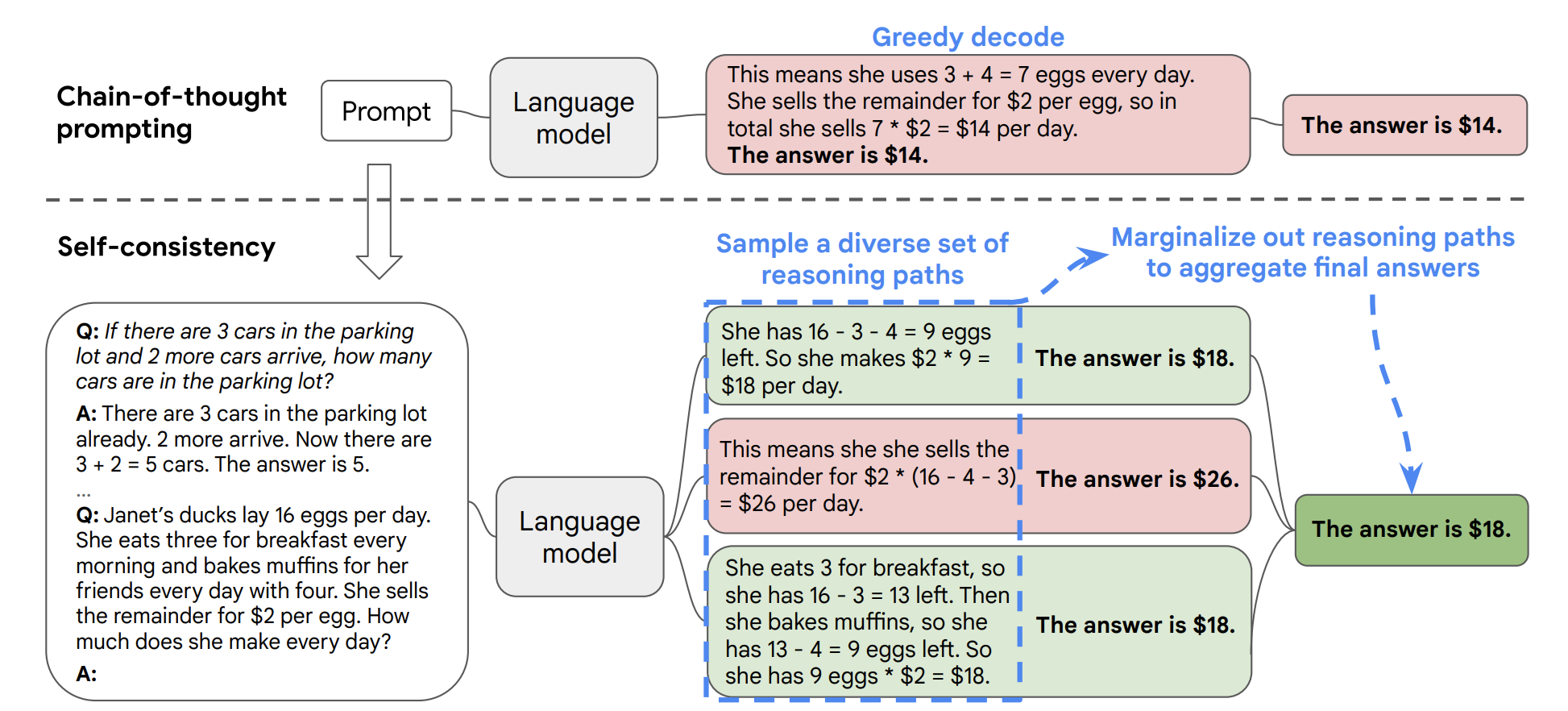
1. The Core Idea: Strength in Numbers
A standard Chain-of-Thought (CoT) prompt is powerful but fragile. It generates a single, linear reasoning path. If the model makes a mistake early on—a "garden path" error—the entire subsequent chain of reasoning will be flawed. Self-consistency directly addresses this vulnerability.
The core idea is simple but profound: if multiple, different lines of reasoning all converge on the same conclusion, our confidence in that conclusion should be much higher.
Chain of Thought Prompting | Self Consistency Prompting Explained | Prompt Engineering 101
To start, let's get a high-level overview. The video 'Chain of Thought Prompting | Self Consistency Prompting Explained' from Analytics Vidhya provides a concise introduction to the concept.
Watch from 03:16 to 05:15. Pay attention to the analogy of how humans solve problems and how self-consistency mimics this by sampling diverse reasoning paths.
As the video explained, self-consistency operates in two main phases:
- Generate Diverse Reasoning Paths: The same prompt is sent to the model multiple times. Crucially, the
temperatureparameter is set to a value greater than 0 (e.g., 0.7). This injects randomness into the decoding process, encouraging the model to explore different, but still plausible, reasoning paths instead of just picking the most likely token at each step. - Aggregate and Select: After generating a set of responses, the final answer from each is extracted. The most frequently occurring answer is chosen as the final output. This is a simple majority vote.
This "sample-and-marginalize" approach is exceptionally effective. It treats flawed reasoning paths as statistical outliers and favors the solution that is repeatedly and logically derived.
Self-Consistency Prompting for Robust LLM Reasoning
For a more formal definition and to see the empirical evidence, let's turn to the article 'Self-Consistency Prompting for Robust LLM Reasoning' from Emergent Mind.
Please read the introduction, Section 1 ('Foundational Principles and Algorithmic Workflow'), and Section 2 ('Empirical Performance and Task Coverage'). Focus on the two-phase process and the table showing the significant accuracy improvements on benchmarks like GSM8K.
The performance gains shown in that article are not trivial. A +17.9% absolute improvement on a complex math reasoning benchmark like GSM8K demonstrates that this simple ensemble technique is a production-ready powerhouse for improving reliability.
2. Implementing Self-Consistency
Now, let's translate this concept into a practical implementation. Given your background in ML engineering, you'll recognize this pattern as a straightforward ensemble method applied at inference time. The main trade-off is clear: increased accuracy and robustness come at the cost of higher latency and token usage, as you are making multiple API calls for a single user query.
Mastering Self-Consistency Prompting
The article 'Mastering Self-Consistency Prompting' on dev.to provides an excellent, actionable Python example of this process.
Read the sections 'Layer 2: Embracing Diversity – Self-Consistency Prompting' and 'Action Card 2: Implementing Self-Consistency'. Pay close attention to the Python code block, which shows a complete, albeit simulated, implementation.
Let's break down the key components from the provided code example:
- The Prompt: The prompt itself is a standard Chain-of-Thought prompt, instructing the model to think step-by-step and format the final answer clearly (e.g.,
"The final answer is XX"). This clear formatting is crucial for the next step. - The Loop: The code simulates looping multiple API calls. In a real system, you would call the LLM API
Ntimes (e.g., 5-10) with the same prompt but withtemperatureset to a value like0.7. - Extraction: A regular expression (
re.search) is used to reliably parse the numerical answer from each of theNgenerated text responses. Robust parsing is a key implementation detail. - Voting: Python's
collections.Counteris used to perform the majority vote. It efficiently counts the occurrences of each extracted answer and.most_common(1)retrieves the most frequent one.
This pattern is most effective for convergent problems—tasks that have a single, verifiable correct answer (e.g., a number, a multiple-choice option, a specific entity).
Test your understanding!
Imagine you've implemented self-consistency with N=5 samples for an arithmetic problem. You get the following final answers: [42, 42, 18, 42, 18].
- What is the final answer your system would return?
- One of the responses that led to
18might have contained a perfectly logical (but flawed) reasoning path. Why does self-consistency still arrive at the correct answer?
Show answer
- The final answer would be 42, as it appears 3 out of 5 times (a majority).
- Self-consistency works because it marginalizes out less common, flawed reasoning paths. Even if the path leading to
18was convincing on its own, the fact that three other different reasoning paths converged on42provides strong evidence that42is the more robust and likely correct answer. The flawed path is treated as a statistical outlier.
3. Quantifying the Benefit: pass@k and Temperature
As an engineer, you need metrics to quantify the benefit of a technique. For sampling-based methods, the standard metric is pass@k.
pass@k measures the probability that at least one correct solution is found within k generated samples.
Since you have a strong CS background, you'll appreciate the formal derivation. Let's say we generate n total samples for a problem and find that c of them are correct. How do we estimate pass@k where k <= n?
The most intuitive way is to calculate the inverse probability:
If we randomly draw k samples without replacement from our n total samples (which include n-c incorrect ones), the probability of the first being incorrect is (n-c)/n. The probability of the second also being incorrect is (n-c-1)/(n-1), and so on.
This leads to the formula:
Using binomial coefficients, this simplifies to:
Therefore, the unbiased estimator for pass@k is:
This formula allows researchers and engineers to report the effectiveness of sampling methods robustly.
The Role of Temperature
The pass@k metric is heavily influenced by the temperature setting, which controls the diversity of the generated samples.
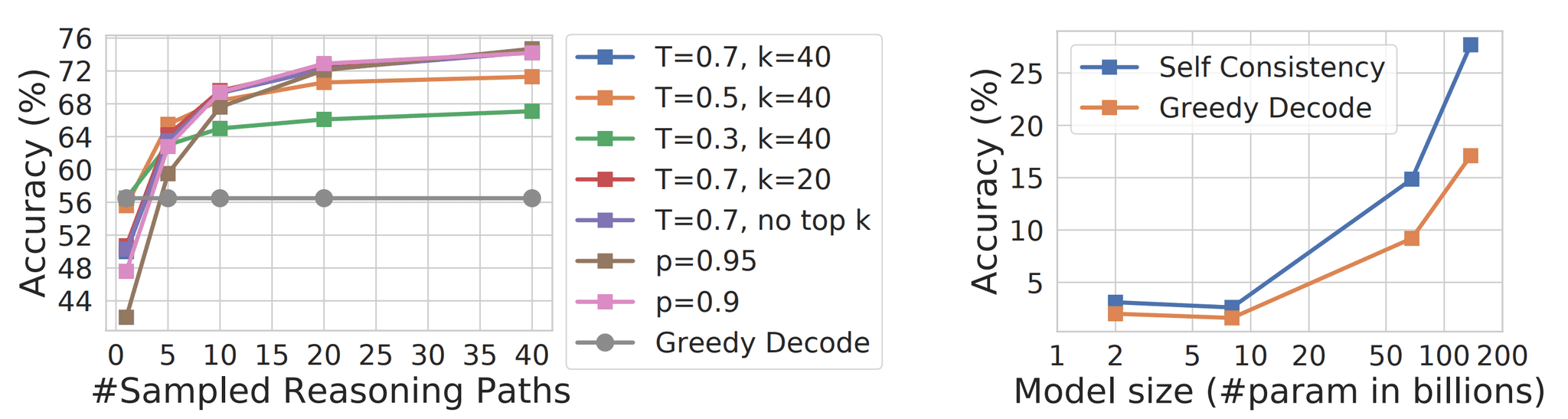
As the graph shows:
- Low Temperature (e.g., T=0.0): The model is deterministic. All
ksamples will be identical, so there's no benefit to sampling more than once. Thepass@kcurve is flat. - High Temperature (e.g., T=1.2): The model's outputs become too random and nonsensical. While diverse, the quality of each path is low, leading to poor overall accuracy.
- Optimal Temperature (e.g., T=0.7): There is a sweet spot that generates enough diversity to explore different valid reasoning paths without sacrificing the logical integrity of each path. This is where
pass@ksees the most significant gains askincreases.
4. Beyond Majority Vote: Universal Self-Consistency (USC)
The majority vote mechanism is great for math problems, but what about open-ended tasks like summarization, creative writing, or code generation? There's no single "correct" answer to vote on.
This is where Universal Self-Consistency (USC) comes in. It's a clever extension of the self-consistency principle for non-convergent tasks.
The Big Idea: Instead of using a programmatic voter, USC leverages the LLM itself as a judge to select the best response from a set of candidates.
Mastering Self-Consistency Prompting
The 'Mastering Self-Consistency Prompting' article also covers this advanced technique. It's a powerful pattern, especially for building agentic AI systems.
Read 'Layer 3: Unlocking Flexibility – Universal Self-Consistency (USC)' and its associated 'Action Card 3'. Focus on how the process shifts from 'voting' to 'judging'.
The USC workflow is as follows:
- Generate Diverse Candidates: As before, generate
Ndiverse responses using a high temperature. - Formulate a Judging Prompt: Construct a new prompt that contains all
Ncandidate responses. - Ask for a Verdict: Instruct the LLM to act as an impartial evaluator, analyze all the candidates, and select the best one based on criteria you define (e.g., "most comprehensive," "most accurate," "best-written," "most efficient code").
This turns the LLM into a tool for self-correction and self-improvement, which is a fundamental concept for building advanced, autonomous agents.
Conclusion
In this lesson, you've learned how to design and apply self-consistency prompting, a robust technique for improving LLM reliability. By moving beyond a single reasoning path and embracing the consensus of multiple diverse attempts, you can build systems that are far more resilient to the random errors and "garden path" fallacies that plague single-shot generation.
Key Takeaways:
- Self-Consistency mitigates the fragility of single-path reasoning by sampling multiple diverse paths (using
temperature > 0) and taking a majority vote. - It offers significant accuracy gains, especially on complex reasoning tasks, but at the cost of increased latency and token usage.
- The
pass@kmetric is used to formally evaluate the effectiveness of samplingkoutputs. - For convergent problems with a single correct answer, a programmatic majority vote is effective.
- For open-ended, non-convergent problems, Universal Self-Consistency (USC) uses the LLM itself as a judge to select the best response from a set of generated candidates.
What's Next?
So far, we've explored techniques that enhance the quality of a single turn in a conversation or a single problem-solving step (ToT, Self-Consistency). In the next lesson, we will focus on prompt chaining, where you will learn to decompose complex tasks into a sequence of simpler, interconnected subtasks. This will shift our focus from optimizing a single prompt-response cycle to orchestrating multi-step workflows, a crucial skill for building sophisticated LLM applications.