Welcome to your first lesson. This course is designed to provide you with a clear, conceptual overview of key machine learning topics to help you prepare for your exam. We'll focus on definitions, key features, and the types of examples you're likely to encounter.
In this introductory lesson, we will tackle the most fundamental classification in machine learning. Your learning outcome is to be able to distinguish between Supervised and Unsupervised Learning and provide exam-relevant examples for each. Understanding this distinction is crucial, as it forms the basis for nearly every topic we will cover in subsequent lessons.
1. Supervised Learning: Learning with a Teacher
Let's begin with the most common type of machine learning: supervised learning. The name itself provides a strong clue. As the "supervised" part suggests, the learning process is guided, much like a student being taught by a teacher who already knows the correct answers.
In supervised learning, we provide the machine learning algorithm with a dataset where each piece of data is "labeled" with the correct output. The algorithm's job is to learn the relationship, or mapping, between the input data and its corresponding output label. After training, the goal is to use this learned relationship to make accurate predictions on new, unseen data.
To solidify this core concept, please start by reading a brief, high-level definition.
Supervised and Unsupervised learning
In this article from GeeksforGeeks, we'll start with the foundational definition of supervised learning.
Please read the section "What is Supervised learning?" and the first paragraph of the example that follows. Pay close attention to the "teacher" or "supervisor" analogy and the concept of labeled data.
Supervised learning problems are typically broken down into two main categories, which are critical to know for your exam:
- Classification: The goal is to predict a discrete category or class. For example, determining if an email is "spam" or "not spam," or, more relevant to your interest in finance, classifying a loan application as "high risk" or "low risk."
- Regression: The goal is to predict a continuous numerical value. Examples include forecasting a company's stock price, predicting the value of a house, or estimating future sales revenue.
The following video provides a concise explanation of these concepts.
Supervised vs. Unsupervised Learning
This video from IBM Technology clearly explains the basics of supervised learning and its two main subcategories.
Please watch the segment from the beginning of the explanation of supervised learning up to the start of unsupervised learning. Focus on how it defines classification versus regression.
Now, let's connect this to practical, exam-relevant examples, particularly from the financial sector.
Supervised vs Unsupervised Learning
This article from Databricks provides excellent real-world examples of supervised learning across different industries.
Please read the section titled "Supervised learning across industries," paying special attention to the Financial services example. Notice how it uses labeled historical data (confirmed fraud cases) to train a model for real-time fraud detection.
2. Unsupervised Learning: Discovering Patterns on Its Own
Now let's turn to the second major category: unsupervised learning. If supervised learning is like learning with a teacher, unsupervised learning is like being given a box of mixed-up items and being asked to find interesting groupings or patterns on your own, with no prior knowledge of what those patterns might be.
The key distinction is that unsupervised algorithms work with unlabeled data. There are no correct answers to learn from. Instead, the goal is to explore the data's inherent structure and discover hidden patterns or groupings.
Supervised and Unsupervised learning
Let's return to the GeeksforGeeks article for the definition of unsupervised learning.
Read the section "What is Unsupervised learning?" Notice the emphasis on the absence of a supervisor and the focus on finding hidden structures.
Similar to supervised learning, unsupervised learning has its own primary tasks:
- Clustering: This involves grouping similar data points together. A classic finance application is customer segmentation, where a bank might group customers based on their transaction history and income to offer tailored financial products.
- Association Rule Learning: This aims to discover relationships between variables in a dataset. The classic example is "market basket analysis," which finds rules like "customers who buy bread also tend to buy milk." This is the foundation for the Apriori algorithm, which we will study in a later module.
The IBM video also offers a great summary of these tasks.
Supervised vs. Unsupervised Learning
Let's continue with the IBM Technology video to see how it explains unsupervised learning.
Watch the segment from the start of the unsupervised learning explanation until the direct comparison begins. Focus on how it describes clustering, association, and dimensionality reduction.
3. The Core Differences: A Head-to-Head Comparison
For your exam, you will almost certainly need to clearly articulate the differences between these two approaches. The most effective way to prepare is to compare them across several key dimensions.
The following images provide excellent, high-level visual summaries that are perfect for quick revision.
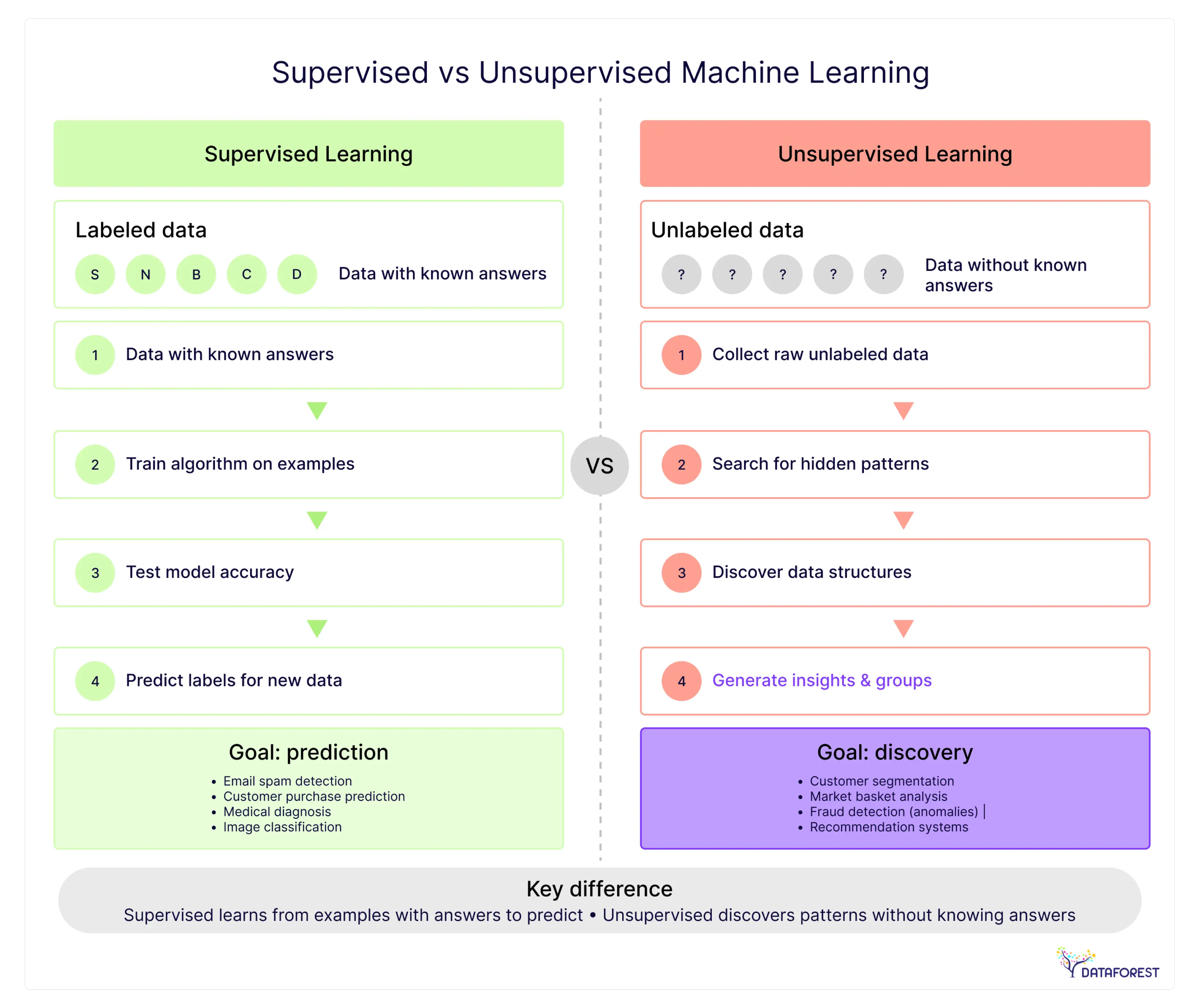
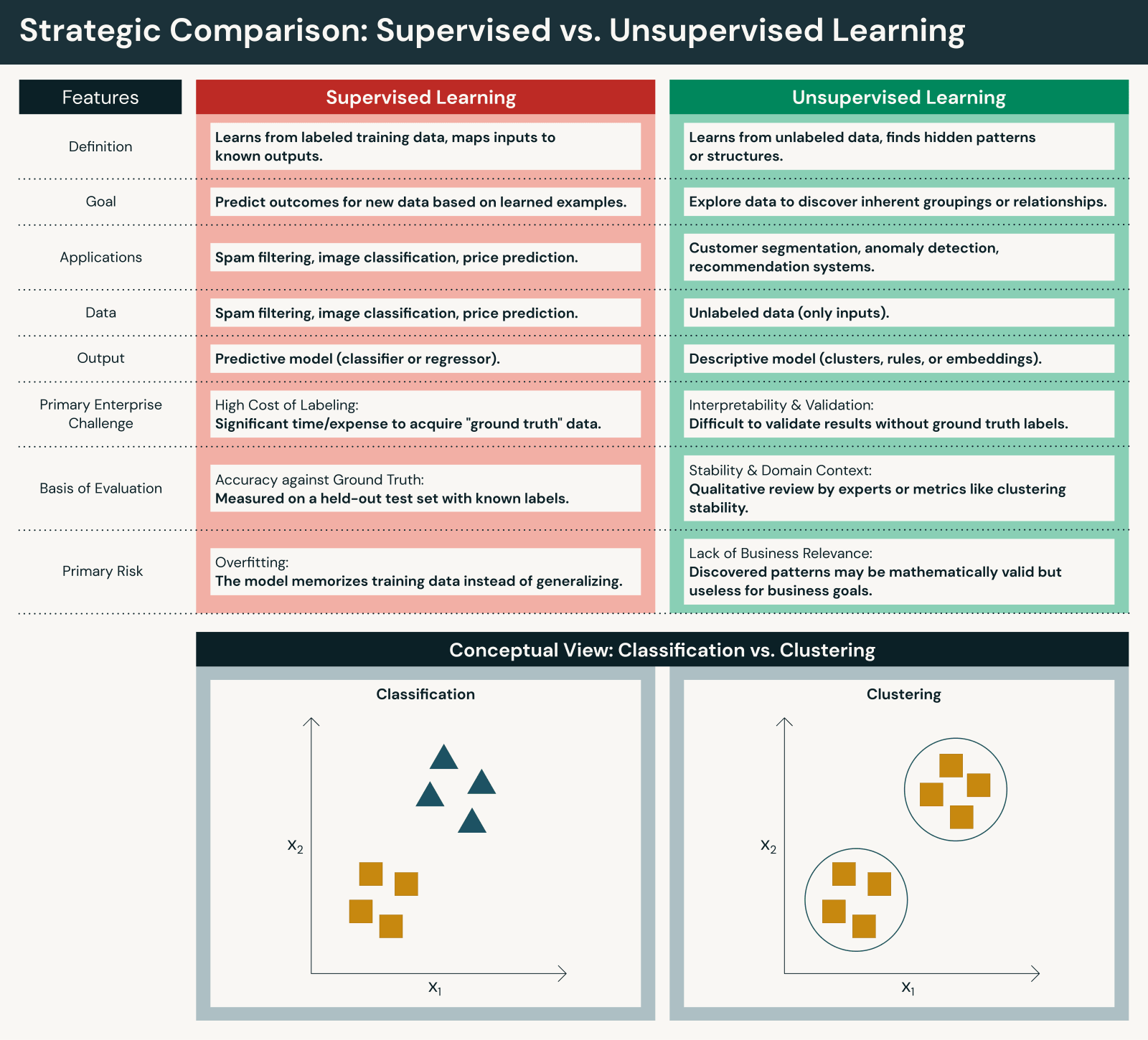
To reinforce these visual aids, let's break down the key differences textually.
| Feature | Supervised Learning | Unsupervised Learning |
|---|---|---|
| Input Data | Labeled data (input-output pairs) | Unlabeled data (inputs only) |
| Goal | Prediction: Predict an output for new data. | Discovery: Find hidden patterns and structures. |
| Approach | Train a model to map inputs to outputs. | Explore the data to find inherent groupings or rules. |
| Evaluation | Accuracy is measured against known "ground truth" labels. | Results are evaluated qualitatively (e.g., expert review) or by metrics of cluster stability. |
| Common Tasks | Classification, Regression | Clustering, Association Rule Learning |
| Example Question | "What will the stock price be tomorrow?" | "What natural customer groups exist in our data?" |
Let's read a final passage that neatly summarizes these distinctions.
Supervised vs Unsupervised Learning
The Databricks article provides a concise textual comparison that is very useful for exam preparation.
Please read the sections titled "Key differences between supervised and unsupervised learning" and the quick FAQ right after, "Addressing common questions". This explicitly answers the kind of direct comparison questions you might see on an exam.
Conclusion
In this lesson, we have established the fundamental difference between the two main paradigms of machine learning. Let's summarize the key takeaways that are essential for your exam:
- Supervised Learning uses labeled data to train a model for prediction. It's like having a teacher. The main tasks are classification (predicting categories) and regression (predicting values).
- Unsupervised Learning uses unlabeled data to discover hidden patterns and structures. It's about exploration. The main tasks are clustering (grouping similar items) and association (finding relationships).
- The primary distinction always comes down to the presence or absence of labels in the training data, which in turn dictates the goal of the algorithm.
In our next lesson, we will delve into Concept Learning. This topic provides a theoretical framework that helps formalize the problem that supervised learning aims to solve. It will give us a deeper, more structured understanding of how a machine "learns" from examples.