Introduction
In our last session, we built a 5-minute drill to dissect earnings reports, focusing on the crucial gap between reported numbers and market expectations. You learned that the market doesn't react to good or bad news, but to the surprise in the news. This is a powerful insight, but it's limited to scheduled, structured events.
Today, we generalize this concept into a core mental model for market operations. The goal is to distinguish what is already known and reflected in a stock's price—what is "priced in"—from information that is genuinely new and capable of forcing a re-evaluation. This is the art of separating signal from noise. Mastering this skill is what allows an operator to move from reacting to headlines to anticipating how the market will digest new information. It's the difference between being a passenger and being in the driver's seat.
The Market as a Forward-Looking Pricing Machine
The first and most critical truth to internalize is that the stock market is not a scoreboard for the present; it is a forecasting machine for the future. The price of a stock today isn't a reflection of its current earnings or the current state of the economy. It is the collective, probability-weighted consensus of all market participants about the company's future profits.
Economic data is, by definition, backward-looking. Stock prices are, by definition, forward-looking. This fundamental disconnect is why the stock market can rally when economic news is terrible, and fall when it's great.
Ben Felix provides a masterclass on this concept. His explanation of the 2008 Global Financial Crisis is a perfect illustration.
The Stock Market vs. The Economy
In "The Stock Market vs. The Economy," Ben Felix breaks down why the market is not the economy and how it prices in future expectations.
Watch the following segments to grasp this core concept: The Premise: The stock market is forward-looking; economic news is backward-looking. The Mechanism: This part explains how market efficiency leads to information being incorporated into prices before it becomes obvious. Critically, he notes: "Whether news is good or bad does not matter. What matters is whether news is better or worse than expected." The 2008 GFC Case Study: This is the key exhibit. Notice how the stock market bottomed in February/March 2009, months before unemployment peaked and while GDP was still cratering. The market didn't need the "all clear" signal from the economy. It started recovering when the incoming bad news was simply less bad than the apocalyptic scenario it had already priced in. The Summary: A concise wrap-up of the principle. Record bad data won't drop prices if the market was braced for even worse data.
Think of the market as a distributed computing system, constantly running simulations. The current stock price is the aggregated output of those simulations. Your job is not to argue with the output, but to find flaws in the input assumptions or to be the first to feed it a new, game-changing variable.
The Anatomy of an Expectation: What "Priced In" Looks Like
So, what does it mean for something to be "priced in"? It means the consensus narrative and its implications for future cash flows are already embedded in the current price.

The blue "Market Belief" line is a shared story the market is telling itself. This story might be:
- "This tech company will grow revenue at 30% for the next five years."
- "This old-world industrial company is a melting ice cube."
- "A recession is coming in six months."
The current stock price reflects the logical conclusion of that story. The game, then, is not to simply learn the story everyone else already knows. As the DayTrading.com resource on mental models bluntly states, what you know is irrelevant if it's already discounted in the price.
45+ Mental Models for Traders - DayTrading.com
This resource provides a collection of mental models for market operators. The section on "Circle of Competence" contains a brutal but essential truth about priced-in information.
Read the section titled Circle of Competence. Pay particular attention to this sentence: "And what you know". This is the core challenge. The article follows this up with the solution: "Only what’s different".
Your edge comes from finding a view that is both different from the consensus and, ultimately, correct. You are looking for a significant divergence between the "Market Belief" and the "Structural Reality."
Reflexivity: When Beliefs Shape Reality
The relationship isn't always one-way. Sometimes, market beliefs can actively shape the underlying reality. This concept, known as reflexivity, was most famously articulated by George Soros.
A rising stock price can make it easier for a company to raise capital, attract talent, and make acquisitions using its expensive stock, thereby improving its fundamental reality. Conversely, a falling stock price can trigger a downward spiral, making it harder to operate.
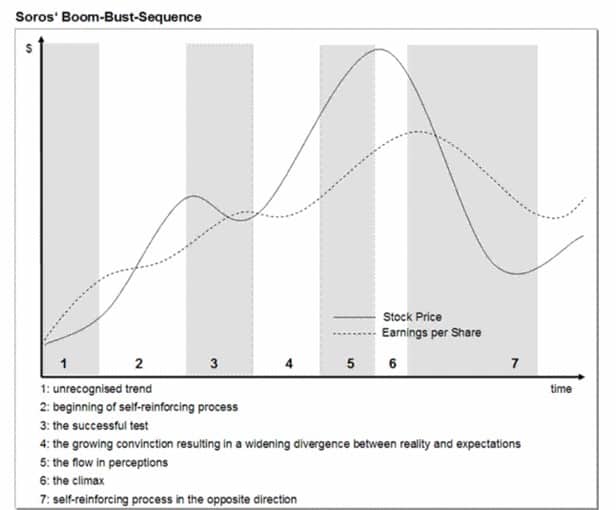
In stage 4 of this model, "the growing conviction resulting in a widening divergence between reality and expectations," you see the "Reality Gap" from the first image in action. The market is pricing in a future that is not just optimistic, but one that is being actively created by that very optimism. Understanding reflexivity helps you identify when a narrative is not just a story, but a powerful force shaping the fundamentals themselves.
The Operator's Filter: A Checklist for Identifying Signal
How do you systematically determine if a piece of information is a genuine signal or just noise that's already priced in? You need a repeatable process, a filter to run every piece of news through.
1. Is the Information Truly New? The Velocity Test.
In an age of instant information, the first question to ask is whether you are hearing something new, or just hearing an echo.
45+ Mental Models for Traders - DayTrading.com
Let's return to the mental models resource to understand the concepts of information velocity and filtering.
Read the short sections on Velocity of Information and Signal vs. Noise. The key takeaway is that by the time news hits your screen, the first-order effect is likely already priced in. Your edge isn't being faster, but having better filters to identify the rare information that actually improves your decision.
2. Does It Change the Narrative? The Bayesian Update.
A true signal is something that forces you to update your model of the world. This is the essence of Bayesian thinking. You start with a prior belief (the consensus narrative) and when new evidence emerges, you update your belief.
45+ Mental Models for Traders - DayTrading.com
This resource explicitly links Bayesian thinking to market reactions.
Read the section on Bayesian Updating. The author makes our point directly: "It’s the basis of why stock prices move after earnings. The market had an idea of where the stock should be and the new data changed the price in light of what was already known."
Ask yourself: Does this news fundamentally alter the company's long-term earnings power, competitive position, or risk profile? Or is it a temporary issue that doesn't affect the core thesis?
3. What are the Second-Order Consequences?
Most market participants stop at first-order thinking ("This is good news, so the stock should go up"). The real edge lies in thinking through the chain of consequences.
An excellent example of this is provided in a (fictional but illustrative) video by Patrick Boyle on a geopolitical crisis. He contrasts the market's simplistic, first-order reaction with the complex, second-order realities unfolding on the ground.
Why Can't the Stock Market See This Coming?
In "Why Can't the Stock Market See This Coming?", Patrick Boyle (playing a role in a fictional scenario) masterfully illustrates the gap between a 'priced-in' market narrative and a developing structural reality.
Watch these key segments to see the difference between first-order and second-order thinking: The Setup: Boyle establishes the core conflict: The stock market is buying the "diplomatic resolution" narrative (the priced-in belief), while physical commodity traders see a darker, more complex reality. Flawed First-Order Thinking: He explains why the market is getting it wrong—it's using "muscle memory" and a flawed analogy to a past trade war, failing to see that a shooting war is different. A Genuine Signal: The "seaborn buffer" of oil is exhausted. This is a new piece of information that invalidates the market's optimistic timeline. It's a true signal that the initial assumption was wrong. Second- and Third-Order Effects: The crisis is now rewiring global capital allocation (a second-order effect) and shifting the balance of global trade (a third-order effect). The market, focused on the daily price of crude, is slow to price in these massive structural changes. The Thesis: The final summary is key. The stock market is "buying the peace trade" based on old assumptions, but the "physical world moves at its own pace." This is the essence of identifying a gap between belief and reality.
4. How is the Stock Reacting? The Market's "Tell".
Finally, the price action itself is a signal. As the framework in HeyGotrade points out, how a stock reacts to news is an honest indicator of what was already priced in.
How to Analyze a Stock in 30 Minutes: A Step-by-Step Framework
This article provides a rapid analysis framework. Step 3 is particularly relevant to our discussion.
Read the section titled Step 3: Read the Latest Earnings Call Summary. Focus on this paragraph: "Stock price reaction". If a company reports record profits and the stock falls, it tells you the market expected even more. If it posts a loss and the stock rallies, it tells you the market was braced for a catastrophe that didn't materialize.
Conclusion
Distinguishing signal from noise is not an innate talent; it's a disciplined process. It requires moving beyond simple news consumption to a deeper level of analysis. The market operator's mindset is not to ask "What happened?" but to constantly ask "What does the market believe?" and "Does this new information change that belief?"
Key Takeaways:
- The Market Prices the Future: Stock prices reflect expectations, not current reality. Bad news can be good for a stock if it's less bad than feared.
- "Priced In" is the Consensus Narrative: Your job is to understand the prevailing story and then hunt for evidence that disproves it.
- Edge Comes from Second-Order Thinking: Don't just analyze the event. Analyze the chain of reactions to the event. That's where mispricing hides.
- Use a Bayesian Filter: Constantly update your beliefs. True signals are rare pieces of information that force a significant update to your model of the world. Most news is just noise confirming what's already known.
- Price Action is a Signal: The market's reaction to news tells you more about its prior expectations than the news itself.
In our next lesson, we will move from reacting to information to proactively seeking it. We will learn how to map potential catalysts for a stock, identifying the specific future events that could force the market to re-evaluate its current narrative and close the gap between belief and reality.