Introduction
In our last session, we installed two powerful mental models—base rate thinking and expected value—to help separate high-probability bets from compelling but dangerous narratives. This is the core of thinking like a professional. However, having the right mental models is useless if you can't systematically apply them and, more importantly, learn from the inevitable mistakes. Your brain, by default, is an expert at self-deception. It retroactively edits your memories to make your successes seem inevitable and your failures the result of bad luck, robbing you of any chance to learn.
This lesson provides the antidote: the decision journal. This is not a diary. It is a rigorous, systematic tool for tracking your reasoning before an event and analyzing the outcome after. It forces brutal honesty and makes your thought process a tangible object you can inspect, debug, and improve. By the end of this lesson, you will have a complete framework for building and using a decision journal—the single most effective tool for transforming yourself from someone who has ideas into someone who has a repeatable edge.
The Enemy Within: Your Brain's Rewriting of History
The biggest obstacle to improving your decision-making is your own memory. When a trade works, your brain conveniently forgets the uncertainty you felt and manufactures a story of brilliant foresight. When it fails, it invents doubts you never had, claiming you "knew it was a bad idea." This is hindsight bias, and it ensures you learn nothing. To improve, you need an incorruptible record of what you were actually thinking at the moment of decision.
This is the fundamental purpose of a decision journal. It's a quality control system for your thinking.
Decision Journal: Template and Example Included - Farnam Street
This article from Farnam Street lays out the core problem perfectly. It explains why our brains are fundamentally unreliable narrators of our own decision-making process.
First, read the introduction to understand the core problem of memory editing. Then, read the section "What is a Decision Journal?" to grasp its role as a mirror for your thoughts. Finally, read the concluding section, "Your Two Lives," which powerfully describes the gap between the story you tell yourself and what actually happened.
The Anatomy of a Professional's Journal Entry
A decision journal is not about prose; it's about structured data capture. For any consequential trade or investment, you must log the key variables before you act. A vague idea in your head is not a plan. Writing it down forces clarity.
Here is a template that integrates our previous work on Expected Value and prepares you for professional-level analysis.
-
The Situation & The Thesis:
- What is the current market context? (e.g., "Post-Fed meeting, market is pricing in rate cuts.")
- What is your specific, falsifiable thesis? (e.g., "I believe Company X will beat earnings expectations due to strong channel checks, and the market is underpricing this possibility.")
-
Key Variables & Invalidation Criteria:
- What are the 2-3 variables that this thesis depends on? (e.g., Gross margins, user growth, raw material costs.)
- What specific event or data point would prove your thesis wrong? This is your "kill criteria." (e.g., "If management guides for lower margins, my thesis is invalid, regardless of the stock price move.")
-
Scenario Analysis & Expected Value (EV):
- This is where you apply the framework from our last lesson.
- Bull Case: What happens if everything goes right? (Value: ₹X, Probability: Y%)
- Base Case: What is the most likely outcome? (Value: ₹A, Probability: B%)
- Bear Case: What happens if it goes wrong? (Value: ₹Z, Probability: C%)
- Calculate the Expected Value: (\text{X} \times \text{Y%}) + (\text{A} \times \text{B%}) + (\text{Z} \times \text{C%})
-
Emotional & Physical State:
- How do you feel? Tired, rushed, euphoric after a win, fearful (FOMO)?
- Be brutally honest. This data point is often the key to discovering your behavioral biases. Are you making a decision based on logic or emotion?
Let's hear from a practitioner about why this last point is so critical.
What to ACTUALLY Write in Your Trade Journal
The video "What to ACTUALLY Write in Your Trade Journal" by Trader Mayne offers a raw, operator's take on journaling. He cuts through the theory and gets to what's practical.
First, watch his summary of the basic data points to record. Then, pay close attention as he explains the importance of documenting your emotional state and feelings during a trade, using his own "mental roller coaster" as a case study. This is the alpha you're looking for in your own journal.
Recording your emotional state allows you to identify patterns. For example, "Every time I trade out of boredom, I lose money," or "After a big win, my next trade is usually undisciplined." This is how you spot and control the emotional impulses that sabotage even the best analysis.
From Logbook to Feedback Engine
Recording your decisions is only the first step. The real value comes from creating a feedback loop: Forecast, Measure, Revise.
A journal helps you become "calibrated." In decision science, calibration means your subjective confidence aligns with your objective accuracy. When you say you're "80% sure," are you right about 8 out of 10 times? Most people are horribly miscalibrated, suffering from chronic overconfidence. A decision journal provides the data to fix this.
This Morgan Stanley report by Michael Mauboussin offers a professional's perspective on this process. We're revisiting it because it provides the quantitative "why" behind the journaling "how."
First, read the section on "Words to probability." Pay attention to the two problems it highlights: miscommunication and avoiding accountability. This is why your journal must use numbers, not vague words. Next, focus on the section "Feedback and calibration." Understand that skill requires timely and accurate feedback. The report then explains how to create this feedback loop, even when outcomes are delayed, by breaking down a thesis into subcomponents. Finally, for your quantitative mind, look at the Appendix and read about the Brier Score. You don't need to calculate it for every trade, but understanding the concept is key. It's a formal method for scoring probabilistic forecasts, turning your subjective confidence into an objective performance metric. It directly measures how good you are at predicting the odds.
The process is:
- Pre-Mortem: Before the trade, you fill out the journal entry. This forces you to clarify your thesis, probabilities, and kill criteria.
- Post-Mortem: After the outcome is known, you review.
- Was the outcome due to your thesis playing out (good process, good outcome) or dumb luck (bad process, good outcome)?
- Was the loss because your thesis was wrong (good process, bad outcome) or because you failed to follow your own rules (bad process, bad outcome)?
- Update your Brier score or other calibration metric. Did your probabilities match reality?
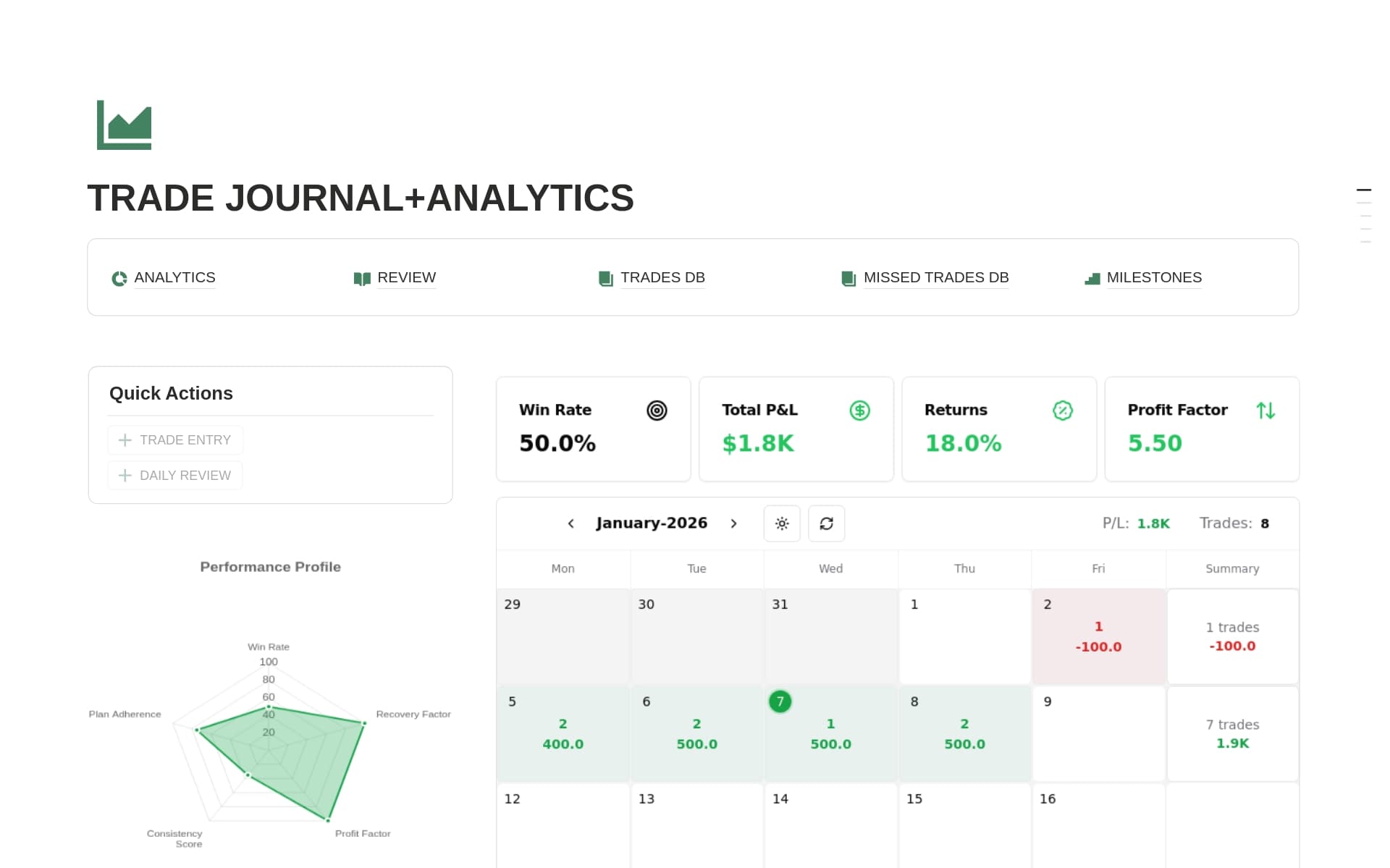
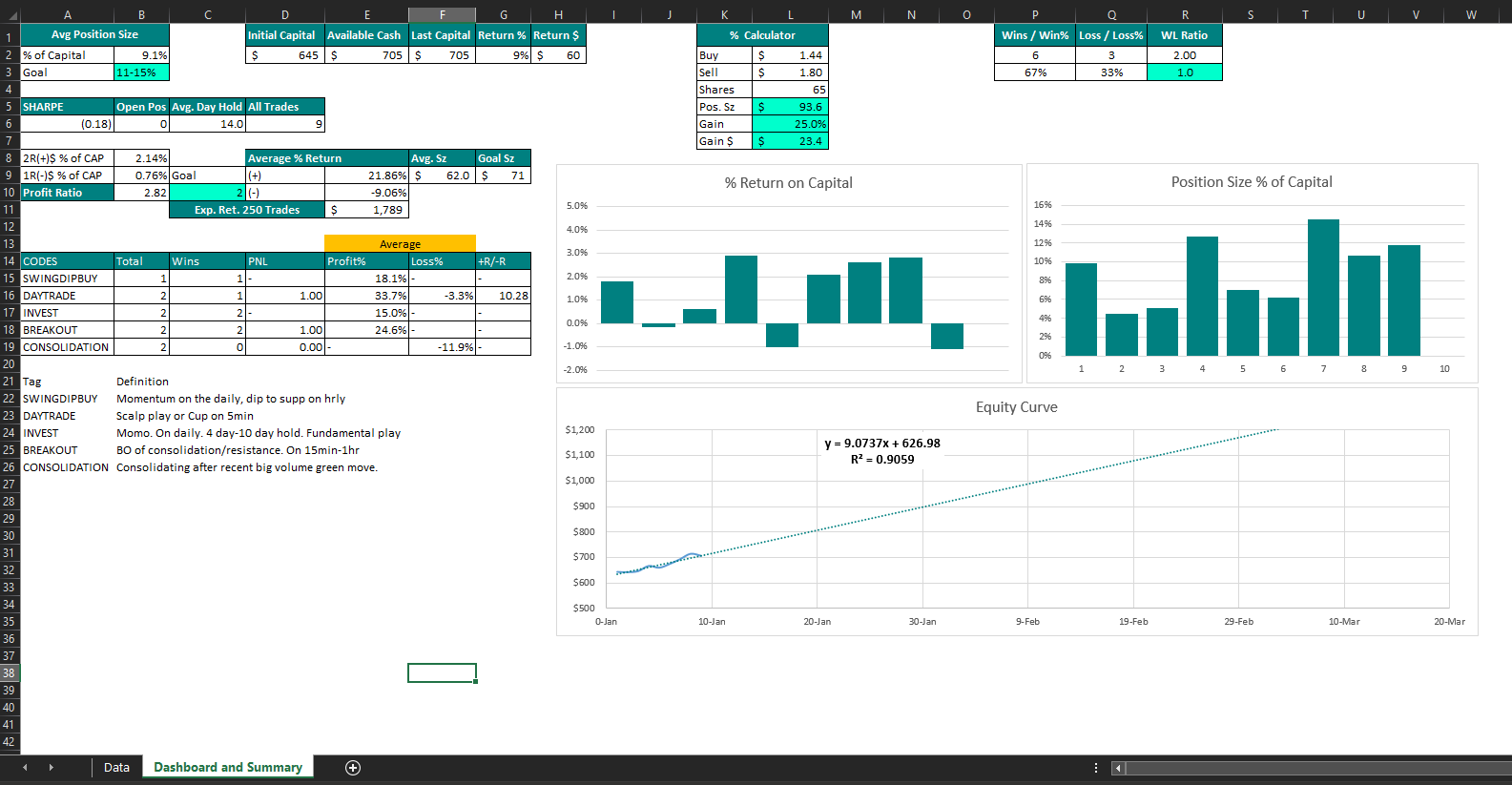
Over time, your journal becomes the raw data for your own personal analytics dashboard. The goal is to move from individual entries to a high-level view of your performance, identifying systemic strengths and weaknesses.
Conclusion
You can't "smell" stocks or develop an operator's instinct through intuition alone. That instinct is built, decision by decision, through a brutally honest feedback loop. The decision journal is that loop. It is the single most important habit that separates amateurs who rely on stories from professionals who rely on a process.
Key Takeaways:
- Your memory is a biased storyteller; trust the written record. A decision journal is an incorruptible log of your thinking at the time of a decision, essential for combating hindsight bias.
- Structure is everything. A good entry includes your thesis, kill criteria, scenario analysis with probabilities (EV), and your emotional state.
- A journal is a tool for process, not just outcome. The goal is to review your reasoning. A good process can lead to a bad outcome, and vice versa. Your job is to improve the process.
- Track your calibration. Use your journal to see if your stated confidence levels match reality. This is how you move from guessing to making educated, probabilistic bets.
This concludes our module on mental frameworks. You now have the tools to think in probabilities (EV, base rates) and a system to track and improve your application of those tools (the decision journal).
Our next module, "The Analyst's Operating System," will build directly on this foundation. In the first lesson, we will construct a systematic research workflow—the process of screening, generating ideas, and rapidly reviewing companies. The ideas generated by this workflow will become the very inputs for your decision journal.