Hello! Welcome to the next step in our journey into JAX.
In our last lesson, we focused on the fundamental data structure in JAX, the jax.Array, and how to manage its placement and data type on an accelerator. We now have a solid understanding of the what—the data itself. This lesson transitions to the how—the functions that operate on this data. We will address a core principle that represents the biggest mindset shift when coming from frameworks like PyTorch: JAX's requirement for functional purity.
Your experience building and deploying complex models in PyTorch is built on an object-oriented, stateful paradigm. JAX operates differently. Its power—derived from function transformations like jit, grad, and vmap—hinges on the functions you write being "pure." Our goal today is to understand what this means and to learn the fundamental pattern for rewriting familiar stateful code into a pure, JAX-friendly form.
1. The Tale of Two Paradigms: PyTorch vs. JAX
To ground our discussion, let's start with a high-level comparison. PyTorch uses a "tape-based" automatic differentiation system. As your code runs, it dynamically builds a computation graph (the "tape"). When you call .backward(), it traverses this graph in reverse to compute gradients. This approach is flexible and fits naturally with Python's imperative, object-oriented style.
JAX, on the other hand, is a "function transformation" system. It takes an entire Python function, analyzes it, and creates a new, transformed version—a gradient function, a vectorized function, or a just-in-time compiled function.
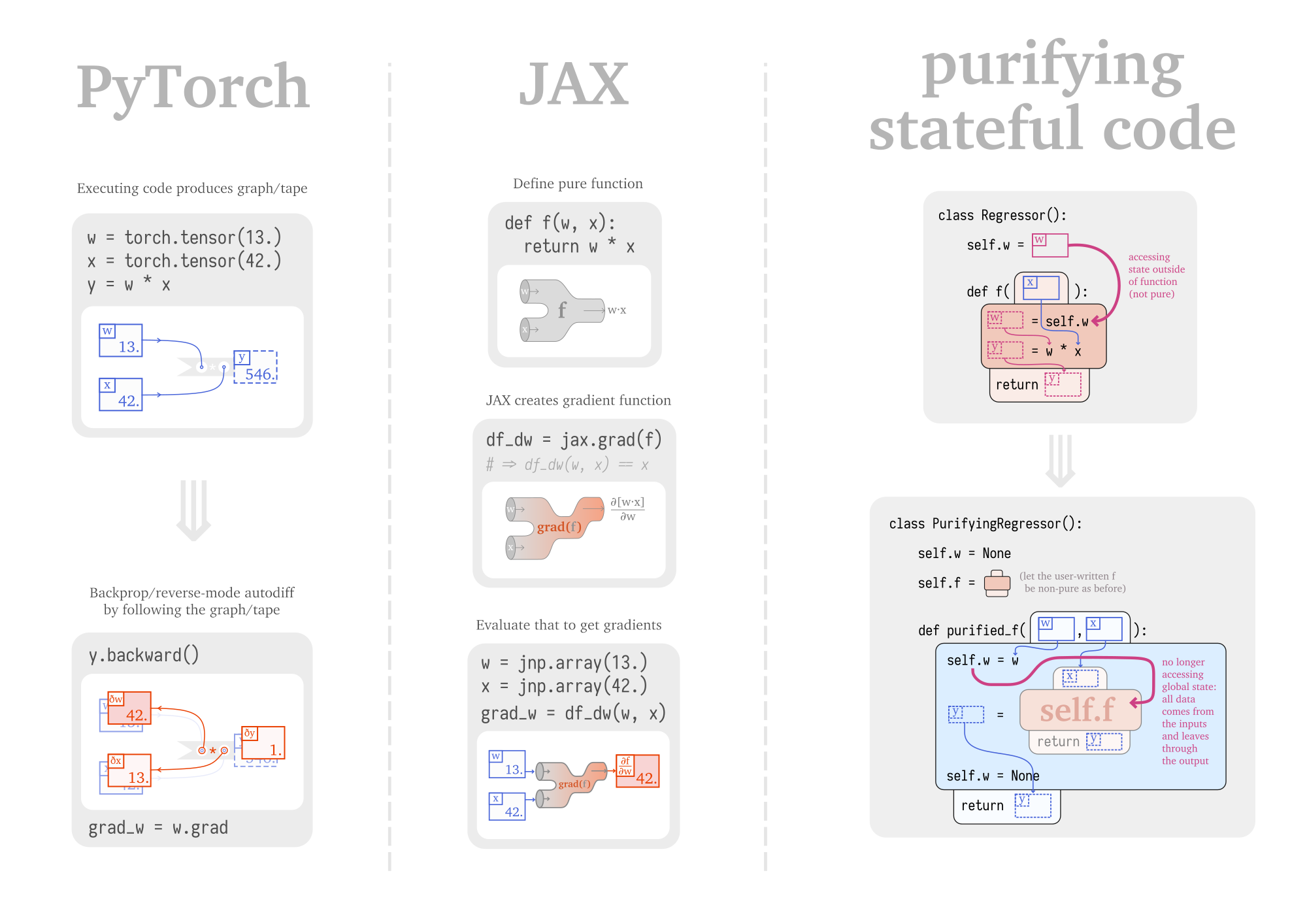
For JAX's transformations to work reliably and efficiently, the original function must be pure. This is the cornerstone of JAX's design and the key to its performance.
2. What is a Pure Function?
The concept of a pure function comes from functional programming and is analogous to a mathematical function. A function is pure if it satisfies two conditions:
- Deterministic: Its output depends only on its explicit input values. Given the same inputs, it will always return the same output.
- No Side Effects: It does not modify any state outside of its own local scope. This means no modifying global variables, no changing input arguments in-place, no printing to the console, and no reading/writing files.
Let's watch a short clip that explains this concept and why it's so important for JAX's compiler.
Understanding JAX: JIT, XLA, and Pure Functions Explained
This video from the Google for Developers channel, "Understanding JAX," provides a concise explanation of purity and its connection to JIT compilation.
Please watch the segment from the definition of purity. Then, watch the section from why JIT needs purity, which explains how JAX's tracing mechanism relies on this property.
The key reason JAX enforces purity is because of its tracing-based compilation. When you apply jax.jit, JAX doesn't run your Python code every time. Instead, it runs it once with placeholder "tracer" objects to record the sequence of operations. This sequence is then compiled into highly optimized machine code by XLA. If your function had side effects, they would either be captured incorrectly during that single trace or cause the trace to fail. By guaranteeing purity, you allow JAX to safely analyze and compile your code for maximum performance.
For a deeper dive into practical examples of pure and impure functions, the following reading is excellent.
From PyTorch to JAX: towards neural net frameworks that purify stateful code — Sabrina J. Mielke
This article by Sabrina J. Mielke provides a clear, code-driven explanation of function purity.
Read section 2, Pure functions. Focus on the two criteria for purity and study the code block that contrasts pure_fn_* with impure_fn_*. Think about why each impure function violates the rules.
3. The Solution: Explicit State Threading
So, how do we work with state, which is essential for machine learning (e.g., model parameters, optimizer state), in a purity-driven framework? The answer is the "explicit state threading" pattern.
Instead of a function implicitly modifying an external state (a side effect), we make the state an explicit input and output of the function. The pattern is:
new_state, result = pure_function(current_state, inputs)
The function takes the current state as an argument, computes what it needs to, and returns the updated state along with any other results. The calling code is then responsible for managing this state, typically by replacing the old state with the new one for the next iteration.
The official JAX documentation provides the canonical example of this pattern using a simple counter.
Stateful computations - JAX documentation
The official JAX documentation demonstrates the problem with stateful code and presents the standard solution.
First, read the introductory section, A simple example: Counter, and the code block that defines the stateful Counter class. Then, read the section that shows why it fails with jit. Finally, read the core solution in the section The solution: explicit state. Pay close attention to how the count method is refactored to take n as an argument and return a new n.
As you saw, the original object-oriented counter, Counter.count(), fails because it modifies self.n as a side effect. The JAX-friendly version, Counter.count(n), becomes a pure function. The responsibility for maintaining the state (n) is moved outside the function.
4. From Counters to Models
This pattern is not just for toy examples; it is fundamental to all JAX programs. Let's apply it to a familiar machine learning task: linear regression. Here, the "state" is the model parameters.
Stateful computations - JAX documentation
We'll continue with the JAX documentation to see how the explicit state pattern is generalized and applied to a simple model.
Read the section A general strategy, which formalizes the transformation from a stateful to a stateless class structure. Then, study the Linear Regression example. Focus on the update function and see how it takes params as an input and returns the updated params as an output.
The linear regression example is a microcosm of a standard JAX training loop. The update function is pure. It accepts the current parameters (params), data (x, y), and a learning rate, and it returns a new set of parameters. The training loop itself is responsible for threading this state:
# Pseudo-code for a JAX training loop
params = initialize_parameters() # Initial state

for x, y in data_loader:


  # The update function is pure
  # It takes the current state (params) and returns the new state
  params = update(params, x, y, learning_rate)


# Final state
final_params = params
This explicit passing of state might seem more verbose than the PyTorch equivalent, where an optimizer simply calls optimizer.step() and modifies the model parameters in-place. However, it makes the data flow completely transparent, which simplifies debugging, analysis, and especially parallelization.
5. The Role of Frameworks like Equinox
You might be thinking that manually threading state for all your parameters, optimizer statistics, and layer states (like in batch normalization) could become cumbersome. You are correct, and this is precisely where libraries like Equinox (your chosen framework), Haiku, and Flax come in.
These libraries provide abstractions that handle the state-threading boilerplate for you, allowing you to write code that looks structured and object-oriented, while ensuring it is functionally pure under the hood.
For instance, in Equinox, a training step is often encapsulated in a single pure function, which is then JIT-compiled. Let's look at a concrete example of this pattern from a tutorial on Equinox.
Neural Networks in Equinox (JAX DL framework) with Optax
This video by the "Machine Learning & Simulation" channel demonstrates building a neural network with Equinox. We will focus on the part where the training step is defined.
Watch the segment from this make_step function. Notice its signature: it takes model and opt_s (optimizer state) as inputs, and it returns the updated model and optimizer_state as outputs. This is the exact state-threading pattern we've been discussing, implemented in a real-world training context.
The make_step function is a perfect, practical illustration of today's lesson. It bundles the loss calculation, gradient computation, and parameter update into a single pure function that receives the entire state (model parameters, optimizer state) and returns the new, updated state. This pure function can then be passed to jax.jit for maximum performance.
Key Takeaways
This lesson was a crucial step in shifting your thinking from the imperative PyTorch style to the functional JAX paradigm.
- Purity is Paramount: JAX's function transformations (
jit,grad, etc.) require that the functions they operate on are pure. - Pure Functions: A pure function's output depends only on its inputs, and it has no side effects. This allows JAX to safely trace, compile, and optimize your code.
- Explicit State Threading: To manage state (like model parameters) in a pure way, you must pass the state into your function as an argument and return the updated state as an output. The pattern is
(new_state, result) = f(state, *args). - Frameworks Handle the Boilerplate: Libraries like Equinox are designed to manage this state-threading pattern for you, providing a clean, high-level API while adhering to JAX's functional principles.
You are now equipped with the most important conceptual tool for writing effective JAX code. In our next lesson, we will build on this by exploring the common pitfalls and errors that arise when these principles of purity and immutability are not followed, such as attempting in-place updates or using standard Python control flow inside jitted functions.