The VIX tells you something about option prices; it is not itself a security you can buy. That distinction becomes important when a market report moves casually between “the VIX rose,” “VIX futures rose,” and “a VIX product rose.” Those statements describe three different prices.
This module separates the index, futures contracts, and exchange-traded products (ETPs). We will start with what exposure each represents. Later lessons will explain why a futures price differs from today’s VIX and why a product that holds futures can produce a different return again.
The VIX: a measurement, not a holding
The VIX is an index calculated from S&P 500 option prices. As established earlier in the course, those prices contain information about implied volatility: the size of market movements reflected in option prices, not a prediction that stocks will rise or fall. The VIX expresses that information as an annualized measure for a constant 30-calendar-day horizon. A VIX reading of 20 is not a share price, nor does it mean the S&P 500 must move 20% over the next month.
An index can be published and observed without being something investors can own. The VIX is such an index. You cannot place an order for “one VIX” and receive the changing index value as an investment return.
Watch this short introduction before reading the more precise distinction below.
“VIX ETFs: Buyer Beware!” from Zacks Investment Research introduces the gap between observing the VIX and buying a product linked to it.
Watch the index for the explanation that the VIX is calculated from S&P 500 options and is not directly tradable. Then watch the products for the distinction between the index and products using futures. Keep one qualification in mind: the VIX uses prices of both calls and puts; do not take the video's emphasis on put buying to mean it is a put-only measure.
FINRA states the key distinction succinctly and adds an important warning: futures can move with the VIX without tracking it precisely.
Volatility Investing | FINRA.org
Read FINRA’s “Volatility Investing” to anchor the three instruments in a neutral description before we examine them separately.
In “Understanding the VIX,” read both paragraphs, beginning with “A variety of volatility-linked ETPs exist” and ending with “the farther out the futures go.” Focus on what FINRA says is not investible, what investors use instead, and why correlation does not mean exact tracking.
The useful starting rule is: the VIX is the quoted measure; any position you can trade is a different instrument with its own return.
A VIX future: a contract with a settlement date
A VIX futures contract is a tradable agreement tied to a specified future settlement date. Its market price is quoted in volatility-index points. If you buy a contract, you gain exposure to changes in that contract’s futures price. You have not bought today’s VIX reading or the S&P 500 options used to calculate it.
VIX futures are cash-settled. At final settlement, there is no delivery of an index or a basket of options. Instead, the contract is settled in cash against its prescribed final settlement value, determined from S&P 500 option prices. That settlement value need not equal the VIX quote you happen to see on a screen at another time that day. Futures positions are also marked to market as prices change before final settlement; cash settlement does not mean nothing happens financially until the last day.
Cboe’s product specifications give the contractual detail behind that description:
Consult Cboe’s VIX fact sheet to see how the futures contract is specified, rather than treating a futures quote as another version of the index.
Find the “Summary Product Specifications” table. In the VX Futures column, locate the “Contract Multiplier” row, then the “Final Settlement Value” row. Read the cash-settlement description, from “Settlement of VX futures contracts will result” through “by $1000.” Keep to the futures column; the adjacent VIX options column describes a different instrument.
The multiplier means a one-point change in the futures price corresponds to $1,000 per standard VX contract. For example, a rise in a contract’s price from 18 to 21 represents a $3,000 gain for one long contract before costs; a fall of three points represents a $3,000 loss. Those gains and losses concern the futures contract, not a purchase of the VIX at 18. Futures require margin, so the cash initially posted is not a cap on potential losses.
Which settlement date a future has matters. The index describes a 30-day volatility window starting now; a particular future is linked to a settlement calculation on a later date. The next lesson will examine that difference in time windows more closely.
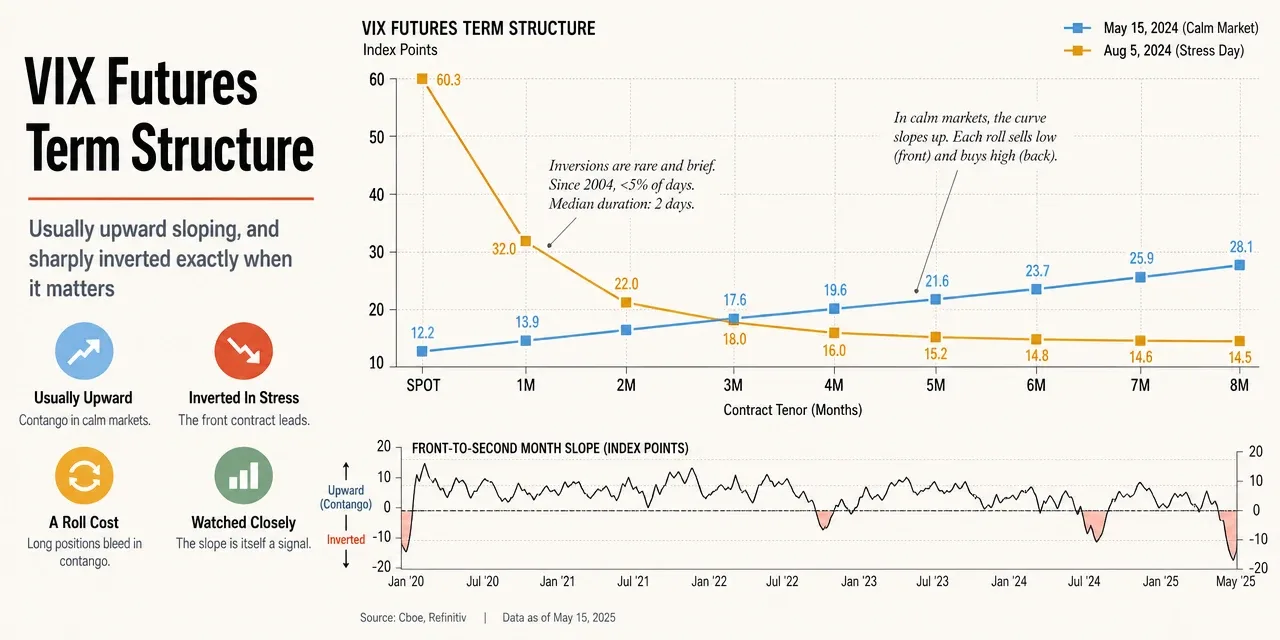
The image makes the distinction visible. In its calm-market snapshot, spot VIX is shown at 12.2, while the approximately one-month futures quote is 13.9. In the separate stress-day snapshot, spot VIX is shown at 60.3, while the approximately one-month future is 32.0. These are snapshots from different dates, not a before-and-after return comparison. In each snapshot, the point labeled “SPOT” is the index; the points labeled by contract tenor are futures prices.
An ETP: a traded share or note linked to a strategy
An exchange-traded product has a share or note price that you can trade through a brokerage account. Volatility-linked ETPs generally obtain their exposure through VIX futures or a benchmark based on VIX futures, because they cannot hold the VIX index itself.
The distinction within “ETP” also matters:
- An exchange-traded fund (ETF) is a fund whose shares represent an interest in its portfolio and strategy.
- An exchange-traded note (ETN) is a debt obligation of its issuer with a return linked to a specified benchmark. It adds issuer credit risk.
The label alone does not tell you the exact futures exposure. A product might follow a benchmark using nearby futures contracts; another might use different maturities or seek an inverse or leveraged daily result. Its stated benchmark and product documents, rather than the letters “VIX” in its name, tell you what it is designed to follow.
For a basic long VIX-futures-linked ETP, buying a share means owning the product, whose performance is intended to reflect its futures-based strategy after expenses and other product effects. It does not mean owning one futures contract directly, and it does not mean receiving the spot VIX’s percentage change. The ETP’s dollar share price has its own units: a $30 ETP share need not correspond to a VIX reading of 30 or a future quoted at 30.
This is why three numbers on the same screen can all be correct. Suppose the VIX reads 20, a particular VIX future is quoted at 24, and a futures-linked ETP share trades at $30. 20 measures current 30-day implied volatility in annualized index points; 24 quotes one futures contract; $30 prices a share or note following its specified strategy. Neither equal prices nor equal percentage changes are required.
Keep the exposure attached to the name
| What you see | Can you buy it directly? | What does it represent? |
|---|---|---|
| VIX index | No | A calculated, annualized measure of 30-day implied volatility from S&P 500 options |
| VIX future | Yes, as a futures contract | Exposure to changes in a contract tied to a particular future cash-settlement date |
| VIX-futures-linked ETP | Yes, as a traded share or note | Exposure to the product’s specified futures-based benchmark or strategy, subject to its structure and costs |
The practical reading habit is to identify which of these three prices a headline or chart shows before interpreting its movement. A rising VIX does not, by itself, specify the return on a particular future or on an ETP.
The next lesson takes up the first gap in the table: why a future’s price can differ from today’s VIX even though both ultimately draw on S&P 500 option prices.