Hello! In our last lesson, you did an excellent job learning to describe your daily routine using the simple present tense. You now have the tools to talk about your habits and recurring activities, which is a big part of everyday conversation.
Today, we're going to significantly expand your storytelling ability. You'll learn to move fluidly between the present and the past. Our goal is to master forming affirmative (positive), negative, and question sentences in both the present tense (for things that are generally true or happen regularly) and the past tense (for specific, completed events). This skill is essential for sharing experiences, giving work updates, and having more dynamic conversations.
Part 1: Mastering the Present Tense
Let's start with a quick, active review of the simple present tense. You already know the basics from our last lesson. Now, let's put it into a conversational context.
Present Simple Verbs - Beginner English Listening Lesson
This resource from ELLLO (English Language Listening Library Online) is great because it presents grammar through short, natural dialogues, which is exactly the kind of practice you prefer.
First, read and listen to the four short conversations. As you listen, notice how the speakers use positive statements ("I work at a tech company"), negative statements ("I don't have a car"), and questions ("What do you do?"). After listening, scroll down and review the grammar points under "Verbs in Simple Present Tense". These points clearly lay out the structures for WH- questions, affirmative statements, negative statements, and Yes/No questions.
Active Practice: Thinking in Present Tense
Knowing the rules is one thing; using them automatically is the goal. The following video uses a powerful "Question and Answer" method to train your brain to produce sentences without translating from Hindi. The key is to speak your answers aloud.
Listen and Speak English Story For Simple Present Tense
The English Easy Practice channel created this video to help you practice forming sentences on the spot. It tells a short story and then asks you questions about it, forcing you to use the grammar you've learned.
First, watch from the beginning to hear the story. Then, from the question and answer section, listen to each question and try to answer it aloud before the video gives you the answer. For example, when it asks "Do I get up late?", you should say "No, you don't" or "No, you get up early." Don't worry about being perfect; the goal is to practice speaking.
As the video explains later on, this kind of repetition is what builds fluency and helps you start thinking directly in English.
Part 2: Talking About the Past
Now that we've solidified the present, let's add the past tense. We use the simple past tense to talk about actions and situations that started and finished in the past. For example: "I interviewed three candidates yesterday."
The structure is often simpler than the present tense because you don't have to worry about adding '-s' for he/she/it. However, you do need to learn the past forms of verbs.
- Regular verbs: add '-ed' (e.g., work -> worked, ask -> asked, decide -> decided)
- Irregular verbs: have unique forms that must be memorized (e.g., go -> went, have -> had, see -> saw)
Let's look at the sentence structures.
Past Simple Conversation Questions (100+ Questions
This article from English Alex provides a very clear and concise grammar reference for the simple past.
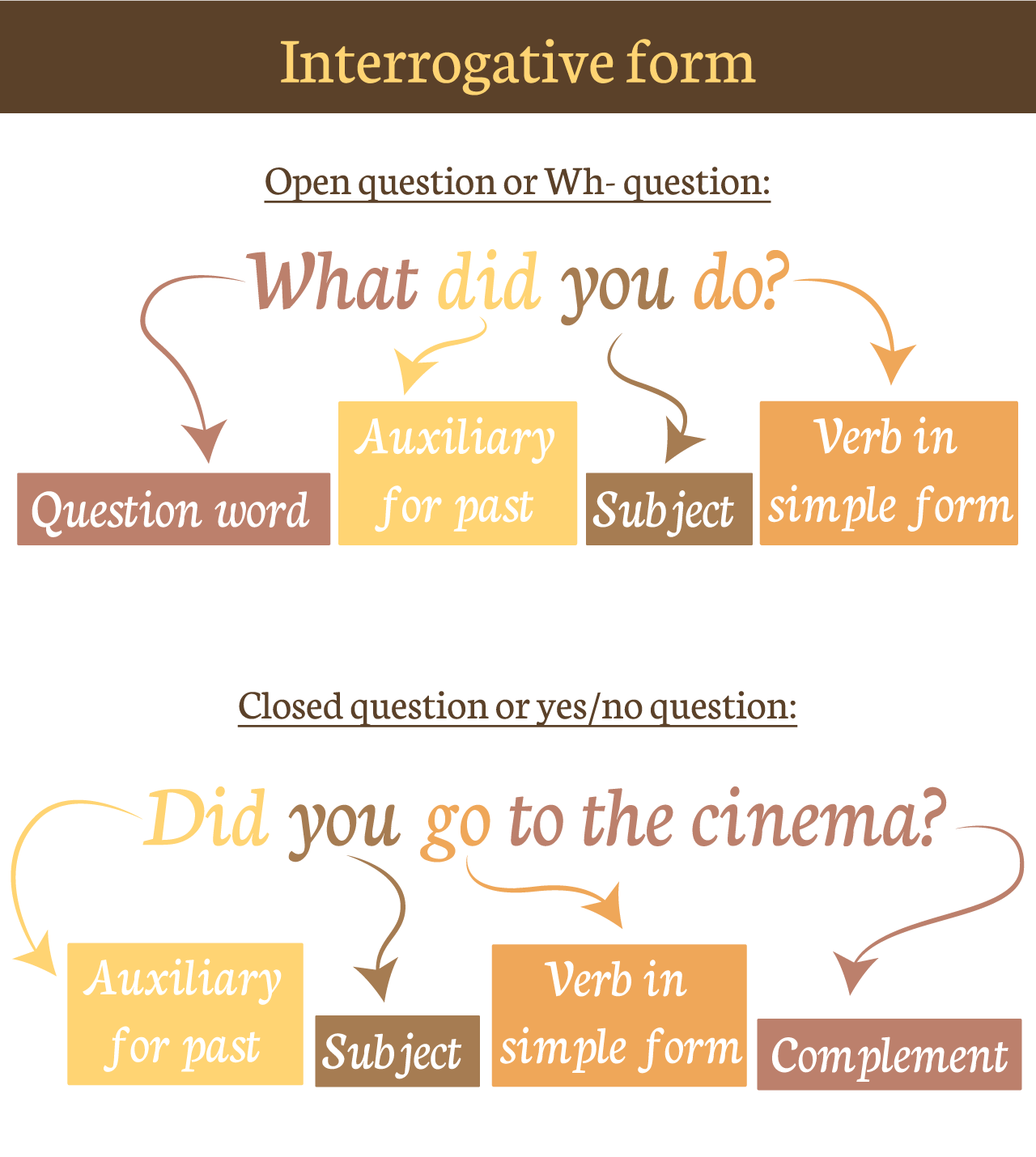
Please scroll down to the "Grammar Reference" section. Read through the three main structures: Statement structure (affirmative and negative), Open question structure (for Wh- questions like 'What', 'Where', 'When'), and Yes/No question structure. Pay special attention to this key rule: in negative sentences and questions, we use the auxiliary verb did (or didn't) and the base form of the main verb. Correct: "She didn't go to the meeting." (NOT "She didn't went...") Correct: "Did you finish the report?" (NOT "Did you finished...")
Active Practice: Telling a Past Story
Let's dive into practice. The following video is a call-and-response exercise. Listen to the question, and say your answer out loud. This is pure speaking practice to get you comfortable with past tense structures.
Past Tense - English Conversation Practice -Improve Speaking Skills- Past Tense conversations
This video from Practice English Conversations is designed for intensive speaking practice. It will ask you a question, pause, and then give you the answer.
Watch the video from the beginning for about 10 minutes (practice section). Follow along by answering each question aloud during the pause. The repetition is intentional and very effective for building automaticity. You'll practice a wide range of "Did you...", "What did you...", and "Where did you..." questions.
Your Turn to Practice: Present vs. Past
This is where you combine everything. Let's start with a quick warm-up.
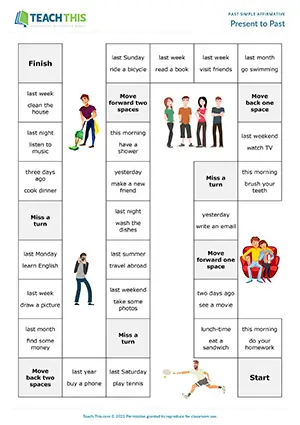
Look at the board game above. Pick any five squares and create two sentences for each—one in the present simple and one in the past simple. Say them aloud.
Example:
- Square: "watch a film"
- Your sentences: "I sometimes watch a film in the evening. Last night, I watched a great movie."
HR-Focused Speaking Task:
Now, let's apply this to your professional life. Your main task is to describe a workday, switching between your typical routine (present tense) and what you did on a specific day (past tense).
- Prepare: Think about your typical tasks as an HR Executive.
- Speak & Record: Use your phone to record yourself. First, describe your typical workday using the present tense.
- “On a typical day, I check my emails first. I usually conduct interviews in the morning. My team has a meeting every Monday.”
- Speak & Record Again: Now, describe what you did at work yesterday using the past tense.
- “Yesterday was different. I didn't check my emails until 10 AM. I spent the morning preparing a new onboarding policy. I had three back-to-back meetings in the afternoon.”
Listen back to your recordings. Do you hear the difference between the tenses? Is your use of do/does and did correct in negatives and questions? Practice this a few times until it feels more natural.
Key Takeaways
- Simple Present: Used for habits, routines, and facts. Questions and negatives use do and does.
- Simple Past: Used for completed actions in the past. Questions and negatives use did. Remember to use the base form of the verb with
did/didn't. - Practice is key: The more you actively form and speak these sentences, the more automatic they will become, freeing you up to focus on what you want to say, not how to say it.
You've made excellent progress today, mastering the fundamental building blocks of English sentences. In our next lesson, we will learn how to connect these simple sentences to form more complex and interesting ideas using essential connector words: 'and', 'but', 'so', and 'because'.