Hello. The previous lesson explained why resistance training, protein-containing food, adequate overall eating, and recovery work together to reduce muscle loss during a deficit. This lesson focuses on one part of that picture: how to judge a proposed protein intake without treating a single number as a rule for everyone. Allow about 35–40 minutes, including the short video and readings.
Start with the person, not the number
Protein recommendations are often expressed as grams per kilogram of body mass per day. That makes comparisons possible, but the calculation does not tell you which recommendation applies. Age, training, the size and severity of an energy deficit, body-size assumptions, dietary preferences, and health conditions all affect the judgment.
The following video offers a starting framework. Watch for its distinction between a general adult reference intake and ranges used for people who exercise.
Dietitian Answers: Optimal Protein Intake For Your Goals (weight loss, muscle gain etc...)
Watch “Dietitian Answers: Optimal Protein Intake For Your Goals” by registered dietitian Maria Lucey for an overview of why protein advice changes with circumstances.
Watch intake ranges for the general adult reference intake, exercising adults, and weight-loss contexts. Then watch individual factors for age and life-stage considerations. In plant foods, focus on essential amino acids and the examples of combining different plant foods; you can stop when the discussion turns to leucine thresholds.
One clarification matters: the commonly cited grams per kilogram per day is a general recommended intake for healthy adults, not a literal point below which deficiency suddenly begins. It is also not an upper limit. A range intended to support resistance training answers a different question from a general reference intake, while a range proposed for a lean, experienced athlete dieting answers a different question again.
To compare a proposed intake with a relevant range, first calculate:
For example, an adult who weighs kg and eats approximately g of protein daily has an intake of g/kg/day. The arithmetic is straightforward; choosing the appropriate comparison is the important part.
What the ranges do—and do not—say
The International Society of Sports Nutrition position statement gives – g/kg/day as sufficient for most healthy exercising individuals seeking to build or maintain muscle. It also discusses – g/kg/day as a potentially useful higher range for retaining lean mass in resistance-trained people during calorie restriction. Those are descriptions of different populations and goals, not successive targets that everyone must climb toward.
Read the position statement’s Abstract for its two contrasting daily ranges. This is a sports-nutrition reference, so keep its stated population in view.
In the “Abstract” under “Position statement,” read numbered points 2 and 3, from the sentence on the two ranges. Notice the change from “most exercising individuals” to “resistance-trained subjects during hypocaloric periods.” Stop after point 3; the later points address other questions.
A second piece of evidence helps explain why the lower end of sports-nutrition advice is not a sharp biological boundary. In a meta-analysis of resistance-training studies, researchers fitted a relationship between daily protein intake and gains in fat-free mass. The estimated gain leveled off around g/kg/day, but the estimated breakpoint had considerable uncertainty: a reported 95% confidence interval ran from about to g/kg/day.
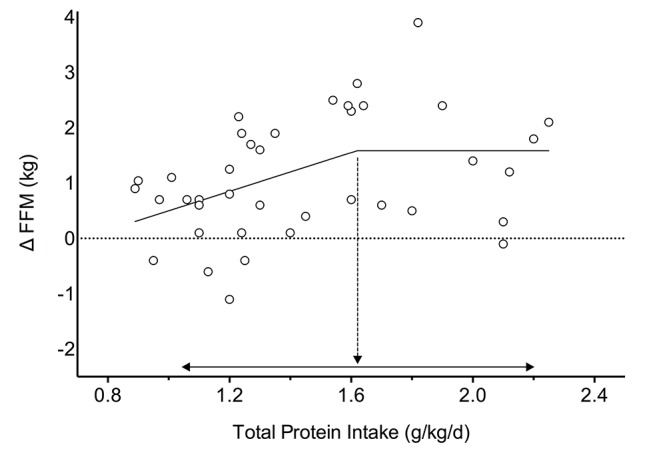
Read this research review to connect the figure’s estimated plateau with its separate discussion of dieting. Pay attention to which conclusions come from resistance-training studies aimed at muscle gain and which concern energy restriction.
In the paragraph discussing a recent meta-analysis immediately before Section 4, “Protein Intake during Energy Restriction,” read from the breakpoint to the end of that paragraph. Then go to Section 5, “Practical Recommendations,” subsection 5.2, “Individuals in Energy Restriction.” Read its bullets from the deficit guidance. Notice how the final bullet distinguishes people who are new to exercise and have more body fat from leaner, experienced lifters.
The figure concerns fat-free mass gains during resistance training, not a test showing that everyone in a calorie deficit needs exactly g/kg/day. Fat-free mass also includes water and other non-fat tissue, not just muscle. The higher dieting range concerns a more specialized effort to retain lean mass, particularly relevant to leaner people with training experience. Neither finding establishes a universal requirement for a beginner pursuing a modest, sustainable deficit.
Apply the evidence to a proposed intake
Consider a healthy adult weighing kg who has recently begun resistance training, is eating a modest deficit, and gets about g of protein daily from a varied diet. Their calculated intake is g/kg/day. It falls within the – g/kg/day range for most exercising people. It is reasonable in context; falling below the higher, specialist dieting range does not by itself show a problem. Training consistency, sufficient food, recovery, and how the person is functioning still matter.
Suppose that adult prefers plant-based foods. The numerical comparison is a starting point, not the whole assessment. Soy foods, beans, lentils, grains, nuts, and seeds can contribute protein across varied meals. Plant proteins differ in their essential amino acid composition, so variety is useful; foods do not have to be paired in a precise combination at every meal. A powder is an option if food alone is inconvenient, not a requirement imposed by the calculation.
Now consider an adult weighing kg, with a higher proportion of body fat, who is also beginning resistance training and proposes g daily. Dividing by actual body mass gives about g/kg/day. That is below the exercising range when that range is applied directly to actual body mass, but it does not automatically prove that the person must eat – g daily, much less adopt an athlete’s dieting range. A total-body-mass calculation may be a poor stand-in for the tissue being supported when body sizes and compositions differ substantially.
For illustration, g divided by an assumed reference mass of kg would be g/kg/day. That does not make kg this person’s correct reference mass or validate a new prescription. It shows how much the verdict depends on the denominator chosen. In a real case, body-size assumptions, the adequacy of the overall diet, training, and clinical circumstances deserve assessment before declaring an intake inadequate or setting a much higher target.
Age and health can change the assessment further. An older adult may have a less responsive muscle-building response to a given protein-containing meal than a younger adult, making adequate intake and its distribution across ordinary meals worth considering. But an older adult with kidney disease, for example, should not simply adopt a high exercise or dieting range from an article about healthy participants. Protein advice may need to be individualized with a clinician or dietitian. The same caution applies whenever a medical condition or treatment affects dietary needs.
Finally, whether restriction is appropriate comes before protein optimization. Pregnancy or breastfeeding, adolescence, undernutrition, and disordered-eating warning signs call for a different approach or professional guidance. A high protein number does not make an inappropriate deficit safe.
A useful way to state the judgment
An evidence-based assessment is more informative than “above target” or “below target.” It identifies:
- The calculation: grams per day divided by the body mass being used.
- The closest relevant evidence: general adult reference, healthy exercising range, or more specialized dieting evidence.
- The limits of the comparison: age, training experience, body-size assumption, dietary pattern, and health context.
- A proportionate conclusion: whether the intake looks plausible, merits review, or cannot safely be assessed without professional input.
The key takeaway is that protein ranges are tools for comparison, not universal prescriptions. Around – g/kg/day is a useful reference for many healthy exercising adults; higher figures arise in more specific dieting and training contexts. Neither a graph’s plateau nor an athlete-focused upper range overrides the person’s circumstances.
The next lesson turns from protein intake to the other major muscle-preserving tool: how to recognize a beginner resistance-training schedule that challenges the major muscle groups while allowing recovery.