Hello. Research integrity is not only about avoiding false claims; it is also about making sure that decisions about research can be trusted. In this lesson, you will learn to recognize actual, potential, and perceived conflicts of interest and to choose a response that protects research judgment. The central distinction is between having an interest, which is often ordinary, and having an interest that competes with a research responsibility.
What makes an interest a conflict?
A researcher’s primary responsibilities include conducting a sound study, reporting findings accurately, and treating participants fairly when people are involved. A secondary interest—such as income, professional advancement, loyalty to a colleague, or a strongly held commitment—can pull against one of those responsibilities.
A conflict of interest is a situation that could compromise judgment, not proof that a researcher has acted dishonestly. It can matter even when the findings turn out to be correct: readers need reason to trust how the question was framed, how evidence was assessed, and what was reported.
Conflict of Interest (COI): What is it and How do I Manage it?
Watch “Conflict of Interest (COI): What is it and How do I Manage it?” from UT Health San Antonio for a short introduction to conflicts and transparency.
Watch the definition. Focus on why an interest can warrant attention even when no improper decision has been shown.
Notice that interest does not mean conflict. A researcher may care deeply about a topic or receive funding to study it. The question is whether a second interest creates a credible competing pull on a particular research duty or decision.
Actual, potential, and perceived conflicts
These labels help identify what is happening now, what may happen later, and what a reasonable observer could conclude. They are aids to judgment, not accusations. Different institutions and funders define them somewhat differently, so a stated policy takes precedence when you must make a formal determination.
Guidelines for Managing Real, Potential, and Perceived ...
Read this guideline’s distinctions among the three types. It uses the term “real” for what is often called an “actual” conflict.
In Section 3, “Types of Conflicts of Interest” (pp. 4–6), begin with the three definitions. Continue through the note immediately after “Perceived Conflicts of Interest,” then stop before Section 4. Pay attention to what is already competing, what may compete in the future, and what a reasonable person might perceive.
An actual or real conflict concerns a present competing interest and responsibility. For example, a researcher who owns shares in a company is making decisions about how to evaluate that company’s product. The current financial stake bears on current research decisions. This does not establish that any decision was biased. The guideline you just read describes a real conflict in terms of an interest interfering with a research responsibility; other policies may focus on the present risk of such interference.
A potential conflict concerns a foreseeable future collision. Suppose a researcher is expected to join a committee that will evaluate a close collaborator’s proposal. Before taking that role, the competing decision-making duties have not yet arisen, but they may. The guideline applies a particular likelihood test to potential conflicts; do not assume every policy uses the same threshold.
A perceived conflict exists when an informed, reasonable observer could think competing interests threaten impartiality, even if the researcher believes—and may be right—that their judgment is unaffected. The test is not whether someone somewhere is suspicious. It is whether the concern is reasonable given the known facts.
These categories can overlap. A present financial stake can create both an actual conflict and a reasonable appearance of bias. Also, a potential or perceived conflict need not become an actual one to deserve a response: an unmanaged appearance can still weaken confidence in the work.
Financial interests are only part of the picture
The following funnel shows why disclosing an interest and determining that it requires a management plan are different decisions.
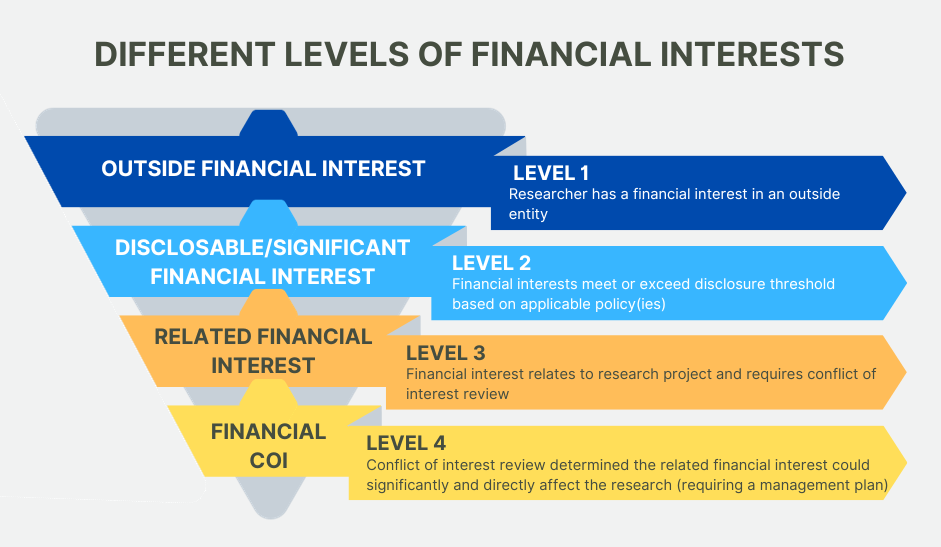
In this financial example, not every outside interest reaches the narrowest level. Equally, a disclosure threshold does not make an interest below it irrelevant in every setting: policies differ, and nonfinancial interests need attention too. Loyalty to a friend may matter when reviewing their work; professional rivalry may matter when assessing a competitor’s proposal; an institution’s commercial stake may matter when it oversees a study. Identify the interest, the research duty, and the decision the interest could affect before deciding how serious the conflict is.
Disclosure starts the response; it does not finish it
If you identify a possible conflict, the first step is to bring it to the appropriate person or body before the affected decision is made. That may be an institutional conflict-of-interest office, a research supervisor or review body, or a research ethics board for a project involving participants, depending on the rules that apply. Publication venues, funders, and participants may also require relevant disclosures. Update a disclosure when circumstances change; an interest acquired midway through a study matters just as one held at the start does.
Guidelines for Managing Real, Potential, and Perceived ...
Return to the guideline for its approach to identifying, disclosing, and managing conflicts. Its named research ethics board procedures are specific to its setting; use the underlying reasoning rather than treating those procedures as universal.
Read Section 4, “Managing Real, Potential, and Perceived Conflicts of Interest,” including Steps 1–3, and Section 5, “Criteria for Assessing Minimization and Mitigation Strategies” (pp. 6–7). Start at the management guidance. Stop after the two numbered criteria in Section 5. Focus on the distinction between reporting a conflict and reducing its possible effects.
A useful disclosure states what the interest is, how it relates to the work, and which decisions the person can influence. It gives a reviewer enough information to assess the risk. Simply telling readers “a conflict exists” does not by itself protect data collection, analysis, peer review, or participant welfare.
Match the safeguard to the risk
Management asks two questions: How likely is inappropriate influence—or a reasonable perception of it? and How serious would the consequences be? The answer determines whether transparency alone is adequate or whether the researcher’s role must change.
Conflict of Interest (COI): What is it and How do I Manage it?
Return to “Conflict of Interest (COI): What is it and How do I Manage it?” for examples of a management plan and changes to decision-making roles.
Watch management planning, then specific safeguards. Focus on the difference between declaring an interest and arranging independent oversight or stepping back from a decision.
Responsible Conduct Research : Conflicts of Interest
Read the individual-level management options for a wider view of what can be changed when disclosure is not enough.
On the webpage, find Section 2.6, “Managing Conflicts of Interest at the Individual Level.” Read the management options, ending with the final bullet on disqualification. Notice the range from disclosure and independent monitoring to changing a role or ending the conflicting relationship.
Possible safeguards include assigning an independent person to review an analysis, changing who recruits participants or assesses outcomes, restricting a conflicted person’s role in a decision, or removing a financial interest. In some circumstances, the person must recuse themselves—take no part in the affected decision. An appropriate authority should agree on the response under the applicable policy; a researcher should not assume that publishing a disclosure statement settles the matter.
Consider a researcher evaluating a company’s testing tool. The researcher owns shares in the company and has final authority over which results enter the analysis. That is a present conflict involving decisions capable of affecting the study’s conclusions; readers could also reasonably perceive a threat to independence. If the researcher is later expected to sit on a committee choosing tools for another project, that appointment introduces a foreseeable future conflict as well. The response is not to label the findings false. It is to disclose the stake promptly, have the relevant authority assess it, and put proportionate safeguards around the analysis and any later purchasing decision. Independent analysis or withdrawal from the decision-making role may be needed; publication disclosure remains important but is not a substitute for those safeguards.
Key takeaways
A conflict of interest is a competing pull on a research responsibility, not a finding of misconduct. Identify whether that pull is present, foreseeable, or reasonably apparent; recognize that the labels can overlap; then disclose it through the appropriate channels and manage the decisions it could affect. The next lesson turns to AI tools, where transparency, reliable verification, and human accountability require similar care.