Hello. In the previous lesson, you examined how a report can mislead readers even when its underlying data are genuine. The same concern for an honest account applies to writing: readers need to know which ideas and words come from a source and which are your own.
This lesson focuses on revising a short passage to avoid plagiarism. You will distinguish common knowledge from sourced material, choose between paraphrase and quotation, and make the source traceable through attribution and citation. The aim is not to add a reference to every sentence; it is to make the origin of each borrowed idea or phrase clear.
What needs a source?
Plagiarism occurs when someone presents another person’s words, ideas, or work without adequate acknowledgment. Copying a sentence without quotation marks is an obvious example. A less obvious one is restating a source’s particular explanation in new words without crediting its origin. Changing the wording does not make the underlying idea your own.
Not every statement needs a citation. A broadly established fact that your intended readers would recognize independently of one particular source may be common knowledge. By contrast, a study’s finding, an author’s interpretation, a distinctive framework, or a specific figure usually calls for a source. The boundary depends partly on the audience: information familiar to specialists might be unfamiliar in an introductory account.
Read Purdue OWL’s Common Knowledge & Attribution for the distinction and for the basic parts of a citation. Its suggestion about finding a fact in multiple credible sources is a helpful clue, not a universal numerical test for common knowledge.
Common Knowledge & Attribution - Purdue OWL® - Purdue University
Purdue OWL explains when attribution is needed and how readers can follow it back to a source.
In “What is ‘common knowledge’?”, read the short discussion, from its proposed rule of thumb through its advice about uncertainty. Then, in “How does citation work? What is attribution?”, start at “There are three elements” and read the explanation through the account of what a bibliographic citation lets readers find. Focus on the different jobs of a signal phrase, an in-text citation, and a full reference.
A useful question during revision is: Could a reader reasonably mistake this claim for something I established or thought of myself? If it comes from a particular source, identify that source. If you are unsure whether a claim is truly common knowledge for your audience, citing it is generally safer than silently treating it as your own.
Citation has two locations. In the passage, a signal phrase such as “Purdue OWL recommends…” or an in-text citation identifies where an idea came from. A full entry in the reference list supplies enough information to find the work. These elements work together; a reference-list entry alone does not show which sentences drew on that source.
Choose how to use another writer’s material
Once you have identified sourced material, decide what you need from it. Paraphrasing restates a particular idea in your own language and structure while preserving its meaning. Summarizing compresses a larger stretch of material into its main points. Quoting reproduces selected words exactly. All three require attribution when the material is someone else’s.
Watch the selected parts of Quoting, Paraphrasing, Summarizing in APA from Rasmussen University Library & Learning Services. The examples use APA conventions, but the underlying distinctions apply across citation styles.
Quoting, Paraphrasing, Summarizing in APA
The video shows why paraphrased ideas need credit, how quotations differ, and how a reader can follow attribution across a passage.
Watch what needs credit, then skip to the three methods and the advice on drafting paraphrases. Continue through the comparisons of weak and stronger paraphrases and the discussion of source use across a paragraph. Finish with source traceability. Focus on whether a reader can tell exactly what came from a source; treat the video’s “three words” advice as a caution about copied wording, not as a universal plagiarism rule.
The infographic below offers a quick comparison. Notice that “use your own words” and “reference the original source” are separate requirements for both paraphrase and summary. For a quotation, you retain the source’s words, visibly mark them as a quotation, and cite them. Include a page number or another suitable locator when the source and required style provide one.
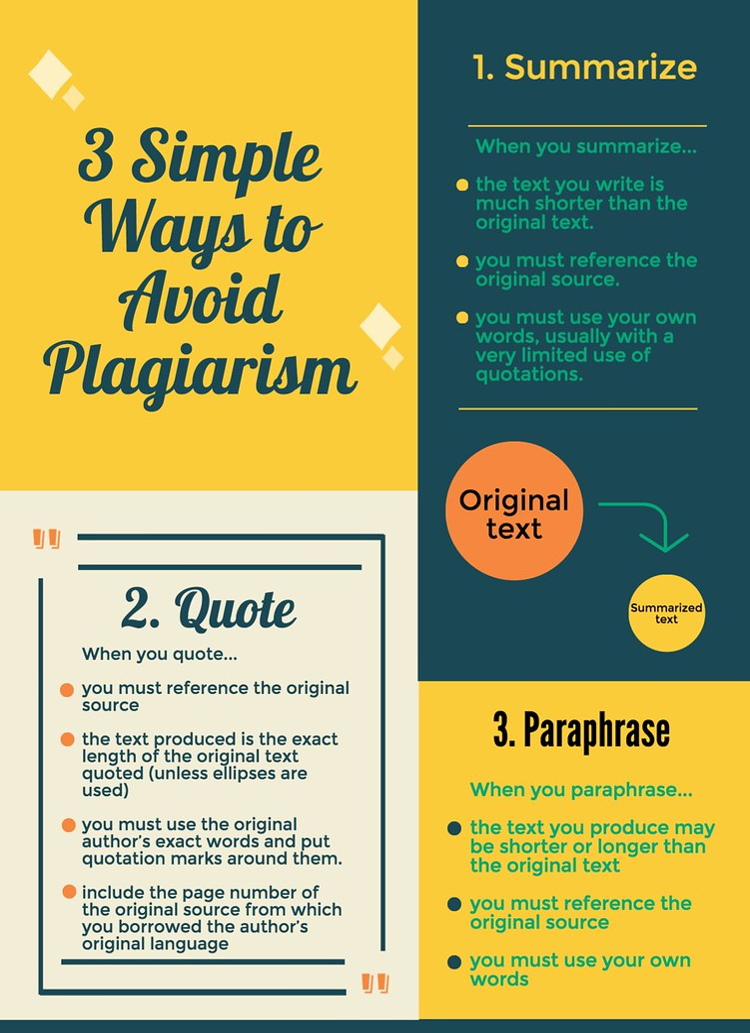
Quotation is useful when the precise wording matters—for example, when you are examining an author’s definition. Otherwise, a paraphrase often lets you integrate the idea more naturally into your own account. Neither choice removes your responsibility to represent the source accurately: a quotation can be misleading if stripped of essential context, just as a paraphrase can be misleading if it changes the original claim.
Paraphrase the idea, not the sentence pattern
A common unsuccessful method is to leave the source open and replace a few words with synonyms. The result may keep the original sentence’s structure and distinctive phrasing. Adding a citation credits the idea, but it does not turn closely copied wording into an independent paraphrase. If you need the wording itself, quote it.
Purdue OWL’s Paraphrase: Write It in Your Own Words gives a more reliable approach and places a legitimate paraphrase beside a plagiarized version.
Paraphrase: Write It in Your Own Words - Purdue OWL
Read Purdue OWL’s definition, its drafting method, and its side-by-side example to see why a paraphrase needs both fresh expression and documentation.
In “A paraphrase is...”, read the definition. In “6 Steps to Effective Paraphrasing”, read all six steps. Finally, in “Some examples to compare”, read from “The original passage:” through “A plagiarized version:”, using the compared passages to locate the range. Compare meaning, wording, and citation rather than looking only for changed vocabulary.
The underlying method is to understand the source first, put it out of view, and write the point as it serves your discussion. Then compare your draft with the original. That final comparison checks two different things: whether you preserved the source’s meaning and whether you inadvertently carried over its distinctive wording. Keep the source details with your notes so that a good paraphrase does not later become an unattributed one.
There is no fixed number of changed words that makes a paraphrase acceptable. Ordinary technical terms may need to stay the same; swapping several everyday words may still leave a copied sentence. The stronger test is whether you have independently expressed the idea and made its origin clear.
A short passage, revised
Here is an unrevised passage. Its first sentence is a broad observation. The remaining sentences reproduce wording from Purdue OWL’s paraphrasing steps but give no indication that those words came from a source:
Research writing builds on earlier work. Reread the original passage until you understand its full meaning. Set the original aside, and write your paraphrase on a note card. Check your rendition with the original to make sure that your version accurately expresses all the essential information in a new form.
The opening observation can reasonably stand without a citation in this context. The instructions cannot: they come from a particular source, and much of their wording is copied. Here is a revision that uses both paraphrase and a deliberately identified short quotation:
Research writing builds on earlier work. Purdue OWL (n.d.) recommends understanding a passage before drafting a restatement and checking the draft against the source afterward. Its instruction to “Set the original aside, and write your paraphrase on a note card” (Purdue OWL, n.d., “6 Steps to Effective Paraphrasing,” step 2) emphasizes the value of drafting without the original wording in view.
Reference: Purdue OWL. (n.d.). Paraphrase: Write It in Your Own Words. Purdue University.
The first sentence remains the writer’s general framing. The second conveys the source’s method in a new form and attributes it. The third preserves a short piece of exact wording in quotation marks, identifies where to find it, and explains why it matters. The reference entry completes the trail. Here, “n.d.” means that no publication date was supplied for this illustrative author–date citation; the exact format you use should follow your required citation style.
In an actual short passage, you might omit that quotation and paraphrase the whole point: the quoted wording is not essential unless you want to discuss the instruction itself. The example includes it to show the distinction. Quotation marks identify borrowed wording; a citation identifies its source. You need both when quoting.
Finally, check the scope of attribution. If several sentences develop one source’s ideas, make it clear throughout where that source’s contribution begins and ends. A single citation at the very end of a paragraph may leave earlier sentences ambiguous; repeating a citation after every sentence may be unnecessary when a clear signal phrase and the surrounding prose already establish the source. The goal is an unambiguous account, not a particular citation count.
What to carry forward
To revise for plagiarism, first separate broadly shared knowledge from claims and language drawn from particular sources. For sourced material, either express the idea independently as a faithful paraphrase or mark exact words as a quotation. In both cases, attribute the source in the passage and provide a full reference so readers can find it. Check especially for lightly altered copying and for sentences whose source is unclear.
This completes the module on traceable data and trustworthy reporting. The next module turns from crediting sources in writing to assigning credit and responsibility among people who collaborate on research.